



# Bedrock Robotics Deploys Autonomous Excavators on Live Infrastructure Projects Across the U.S.
A San Francisco-based robotics startup has successfully placed fully autonomous, heavy-duty excavators onto active construction sites in Texas and Nevada, marking a turning point for AI-driven automation in the physical economy. The company’s retrofit technology transforms conventional earth-moving equipment into self-operating machines, targeting some of the most pressing challenges in modern construction.
## Addressing a Sector in Crisis
The U.S. construction industry is facing an unprecedented labor shortage. Industry analysts estimate that more than 40% of the current construction workforce will retire within the next five years. Compounding the problem, large-scale projects already average 20% over their original timelines and 80% beyond initial budgets. Workplace safety remains a persistent concern as well, with construction workers accounting for roughly 7.5% of the national labor force but nearly 20% of all workplace fatalities.
The startup’s autonomous excavation platform is designed to tackle these issues head-on. By converting standard excavators into software-driven systems, Bedrock Robotics aims to remove the dependency on scarce skilled operators while improving both site safety and project economics.
## Backed by Major Venture Capital and Industry Expertise
The company has secured $350 million in venture capital funding and was founded by veterans of Waymo, Alphabet’s autonomous vehicle division. This lineage in self-driving technology has informed the company’s approach to perception, planning, and execution systems that operate heavy machinery without human intervention.
“Getting here took real partnership with contractors who are designing these solutions alongside us and an uncompromising commitment to doing this safely, responsibly, and with optimism about the future,” stated Boris Sofman, co-founder and CEO of the company. “This fundamentally redefines not just the productivity of a single machine, but the very scale of what contractors — and our country — can achieve.”
## First Deployments: Earthwork at Scale
Bedrock Robotics has launched its autonomous systems on three notable projects to date:
– A water treatment facility developed in collaboration with Sundt Construction in Nevada
– A multi-million cubic yard earthwork site operated by Champion Site Prep in Texas
– A civil sitework project requiring the movement of 1.2 million cubic yards of material, led by Zachry Construction Corp.
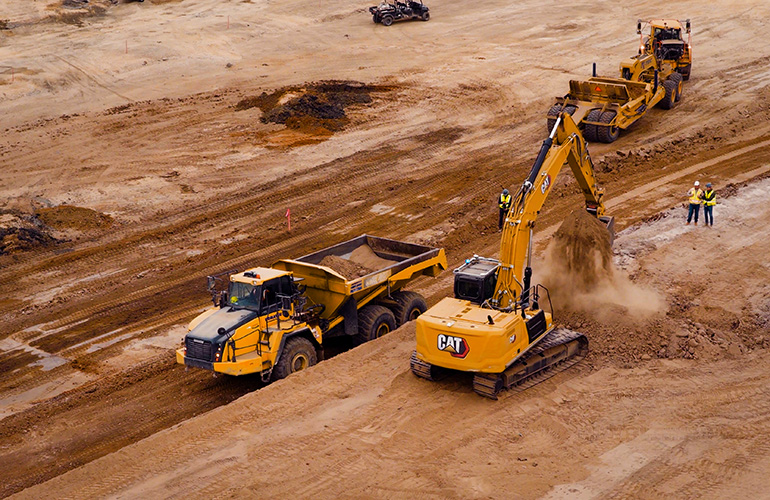
These initial deployments focus on early-stage earthwork — clearing, cut and fill operations, and site preparation for foundations — which is widely considered the foundational phase of any major construction project. Until earthwork is complete, subsequent stages such as concrete pouring, steel erection, and mechanical or electrical installation cannot begin.
“Our partnership with Bedrock Robotics is helping us tackle some of the challenges that matter most in construction: making schedules and costs more predictable, getting more consistent use out of our equipment, and allowing our skilled crews to focus on the work where their experience matters most,” said Cade Rowley, CEO of Sundt Construction Inc.
## How the Technology Works
The company’s retrofit system is designed for same-day installation and does not require permanent modifications or the purchase of new machinery. A sophisticated sensor and computing suite is integrated into existing excavators, enabling the machines to perceive their surroundings, plan movements, and carry out complex tasks autonomously once a site manager establishes the initial work plan.
The end-to-end machine learning model behind the system has been trained across tens of thousands of field hours. Operators set the scope of work from a control station, and the excavator handles the execution. The system is capable of self-monitoring, tracking its own progress, and calling for assistance if it encounters obstacles or becomes stuck. A human operator remains in a supervisory role — referred to internally as a “person in the loop” — ensuring that operations proceed smoothly without constant on-site intervention.
## Safety as the Core Design Principle
Safety remains the top priority throughout system deployment. The autonomous excavators operate on active job sites alongside water trucks, other equipment, and personnel. The system is engineered to detect and react to dynamic conditions in real time, processing sensor data to avoid collisions and adjust its path accordingly.
“We can’t compromise safety,” said Kevin Peterson, the company’s chief technology officer. “The machines operate around people; water trucks drive up, and the machine has to react. That’s really what we care about.”
## The Road Ahead: Fleet Orchestration and Task Expansion
Bedrock Robotics has outlined a multi-phase strategy for scaling its technology. Near-term goals include broadening the types of tasks the system can perform, moving from large-scale earthwork into more precise and specialized operations. Longer-term ambitions center on fleet orchestration — deploying clusters of machines that collaborate as a team.
The vision involves coordinating excavators, bulldozers, haul trucks, graders, and other heavy equipment to share information and execute complex workflows simultaneously. This coordinated approach, the company argues, could dramatically accelerate project timelines and unlock new levels of efficiency across the entire construction sector.
## Why Excavators?
Excavators were chosen as the starting point for autonomous deployment for several reasons. They are among the most complex and most heavily utilized machines on a job site, often comprising roughly 25% of a contractor’s fleet. Mastering an excavator typically requires five or more years of training and hands-on experience, making them one of the hardest machines to staff reliably with skilled operators. By automating this critical equipment, Bedrock Robotics addresses both the labor gap and the productivity bottleneck in a single stroke.
—
## Frequently Asked Questions
**What is Bedrock Robotics?**
Bedrock Robotics is a San Francisco-based startup specializing in autonomous heavy equipment. The company develops retrofit systems that transform conventional excavators into fully autonomous machines capable of performing earthwork without an operator present in the cab.
**How does the autonomous excavation system work?**
The system integrates a sensor and compute suite into existing excavators through a same-day retrofit installation. A machine learning model trained on tens of thousands of field hours enables the equipment to perceive its environment, plan motions, and execute complex earthwork tasks autonomously. A human supervisor oversees operations remotely, intervening only when necessary.
**Where have the autonomous excavators been deployed?**
The company has placed its autonomous systems on active infrastructure projects in Texas and Nevada, including a water treatment facility, a large-scale earthwork project, and a civil sitework job involving over a million cubic yards of material movement.
**How much funding has Bedrock Robotics raised?**
The company has secured $350 million in venture capital funding.
**What safety measures are in place for autonomous operation?**
The system monitors itself in real time, detects surrounding personnel and vehicles, and adjusts its movements accordingly. If the machine encounters an obstacle or becomes stuck, it has built-in protocols for managing the situation. A human operator remains in a supervisory role at all times.
**What are the company’s future plans?**
Bedrock Robotics plans to expand the range of tasks its systems can perform, increase the number of deployments, and eventually orchestrate fleets of multiple machine types — including bulldozers, haul trucks, and graders — working together on construction sites.
**Why focus on excavators specifically?**
Excavators are among the most complex and most common machines on construction sites, representing approximately 25% of a contractor’s fleet. They also require years of training to operate skillfully, making them an ideal target for automation to address skilled labor shortages.
**Who is behind Bedrock Robotics?**
The company was co-founded by Boris Sofman and is led by former veterans of Waymo, Alphabet’s autonomous vehicle division. The engineering team draws on deep expertise in perception, planning, and machine learning developed in the self-driving car industry.
—
## Conclusion
The deployment of fully autonomous excavators on live infrastructure projects represents a significant leap forward for the construction industry. As Bedrock Robotics demonstrates, AI-driven heavy equipment is no longer a theoretical concept but a functioning reality on active job sites. With the sector confronting a deepening labor crisis, persistent safety challenges, and chronic cost overruns, autonomous earthwork solutions offer a compelling path forward. By combining the self-driving expertise of its founding team with real-world contractor partnerships, Bedrock Robotics is helping redefine what autonomous machines can achieve in the physical economy — moving beyond single-machine operation toward coordinated fleets that could reshape the pace and scale of construction for years to come.
Thank you for reading.
