



**Building Production-Ready AI Agents: A Guide to the Five Core Tools**
Deploying a generative AI agent from a notebook prototype into a robust, production environment is a significant engineering challenge. Most models fail not because of the underlying artificial intelligence, but due to the surrounding infrastructure. Production demands resilience, security, memory, observability, and scalable compute—five distinct layers that are often overlooked until a critical failure occurs.
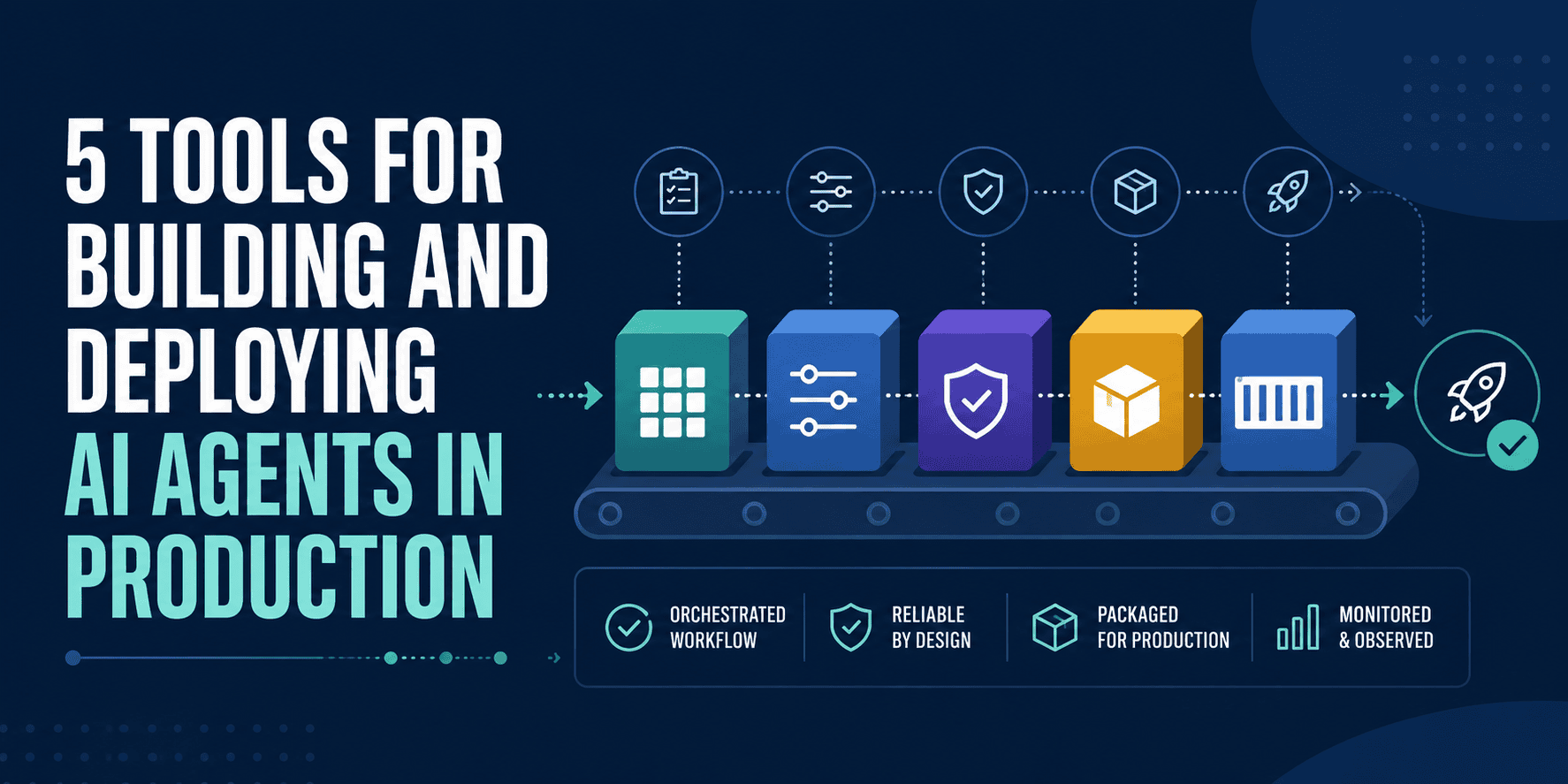
To help bridge this gap, this article explores five complementary tools designed to handle these specific layers of the AI agent stack. These tools are not competitors but collaborators, and modern production systems in 2026 will likely leverage a combination of all five.
### 1. LangGraph: Durable Agent Logic
The foundation of any agent is its logic—the rules and workflows that govern how it interacts with tools and users. A simple `while` loop calling a Large Language Model (LLM) is insufficient for production. Agents need the ability to branch, retry failed operations, handle human interruptions, and recover from crashes without losing progress.
**LangGraph** solves this by representing an agent as a **directed graph**. Instead of a linear chain of prompts, nodes represent functions (like tool calls or reviews), and edges define the paths of execution. Crucially, LangGraph automatically **checkpoints** the agent’s state at every step. This state persistence enables powerful features like pausing for human approval, “time-travel” debugging to see previous steps, and automatic recovery after a server restart.
* **Adoption & Production Readiness:** The framework has gained immense traction, with high-profile users like Klarna, LinkedIn, Uber, and Replit, and a GitHub repository exceeding 30,000 stars.
* **Critical Implementation Detail:** While development can use an in-memory checkpointer, **this is insufficient for production**. For any real-world application, teams must switch to a **Postgres-backed checkpointer**. This single change is what transforms a fragile script into a resilient piece of infrastructure.
### 2. E2B: Secure Code Execution
Once an agent is capable of writing its own code, a major security and operational challenge arises: you cannot safely execute untrusted, model-generated code on your primary application servers. This requires an isolated, disposable, and secure environment.
**E2B** is built specifically for this purpose. It provides **secure sandboxes** for AI agents using **Firecracker microVMs**. Unlike standard containers that share the host kernel, each E2B sandbox runs in its own virtual machine with a dedicated kernel, creating a much stronger security boundary. This makes it ideal for executing risky, one-off operations.
* **Market Validation:** E2B reports usage by **88% of Fortune 100 companies** for agentic workflows, with clients including Perplexity, Hugging Face, Manus, and Groq.
* **Tradeoff to Consider:** E2B is optimized for **ephemeral tasks** with short execution times, typically capped at one hour (Hobby plan) or 24 hours (Pro plan). It is perfect for running a script or a single analysis but is not designed for agents requiring persistent, long-lived state across days. For those needs, you must pair it with a memory layer like Mem0.
### 3. Mem0: Cross-Session Memory
Language models are stateless by design. An agent that needs to remember a user’s preferences, project details, or the context of a multi-day task across separate sessions will quickly become unreliable without a dedicated memory system.
**Mem0** acts as a purpose-built memory layer. During a conversation, it identifies facts worth retaining and stores them in a vector database, tagging them by user, session, and agent. Before generating a response, Mem0 performs a targeted retrieval, pulling relevant memories using a combination of semantic similarity, keyword, and entity matching. This happens automatically, making the agent *appear* to have a continuous memory.
* **Synergy with Other Tools:** LangGraph handles short-term memory within a single session (e.g., remembering the last step of a workflow). Mem0 fills the gap for **durable, cross-session memory**, such as remembering a user’s name or a long-term project goal that persists for weeks or months. It effectively decouples long-term memory from the transient execution flow.
### 4. LangSmith: Observability, Tracing, and Debugging
A silent failure is the most dangerous kind for an AI agent. If an agent fails without providing insight, debugging becomes a guessing game. Production systems require comprehensive tracing to record every action, tool call, and observation.
**LangSmith** is an engineering platform dedicated to this need. It provides end-to-end **tracing** for agents built with LangGraph and other frameworks. It offers a detailed, run-by-run view of an agent’s execution, allowing developers to replay a specific instance to see exactly where and why it deviated from expectations.
* **Value Proposition:** While standard logging shows *that* something went wrong, LangSmith’s tracing shows *why*. This distinction is critical, reducing what could be a multi-day investigation into a five-minute fix. Its generous free tier (5,000 traces/month) makes it accessible for teams to evaluate before committing to a paid plan.
### 5. Modal: Scalable and Cost-Efficient Compute
With the logic, security, memory, and observability defined, the final piece is the compute infrastructure. Agent workloads are notoriously bursty, characterized by long periods of inactivity followed by intense traffic spikes. Running this on fixed servers leads to either massive over-provisioning or constant capacity crises.
**Modal** is a serverless compute platform architected for these exact patterns. It spins up isolated, on-demand sandboxes for compute-intensive tasks and scales them back to zero when idle, optimizing cost. It is used by major companies like DoorDash, Anthropic, Meta, and Ramp.
* **Performance-Critical Detail:** For agent workloads, cold-start latency is a primary concern. Modal addresses this with features like GPU memory snapshots, which can reduce cold-start times by up to **10x** for certain workloads. This drastically reduces the wait time for each agent session, a crucial advantage when running thousands of interactions per day.
### Wrapping Up
There is no single “silver bullet” tool for building production AI agents. The five tools discussed—LangGraph, E2B, Mem0, LangSmith, and Modal—represent distinct, solvable problems that must work together.
The most successful teams understand that these components form a layered stack:
1. **LangGraph** for reliable logic.
2. **E2B** for safe execution.
3. **Mem0** for persistent memory.
4. **LangSmith** for deep observability.
5. **Modal** for elastic compute.
If you are just starting, a pragmatic approach is best: begin with the core logic (LangGraph), add a secure sandbox (E2B), and only introduce memory and advanced infrastructure once you have a single, reliable end-to-end agent run. Crucially, **observability (LangSmith) should be implemented from day one**; it is far easier to build tracing in at the start than it is to debug a major incident after it has occurred.
By treating each challenge as a separate layer and selecting the right tool for the job, teams can move beyond experimental pilots and deploy robust, production-grade AI agents.
—
### FAQ
**Q1: Can I use these tools in any order, or is there a recommended sequence?**
A: Yes, there is a recommended progression for teams starting from scratch. Begin with **LangGraph** to define a stable agent logic layer. Next, integrate **E2B** to safely execute any code the agent generates. Once you have a reliable run, add **Mem0** if you need the agent to retain information across different user sessions. Instrument your system with **LangSmith** early for debugging, and finally, deploy on **Modal** to handle scaling and cost-efficiency.
**Q2: Are these tools open-source, and do they have free tiers?**
A: Most of these tools offer free tiers or open-source core versions. **LangGraph** and **LangSmith** (the tracing component) have generous free options. **E2B** provides a free tier for its runtime. **Mem0** also has a free plan to get started. **Modal** also offers credits for new users to try its platform.
**Q3: My agent works in my notebook. Why do I need all of these tools?**
A: A notebook environment lacks the resilience required for real-world traffic. It does not automatically recover from crashes, secure your code from malicious input, remember user data between chats, or provide logs when something breaks. These five tools collectively build the missing infrastructure (the “five layers”) that allows an agent to transition from a prototype to a reliable, production-grade service.
**Q4: Can I replace one of these tools with a different one?**
A: Yes, while this article presents a common and effective combination, the stack is modular. You could use a different framework instead of LangGraph (like LlamaIndex or a custom solution), or a different sandboxing solution instead of E2B. However, you will generally still need a solution for each functional layer: logic, execution, memory, observability, and compute.
### Conclusion
Moving AI agents from prototype to production requires more than just a powerful model. It demands a strategic approach to infrastructure, addressing five distinct challenges: state management, secure execution, memory, observability, and scalable compute.
Tools like LangGraph, E2B, Mem0, LangSmith, and Modal provide proven, battle-tested solutions for each of these problems. They are designed to work together, allowing teams to build agents that are not only intelligent but also reliable, secure, and scalable. By understanding the role of each tool and implementing them deliberately, engineering teams can successfully close the gap between AI innovation and real-world deployment.
