



## Cartesia Sonic-3.6: The Real‑Time Text‑to‑Speech Breakthrough
Cartesia has shipped **Sonic‑3.6**, the latest iteration of its flagship real‑time text‑to‑speech (TTS) model. Launched roughly three months after Sonic‑3.5, the update focuses on naturalness and introduces independently verifiable improvements. According to Artificial Analysis benchmarks, Sonic‑3.6 now leads all evaluated models on **two speech leaderboards**, marking a new high for production‑ready TTS quality. Below are the key takeaways.
—
### 🚀 Is It Deployable?
Yes—Sonic‑3.6 is **available in beta** and via a hosted API, though it is not offered as self‑hosted weights. It is a **closed, commercial model** with no open weights or Hugging Face repo. Pricing and access tiers are designed for developers, startups, contact‑center scaleups, and regulated enterprises requiring DPAs, BAAs, and SSO. Supported industries include financial services, healthcare, retail, logistics, recruiting, SaaS support, and media localization. Common use cases range from inbound/outbound agents and IVR replacement to audio localization and in‑product voice UIs.
—
### ⚙️ The Architecture: State Space Models Over Transformers
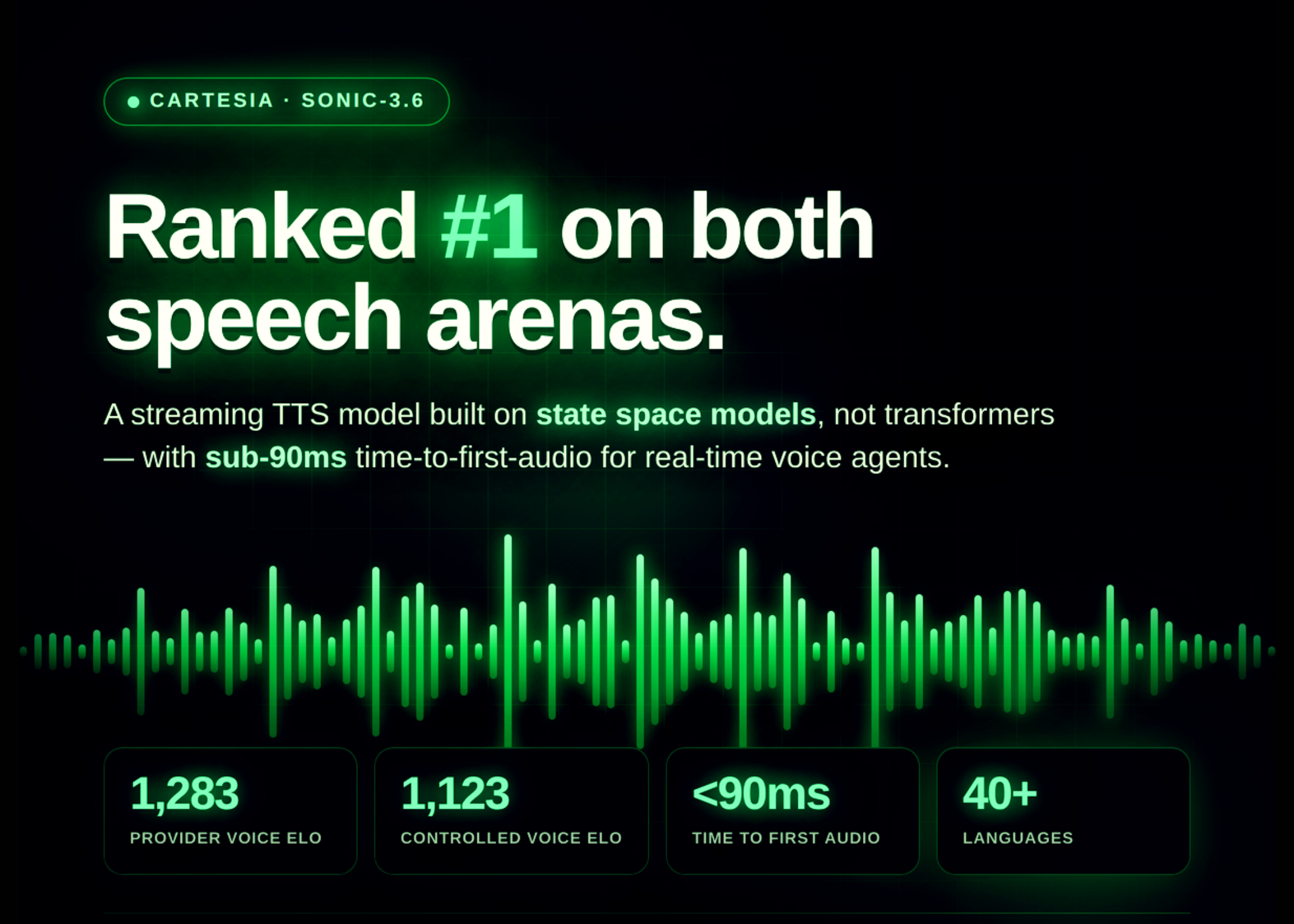
Sonic‑3.6 runs on **state space models (SSMs)** rather than transformers. Cartesia frames the classic speed‑vs‑naturalness, accuracy‑vs‑cost tradeoffs as architectural choices rather than inevitable constraints. The practical benefit is **sub‑90ms time‑to‑first‑audio**, with vendor‑stated 100ms transcript latency for its Ink‑2 speech‑to‑text model. These figures reflect model‑only latency, not end‑to‑end round‑trip performance.
—
### 📊 Independent Leaderboard Results
Artificial Analysis runs two parallel leaderboards:
– **Provider Voice**: Models use their own best voices.
– **Controlled Voice**: All models are cloned onto the same eight reference voices, isolating the synthesis engine from the voice catalog.
On the Controlled Voice board—considered more rigorous for engine comparison—Sonic‑3.6 ranks **#1**, followed by Sonic‑3.5 in second and ElevenLabs Eleven v3 in third. The model achieves **1,283 Elo** on the Provider Voice board and **1,123 Elo** on the Controlled Voice board.
> **Note**: These are preference‑based Elo scores from blind listening tests measuring perceived naturalness, not transcript accuracy or pronunciation correctness. Rankings can vary week to week.
—
### 🎛️ Interactive Explainer
The post includes a **four‑pane interactive demo**:
1. **Latency Race** – A real‑time visual comparison between Sonic‑3.6 (state‑space, streaming) and a chunked transformer baseline. A live clock shows sub‑90ms first‑audio performance.
2. **Arena Scores** – Dynamic bar charts displaying Elo rankings and confidence intervals across providers.
3. **Expression Control** – Modify transcripts on the fly using tags like `[laughter]`, IPA overrides, speed, volume, and language switching. Hear how delivery changes without preprocessing.
4. **Cost & Capacity** – A slider to estimate monthly TTS minutes and matching Cartesia plan, including concurrency limits and commercial licensing notes.
> The interactive widget is embedded via an iframe and requires a modern browser with JavaScript enabled.
—
### 💰 Pricing and Plan Fit
Cartesia operates on a **monthly minute‑based pricing model**, with commercial use starting at the **Pro** tier. Key limits include:
– **Concurrency caps** per tier (e.g., 2 concurrent streams on Pro, 5 on Startup, 15 on Scale).
– Separate line‑item billing for telephony via Cartesia’s Voice API.
– Enterprise tiers offer DPAs, BAAs, and SSO.
The model is priced at **$49.00 per 1M characters** for Sonic‑3.6, while voice‑API lines bill at **$0.06/min** plus **$0.014/min** for Cartesia‑provided telephony.
—
### 📈 Leaderboards Summary (as of August 18, 2026)
| Rank | Model | Board | Elo |
|——|——-|——-|—–|
| 1 | Sonic‑3.6 | Provider Voice | 1,283 |
| 2 | Sonic‑3.5 | Provider Voice | — |
| 3 | ElevenLabs Eleven v3 | Provider Voice | — |
| 1 | Sonic‑3.6 | Controlled Voice | 1,123 |
| 2 | Sonic‑3.5 | Controlled Voice | — |
| 3 | ElevenLabs Eleven v3 | Controlled Voice | — |
—
### 🔗 Sources and Verification
– [Cartesia Sonic – cartesia.ai/sonic](https://www.cartesia.ai/sonic)
– [Cartesia Pricing – cartesia.ai/pricing](https://www.cartesia.ai/pricing)
– [Cartesia Docs – TTS Models](https://docs.cartesia.ai/build-with-cartesia/tts-models/latest)
– [Artificial Analysis TTS Leaderboard](https://artificialanalysis.ai/text-to-speech/leaderboard/provider-voice)
Data timestamp: **August 18, 2026**
—
## Frequently Asked Questions (FAQ)
**Q: Can I self‑host Sonic‑3.6?**
A: No. Sonic‑3.6 is a closed, commercial model. It is not distributed as open weights and is not available on Hugging Face. Access is provided via API or as a hosted service.
**Q: What is the difference between Provider Voice and Controlled Voice leaderboards?**
A: Provider Voice lets each model use its own best voices, reflecting real‑world voice selection. Controlled Voice clones all models onto the same eight reference voices, removing voice quality and selection bias so the synthesis engine can be compared directly.
**Q: What does “sub‑90ms time‑to‑first‑audio” mean in practice?**
A: It means the model begins emitting audio within 90 milliseconds of receiving a streaming transcript. This is measured at the model output, not including network latency or client playback overhead.
**Q: Is there a free tier for commercial use?**
A: No. The Free tier does not include a commercial license. Commercial use begins at the Pro tier.
**Q: How are concurrency limits applied?**
A: Each tier caps the number of concurrent TTS requests (e.g., 2 for Pro, 15 for Scale). Exceeding this limit will cause queuing or rejection until slots free up.
**Q: Can I use IPA characters in my transcripts?**
A: Yes. Sonic supports inline IPA overrides (e.g., `<
**Q: What happens if I exceed my purchased minutes?**
A: Usage beyond your plan’s included minutes typically results in overage charges or throttling, depending on your contract. Enterprise tiers can negotiate custom caps.
**Q: How often are the leaderboards updated?**
A: Rankings are updated weekly based on new blind listening votes. The data cited here is from August 18, 2026.
—
## Conclusion
Cartesia Sonic‑3.6 represents a significant step forward in real‑time, production‑grade text‑to‑speech. By adopting state‑space architectures, the model achieves remarkably low latency (sub‑90ms) without sacrificing naturalness, as demonstrated by its top ranking on controlled‑voice leaderboards. With a clear path to deployment via hosted API, granular expression controls, and enterprise‑grade compliance options, Sonic‑3.6 is well positioned for voice agents, IVR systems, and other commercial applications where both speed and quality are critical. As always, benchmark against your own workload and network conditions before committing to a production rollout.
