



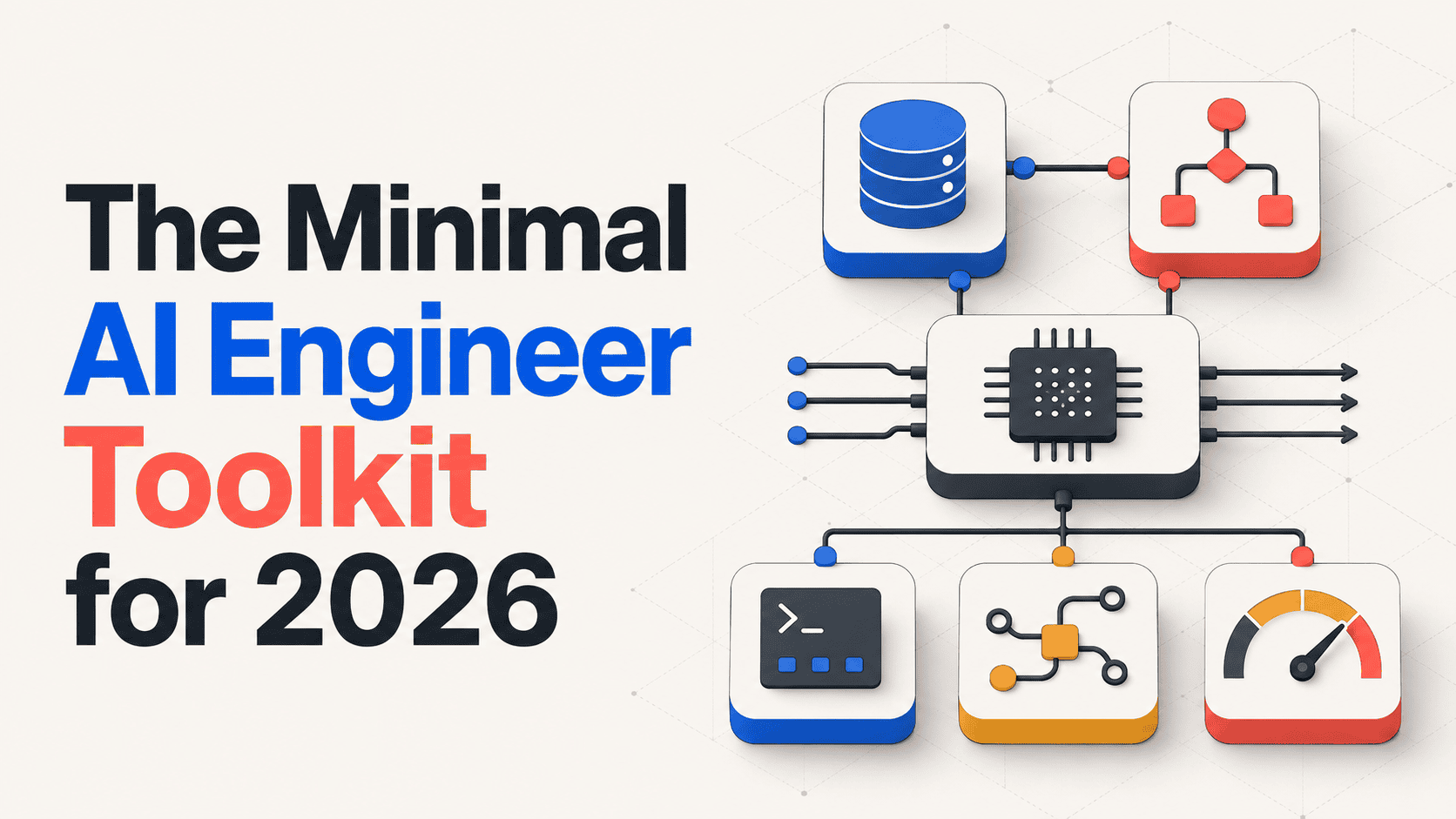
## The Essential AI Engineering Toolkit for 2026
The landscape of AI engineering has evolved dramatically. Early generative AI applications were characterized by complex, brittle stacks heavy with dependencies—vector databases, intricate chunking algorithms, and custom integrations—that were suitable for prototyping but fell short in production environments. Today, the role of the AI Engineer has matured significantly. As outlined in *”From Python to AI Engineer: A Self-Study Roadmap,”* the focus has shifted from frantic API wiring to building deterministic systems around non-deterministic engines. Modern foundation models integrate native reasoning and state management, allowing for a leaner, standardized set of primitives. This article presents the minimal, production-grade toolkit required to build, evaluate, and deploy autonomous systems effectively in mid-2026.
### Orchestration: Graphs and Event Loops
Orchestration is the foundation of any robust AI system. It provides visibility into execution graphs, state transitions, and error handling—critical elements that obscure the underlying prompts in less mature frameworks. Two primary paradigms dominate 2026:
* **Code-First Graph Frameworks:** For complex, stateful applications, cyclical graphs are standard. Frameworks like **LangGraph** and **Burr** allow developers to define nodes (agents or tools) and edges (conditional routing logic), maintaining state automatically and enabling human-in-the-loop pauses without losing context.
* **Visual Event-Driven Orchestration:** For workflow automation and data pipelining, visual tools like **n8n** offer superior maintainability. They treat AI models as first-class citizens, enabling workflows via webhooks, classifiers, Python execution, and databases with built-in retry logic and observability.
The rule is straightforward: use code-first graphs for conversational, multi-turn planning, and visual orchestrators for asynchronous, event-triggered workflows.
### The Universal Connector: Model Context Protocol
Integrating tools once required writing custom Python wrappers, defining JSON schemas, handling API authentication, and parsing arguments—a process fraught with inefficiency. The **Model Context Protocol (MCP)** has drastically reduced this overhead. MCP functions like a USB-C standard for AI, allowing any agent to connect to any data source or tool through a consistent interface. This shifts the engineering focus from integration to governance, separating execution from reasoning and centralizing credential management on the server side.
### Local Inference and Small Language Models
Developing entirely offline is not only possible but also highly efficient today. **Small Language Models (SLMs)**, as detailed in *”Introduction to Small Language Models: The Complete Guide for 2026,”* have reached a quality threshold where models under 10 billion parameters often outperform larger frontier models on specific tasks. The local stack includes:
* **Inference Engines:** Tools like **Ollama** or **MLX** (for Apple Silicon) run quantized models locally with a single command.
* **Workflow:** Build and debug orchestration logic using fast, current-generation local models like Qwen3, Gemma 3, or Phi. This provides zero-cost, zero-latency testing.
* **Portability:** Because local inference engines expose OpenAI-compatible API endpoints, transitioning to production is seamless—changing only the base URL and API key is required.
### The Evaluation Engine: CI/CD for Prompts
Rigorous evaluation is the most commonly skipped yet critical component of production AI deployment. As warned in *”7 Important Considerations Before Deploying Agentic AI in Production,”* probabilistic outputs demand statistical testing. An evaluation framework—such as **Promptfoo**, **LangSmith**, or **Braintrust**—must be integrated directly into the CI/CD pipeline.
This involves “LLM-as-a-Judge” grading, where a secondary model scores the agent’s output against a strict rubric (e.g., “Did the agent correctly use the `refund_api` tool without hallucinating a transaction ID?”). Setting a pass rate threshold (e.g., 95%) as a build gate ensures reliability. Furthermore, structured output must be enforced to guarantee downstream code receives data in the expected format.
### Structured Output Enforcement
The era of instructing models to “return only valid JSON” is over. Modern toolkits rely on two complementary approaches:
* **Constrained Decoding:** Libraries like **Outlines** and **vLLM Guided Decoding** use a Pydantic model as a schema to restrict token generation at the sampling stage.
* **Validation-and-Retry:** **Instructor** wraps the model’s function-calling interface, validates output against a Pydantic schema post-generation, and automatically retries if validation fails.
These methods eliminate parsing errors that previously crashed pipelines. Choose constrained decoding for full stack control or Instructor for hosted APIs.
### Advanced Development Workflows: Git Worktrees
AI development involves constant experimentation, which can create friction with standard branching methods. **Git Worktrees** allow multiple branches to exist in separate directories simultaneously. This enables developers to run evaluation suites on an `experimental-agent` branch while fixing bugs in `main`, all while retaining local model state and environment variables. This workflow significantly enhances development fluidity.
### The Bottom Line
The six tools presented form a coherent stack that addresses specific sources of friction, replacing bespoke solutions with standardized primitives. The defining characteristic of senior AI talent is knowing which layers of abstraction to remove. The minimal toolkit—a graph orchestrator, MCP for integrations, local SLMs for testing, structured output for reliability, and automated evaluation for CI/CD—provides the foundation for solid AI systems. The key is to start with the layer representing your biggest bottleneck. If development is slow, start local; if deployments are unpredictable, start with evaluation. These tools fit together logically, making everything else noise.
—
### FAQ
**Q: What is the Model Context Protocol (MCP) and why is it important?**
**A:** MCP is an open standard that allows AI agents to connect to any data source or tool through a consistent interface, similar to how USB-C connects hardware devices. It eliminates the need for custom Python wrappers for every integration, shifting the engineering focus from building integrations to managing governance and security.
**Q: Why are Small Language Models (SLMs) recommended for local development?**
**A:** SLMs under 10 billion parameters have reached a quality threshold where they often outperform larger frontier models on targeted tasks. They enable cost-effective, zero-latency local development, allowing for rapid iteration and debugging without cloud expenses. Furthermore, their compatibility with OpenAI APIs ensures a smooth transition to production.
**Q: What is the difference between constrained decoding and validation-and-retry for structured output?**
**A:** Constrained decoding (e.g., Outlines) enforces a schema at the token-generation level, preventing the model from ever outputting invalid tokens. Validation-and-retry (e.g., Instructor) generates the output first and then validates it against a schema, automatically retrying if the output fails validation. Constrained decoding is stricter and requires specialized infrastructure, while validation-and-retry is more flexible and works with any OpenAI-compatible API.
**Q: When should I use a visual orchestrator versus a code-first graph framework?**
**A:** Use a visual orchestrator like n8n for workflow automation and data pipelining, where tasks are event-triggered and require maintainability. Use a code-first framework like LangGraph for complex, stateful applications involving conversational memory and multi-turn planning, where explicit control over state and transitions is critical.
**Q: How does an evaluation framework prevent AI application failures in production?**
**A:** An evaluation framework, integrated into CI/CD, uses “LLM-as-a-Judge” to automatically test agent outputs against a strict rubric. This statistical testing catches probabilistic errors that manual checks would miss, ensuring that changes to prompts or models do not break production functionality. It transforms prompt engineering from an art into a version-controlled discipline.
### Conclusion
The modern AI engineering toolkit for 2026 is defined by its elegance and composability. It moves away from the bloated “kitchen sink” approaches of the past toward a lean stack of standardized primitives: a code-first graph orchestrator, the Model Context Protocol for seamless integrations, local small language models for efficient development, structured output enforcement for reliability, and automated evaluation for robust deployment. This stack addresses the specific pains of early GenAI development, replacing them with manageable, scalable solutions. Whether you are just starting or looking to stabilize existing systems, adopting these tools provides a clear path toward building solid, production-ready AI applications. The key is to identify your current bottleneck and build outward, leveraging these interconnected tools to create efficient and reliable systems.
