



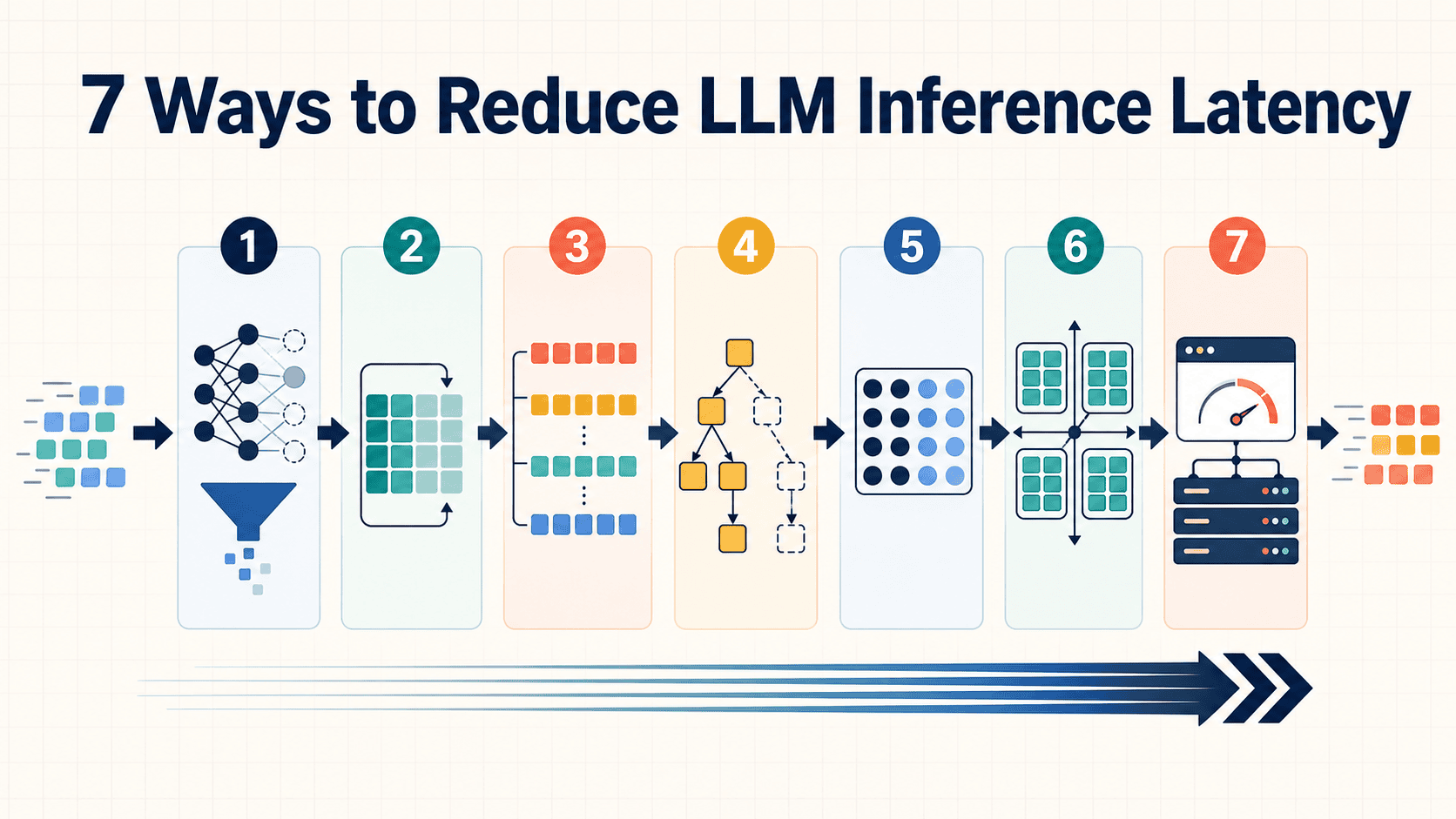
## Reducing Inference Latency in LLM Workflows: 7 Proven Strategies
As large language models (LLMs) move from research prototypes into production, engineering teams run into a hard truth: building an intelligent model is only half the battle. Serving that model to users in real time is a different engineering challenge entirely.
In generative AI, **inference** is the phase where a trained model processes your input (the prompt) and generates an output (the response). **Inference latency** is the time delay during this process. Unlike standard web applications where latency is usually measured in milliseconds, LLM latency can stretch into seconds or longer if left unoptimized, leading to poor user experiences and high compute costs.
Understanding the anatomy of a slow response is the first step. LLM generation happens in two distinct phases:
1. **The Prefill Phase (Reading):** The model ingests the entire prompt at once. This phase is compute-bound. The longer your prompt, the longer this takes.
2. **The Decode Phase (Writing):** The model generates the answer sequentially, one token at a time. Because each new token requires the context of all previous tokens, this phase can’t be parallelized and is memory-bandwidth bound.
These two phases produce two metrics that dictate user experience: **Time to First Token (TTFT)**, measuring how long before the first word appears, and **Time Per Output Token (TPOT)**, measuring ongoing generation speed.
Here are seven proven approaches to reduce inference latency in your LLM workflows.
—
### 1. Implementing Model Quantization
An LLM is essentially a large collection of numeric weights. By default, these are stored in 16-bit floating-point format (FP16 or BF16). A 70-billion-parameter model in FP16 requires roughly 140 GB of VRAM just to load, and moving that data across the GPU for every generated token creates a severe memory bandwidth bottleneck that directly drives up TPOT.
**Quantization** compresses the model by converting weights from 16-bit to 8-bit (INT8) or 4-bit (INT4) integers, shrinking the model’s memory footprint considerably. A 4-bit quantized model moves through memory four times faster than an FP16 equivalent, producing a direct reduction in decode latency. The trade-off is a potential slight degradation in model reasoning quality, though modern techniques like **Activation-aware Weight Quantization (AWQ)** and **GPTQ** minimize that accuracy loss.
—
### 2. Utilizing Key-Value Caching
Under the hood, LLMs use the Transformer architecture, which relies on a self-attention mechanism. As the model generates token #100, it needs to understand how that token relates to tokens 1 through 99. Recalculating the mathematical relationships (the Keys and Values) for all previous tokens at every single step is computationally expensive, and that’s exactly the redundant work key-value (KV) caching eliminates.
**KV caching** stores the Key and Value matrices of previously processed tokens in VRAM. When generating the next token, the model retrieves historical context from the cache and only computes the math for the newest token. This reduces computation time and lowers TPOT. The trade-off is memory cost: as generated text grows longer, the KV cache grows dynamically, consuming more VRAM. Balancing cache size against generation speed is a core infrastructure concern for any production LLM system.
—
### 3. Leveraging Speculative Decoding
The most stubborn bottleneck in LLM inference is the sequential nature of auto-regressive generation. You can’t generate token #5 without knowing token #4, and this hard dependency makes naive parallelization impossible. **Speculative decoding** works around this by letting models write multiple words at once, using two models in tandem:
– A massive, slow “target” model (e.g. Llama-3-70B)
– A tiny, fast “draft” model (e.g. Llama-3-8B)
The process works as follows:
“`python
# PSEUDOCODE — illustrative only, not a real framework API
draft_tokens = draft_model.generate(prompt, n=5) # Near-instant
accepted = target_model.verify(draft_tokens) # Single parallel pass
# If draft is accurate, all 5 tokens are accepted
output_tokens.extend(accepted)
“`
In practice, Hugging Face implements this by passing `assistant_model=draft_model` to the target model’s `.generate()` call. The verification loop is handled internally. When the draft model is accurate, you bypass the sequential memory bottleneck entirely, accelerating text generation by 2x to 3x without any loss in output quality in favorable conditions.
—
### 4. Transitioning to Continuous Batching
Traditional machine learning servers process requests in static batches to maximize GPU utilization. If four requests arrive together, the server groups them, processes them in parallel, and returns results. The problem: LLM outputs have highly variable lengths. If three requests finish in 100 tokens but one requires 1,000, the first three users wait idly for the longest request to complete.
**Continuous batching** (also called iteration-level scheduling) fixes this. Instead of waiting for an entire batch to complete, the inference engine continuously injects new requests and evicts finished ones at the token level. The moment a short request completes, the server returns it immediately and slots a new user into that freed compute space, reducing both individual latency and overall server wait times.
—
### 5. Pruning and Distilling Your Models
If quantization shrinks the size of existing weights, **model pruning** removes weights entirely. Neural networks are inherently over-parameterized, and not every neuron contributes equally to every task. By identifying and eliminating the layers or attention heads that contribute least to model performance, you physically reduce the architecture.
**Knowledge distillation** takes a different angle: training a smaller, faster “student” model to replicate the behavior of a larger “teacher” model. If you’re using a 70B-parameter model for a task like basic sentiment analysis or structured data extraction, the overhead is unnecessary. Distilling that capability into a purpose-built 8B-parameter model can dramatically reduce inference latency — potentially to tens of milliseconds on a modern GPU — while retaining the specific reasoning quality you need.
—
### 6. Deploying with Optimized Inference Engines
If you’re serving LLMs using a standard library’s default `.generate()` function, your latency will suffer. Standard libraries are designed for research flexibility and ease of debugging, not for high-throughput, low-latency production serving. To get serious about speed, deploy your models using a dedicated inference serving framework. **vLLM**, Hugging Face’s **Text Generation Inference (TGI)**, and NVIDIA’s **TensorRT-LLM** are all purpose-built for high-performance serving: TGI is written in Rust and Python, vLLM uses Python with optimized C++/CUDA kernels, and TensorRT-LLM is implemented in C++ and CUDA.
These engines automatically implement:
– **PagedAttention**: Smart, non-contiguous memory management for the KV cache.
– **Continuous batching**: As described above, built into the serving layer.
– **Optimized CUDA kernels**: Hardware-level acceleration for Transformer operations.
Adopting one of these frameworks often reduces both TTFT and TPOT considerably with minimal changes to your model code.
—
### 7. Optimizing Context and Prompt Management
Engineering teams frequently overlook the most accessible way to reduce TTFT: send less data to the model. In retrieval-augmented generation (RAG) pipelines, it’s common to inject thousands of words of retrieved context into a prompt as a precaution, even when most of it is irrelevant. Every additional token in the prompt increases prefill compute time. Two targeted strategies help here.
**Prompt compression:** Use lighter natural language processing (NLP) models to summarize or extract only the most relevant sentences from your vector database before passing them to the LLM. This trims prefill overhead without sacrificing answer quality.
**Prompt caching:** If your application relies on a large, static system prompt (such as a 2,000-word behavioral instruction set), modern APIs and inference engines let you cache the prefill state of that prompt. When a new user connects, the model skips recomputing the system prompt and only processes the user’s specific query, directly cutting TTFT.
—
### Stacking Optimizations in Practice
Reducing inference latency is rarely about a single fix. It’s a process of stacking incremental improvements. A workflow using an INT8 quantized model, served via vLLM with continuous batching and accelerated by speculative decoding, will behave like a completely different application compared to an unoptimized baseline.
Speed always involves trade-offs around infrastructure cost, throughput ceilings, and engineering complexity. As you implement these approaches, you’ll need a structured way to evaluate your return on investment and ensure that speed gains aren’t quietly increasing hosting bills.
Each of these seven approaches addresses a different layer of the inference stack, from the weight level up to prompt engineering. Working through them systematically is the most reliable path to shipping fast, cost-efficient generative AI applications.
—
### FAQ
**Q1: What is the biggest cause of high LLM inference latency?**
A: The biggest cause is typically the sequential nature of token generation (auto-regressive decoding), which creates a memory-bandwidth bottleneck during the decode phase. This is compounded by large model sizes and unoptimized serving infrastructure.
**Q2: How does quantization reduce latency?**
A: Quantization reduces the precision of model weights (e.g., from 16-bit to 4-bit), shrinking the model size and allowing faster data movement in memory. This directly reduces the time per output token (TPOT).
**Q3: What is the trade-off of using speculative decoding?**
A: The trade-off is increased complexity and potential verification overhead. If the draft model is inaccurate, rejected tokens must be regenerated by the target model, which can negate speed gains.
**Q4: When should I use continuous batching?**
A: Continuous batching is ideal for production systems with variable request sizes and arrival patterns. It minimizes idle time and improves GPU utilization compared to static batching.
**Q5: Do optimized inference engines work with all LLMs?**
A: Most modern frameworks support major architectures like GPT, Llama, and Mistral. However, some exotic or research-oriented architectures may require custom kernels or additional configuration.
**Q6: Is prompt caching only useful for long system prompts?**
A: Yes, prompt caching is most beneficial when you have a large, static prompt that is reused across many user queries, such as in enterprise or agentic applications.
—
### Conclusion
Reducing LLM inference latency is essential for delivering responsive, cost-effective AI applications. By applying a combination of model optimization techniques like quantization and pruning, infrastructure improvements such as continuous batching and optimized inference engines, and strategic prompt management, you can dramatically improve performance without sacrificing quality.
The key is to understand your specific latency bottlenecks, measure the impact of each optimization, and stack techniques that complement each other. As the ecosystem of inference tools continues to mature, what was once cutting-edge optimization is becoming standard practice—enabling faster, smarter, and more efficient generative AI for all workloads.
