



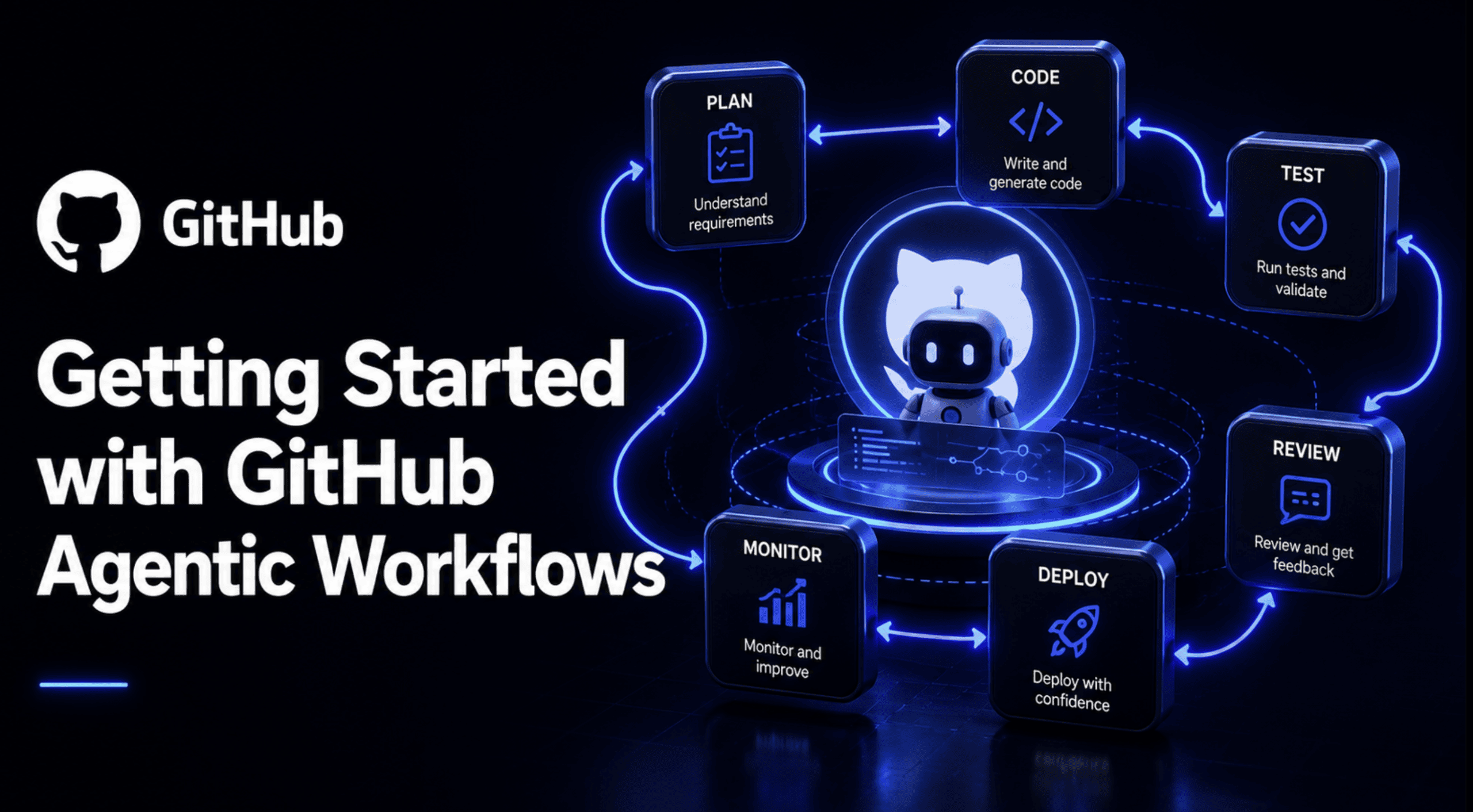
## Understanding GitHub Agentic Workflows: A New Era for Automation
GitHub Agentic Workflows marks a significant shift in how developers automate repetitive tasks within their repositories. Launched in public preview on June 11, 2026, this innovative feature allows developers to encode judgements into automation, freeing up valuable time by tackling the mundane and repetitive tasks that often bog down development teams.
### What Are GitHub Agentic Workflows?
At its core, GitHub Agentic Workflows enable developers to define workflows in plain English within a Markdown file located in the `.github/workflows/` directory. These workflows are powered by various AI engines—such as GitHub Copilot, Anthropic’s Claude, OpenAI Codex, and Google Gemini—and compile into standard GitHub Actions workflows. This means they utilize existing runners and security policies, ensuring a familiar and secure environment.
### The Benefits of Agentic Workflows
The appeal of Agentic Workflows lies in their ability to handle reasoning-heavy tasks automatically. Imagine a workflow that triages issues as they arise, classifying them, applying labels, and even posting responses—all without human intervention. This capability is particularly beneficial for teams looking to streamline their processes and reduce the time spent on routine maintenance.
Moreover, the feature is designed with security in mind. With layers such as read-only tokens, zero secrets in the agent process, and a sandboxed execution environment, GitHub has built a robust security model that ensures agents can read but not write directly to repositories unless explicitly allowed.
### Setting Up Your First Workflow
Getting started with GitHub Agentic Workflows is straightforward. Developers need a supported AI engine, a GitHub repository, and the GitHub CLI. Once set up, you can write your first workflow, such as an issue triage bot, and compile it using the CLI. This process generates a `.lock.yml` file that integrates seamlessly with GitHub Actions.
### Understanding the Security Model
Security is paramount in Agentic Workflows. The feature includes multiple layers of protection, such as read-only tokens, network firewalls, and safe output types, ensuring that even if an agent is compromised, the potential damage is limited. This thoughtful approach to security allows teams to automate complex tasks with confidence.
### Common Patterns and Reusability
GitHub Agentic Workflows supports over 18 documented design patterns, including IssueOps and DailyOps, which cater to various automation needs. Additionally, developers can reuse workflows from GitHub’s public catalogue, making it easier to implement proven automation strategies without starting from scratch.
### What’s Still Evolving
While GitHub Agentic Workflows is a powerful tool, it is still in public preview. Some areas, such as debugging and cost visibility, are works in progress. However, the feature’s robust security model and ease of use make it a valuable tool for developers looking to enhance their automation capabilities.
### Conclusion
GitHub Agentic Workflows represents a paradigm shift in automation, allowing developers to focus on strategic tasks while the platform handles routine operations. By encoding judgment into automation, teams can improve efficiency and reduce errors. As the feature matures, it promises to become an integral part of the developer toolkit, offering new possibilities for automating complex workflows with ease and security. Whether you’re just starting to explore automation or looking to refine existing processes, GitHub Agentic Workflows offers a compelling solution that is worth exploring further.
—
### FAQ
**Q: What are GitHub Agentic Workflows?**
GitHub Agentic Workflows are a feature that allows developers to automate tasks within their repositories using AI. By writing simple English instructions in a Markdown file, developers can create workflows that run on a schedule or in response to specific events, utilizing various AI engines.
**Q: How do I set up a workflow?**
To set up a workflow, you need a GitHub account with a supported AI engine, a repository, and the GitHub CLI. After installing the necessary extensions, you can write your workflow in a Markdown file, compile it, and commit it to your repository.
**Q: Are there any security concerns?**
Security is built into the Agentic Workflows with multiple layers, including read-only tokens and sandboxed execution. This ensures that while agents can read and process information, they cannot make unauthorized changes without explicit permissions.
**Q: What common patterns are supported?**
Agentic Workflows support patterns like IssueOps for issue management, DailyOps for scheduled reports, and ChatOps for responding to comments. These patterns help automate routine tasks and improve team efficiency.
**Q: Can I reuse existing workflows?**
Yes, GitHub provides a public catalogue of workflows that developers can reuse and customize for their needs, making it easier to implement automation without starting from scratch.
