



Based on the provided post content, I will write a new article that summarizes the key information about the CopilotKit Channels SDK, incorporating the interactive embed details. I will also add a dedicated FAQ section and a conclusion section.
***
## Article
### CopilotKit Open-Sources the Channels SDK: Turning Your Agent into a Messaging Platform
CopilotKit has officially launched the **Channels SDK**, a significant new tool in the AI agent infrastructure space. This open-source library addresses a critical bottleneck in agent deployment: the need to rewrite logic for every new messaging platform. The core promise of Channels is simple yet powerful—it takes an existing agent and gives it a place to interact with people through messaging apps, without requiring a per-platform rebuild.
#### The Core Concept: A Transport Layer, Not a Second Agent
The most important distinction to understand is what a “channel” is *not*. It is not a duplicate or a secondary agent with its own logic. Instead, a channel is purely a **transport layer and rendering target**. You write your agent’s logic once, and the channel adapter handles the “lowering” of that logic into the native format of each platform.
For example, your agent authoring tools in JSX results in **Block Kit for Slack** and **Adaptive Cards for Microsoft Teams**. This approach ensures a consistent experience while respecting the native paradigms of each communication channel. The article’s interactive embed highlights this by showing the provider matrix, confirming that Slack is Generally Available (Managed), Teams is SDK-Ready, and Discord, Telegram, and WhatsApp are supported as direct adapters where you manage the tokens.
#### Supported Platforms and Getting Started
The SDK is designed for immediate use in production environments. It is MIT licensed and available via npm.
“`bash
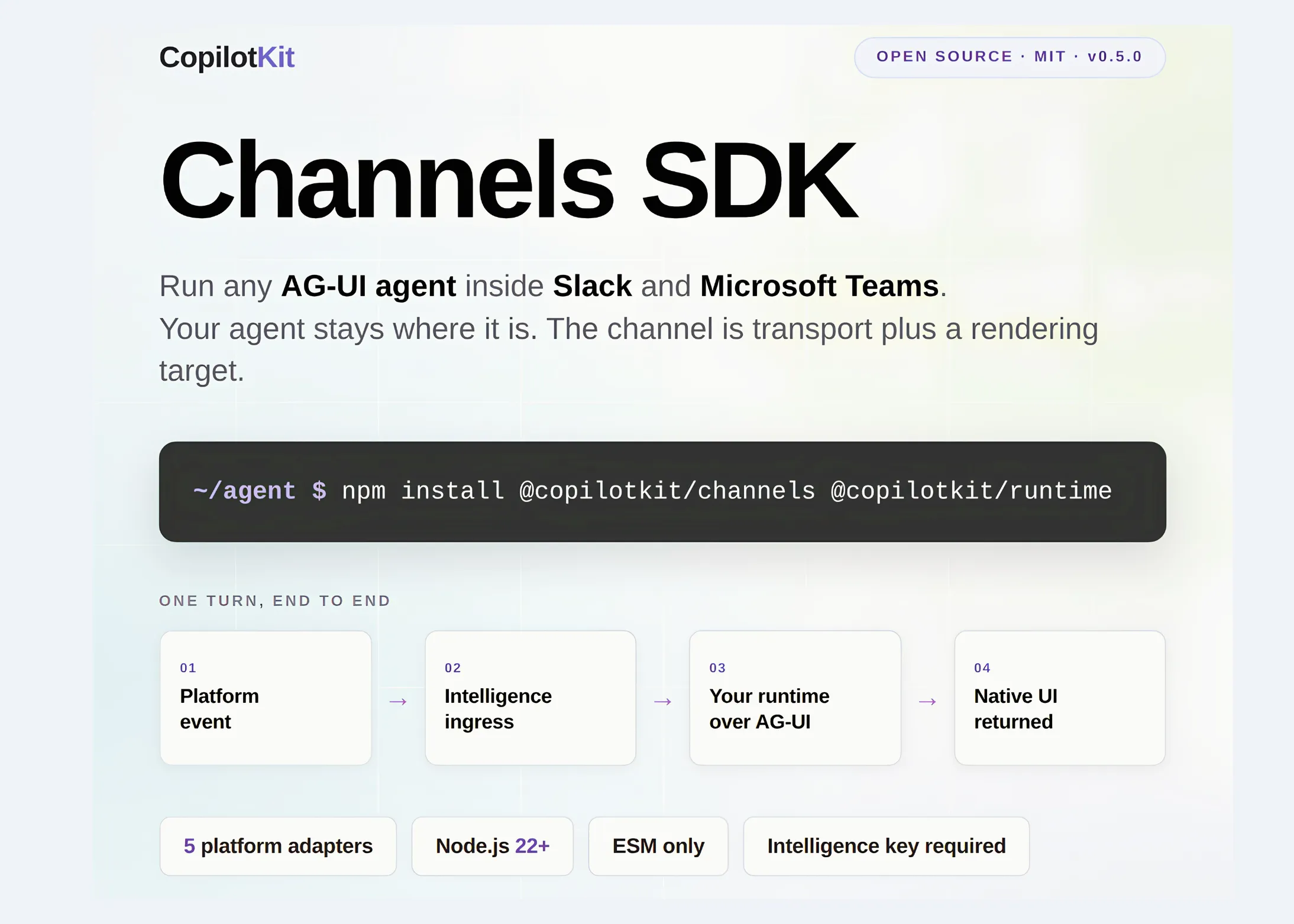
npm install @copilotkit/channels @copilotkit/runtime
“`
The connection between the SDK and your agent is facilitated by **AG-UI (Agent-User Interaction protocol)**. The article emphasizes that *anything* speaking AG-UI is compatible. This includes major frameworks like LangGraph, CrewAI, Mastra, and Pydantic AI, as well as custom HTTP agents. Your model and orchestration layer remain exactly where they are.
The initial early-access surfaces are **Slack and Microsoft Teams**. Planned future integrations include Discord and Google Chat.
#### The Runtime Contract: How It Actually Works
The article provides a clear, step-by-step breakdown of a single “turn” or interaction, which is essential for understanding the deployment model:
1. A user sends a message in Slack or Teams.
2. **CopilotKit Intelligence** receives the platform event and routes it to your Channels process.
3. The **Channels runtime** executes your agent via AG-UI, running tools and generating a response.
4. **Intelligence** sends the native UI (Block Kit or Adaptive Cards) back into the conversation.
This flow clarifies the “runtime contract.” The user must run a long-running Node.js process (or container) to maintain the open connection. Serverless functions are not suitable. The runtime is responsible for managing the agent’s lifecycle, while Intelligence manages the platform credentials and ingress.
#### Key Takeaways for Developers
The article distills the technical details into actionable takeaways:
* **It’s Live:** `@copilotkit/channels` 0.5.0 is available under the MIT license.
* **API Key Required:** Every channel, whether on the managed path (Slack/Teams) or the direct path (Discord/Telegram), requires a CopilotKit Intelligence API key.
* **Provider Status:** Slack is the stable, managed choice. Teams is available but requires verification. Discord, Telegram, and WhatsApp are direct adapters for early adopters.
* **Deployment:** You need Node.js 22+, an ESM (module) project, and a persistent process. Serverless environments are not supported.
### FAQ Section
**Q: What is the CopilotKit Channels SDK?**
A: It is an open-source library that connects your existing AI agent to messaging platforms like Slack and Microsoft Teams. It acts as a transport layer, converting your agent’s JSX-based logic into the native UI components (like Block Kit or Adaptive Cards) for each platform.
**Q: Do I need to rewrite my agent to use Channels?**
A: No. The core philosophy is “write once, run anywhere.” You keep your agent’s model, tools, and business logic. You only add the Channels SDK to provide a messaging interface.
**Q: Which messaging platforms are currently supported?**
A: Slack and Microsoft Teams are available now, with Discord and Google Chat listed as planned integrations. The SDK also ships with direct adapters for Telegram and WhatsApp.
**Q: Is there a cost or API key required?**
A: Yes. To use any channel, you need a CopilotKit Intelligence API key. This is true for both managed providers (like Slack) and direct adapters.
**Q: Can I deploy this on serverless functions (like Vercel or AWS Lambda)?**
A: No. The SDK requires a long-running Node.js process to maintain the persistent connection needed for messaging. A traditional serverless function, which spins down, is not suitable.
**Q: What programming frameworks are compatible with the runtime?**
A: The runtime is designed to work with Node.js, and it provides specific listeners for Node, Hono, and Express. Any framework that can run a persistent Node.js process can integrate with Channels.
### Conclusion
The CopilotKit Channels SDK represents a paradigm shift in how we deploy AI agents into conversational interfaces. By abstracting the complexities of platform-specific rendering and communication, it allows developers to focus on what they do best: building intelligent agents. With its support for major frameworks, MIT licensing, and clear roadmap for expansion, the Channels SDK is a powerful tool for anyone looking to move beyond simple chatbots and deploy robust, integrated agent applications in the tools their users already rely on.
