



**Datalab’s Marker 2: A Full Rewrite of an Open-Source Document Conversion Pipeline**
Datalab has released Marker 2, a full rewrite of its open‑source document conversion pipeline. Marker converts PDF, image, PPTX, DOCX, XLSX, HTML, and EPUB files into markdown, JSON, HTML, or chunked text. The new version is built around three core components: **Surya OCR 2**, a **20M‑parameter fast layout model**, and a rebuilt **pdftext** engine that is reportedly **3× faster** than its predecessor.
**Benchmark Results**
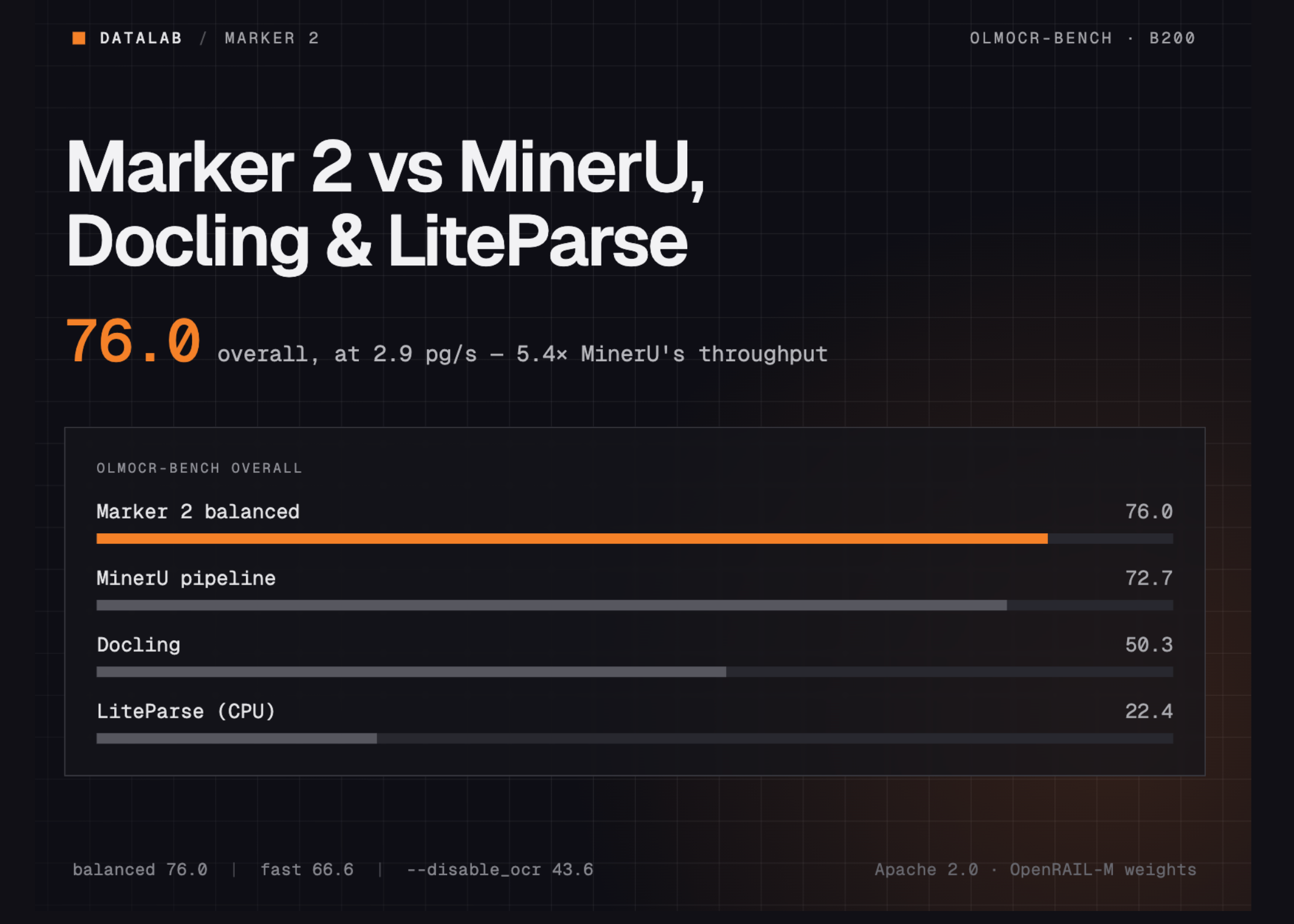
The main performance claim comes from **olmOCR‑bench**, a third‑party benchmark from Allen AI. In that benchmark:
– **Marker 2 (balanced mode)** scores **76.0% overall** and **83.5% on born‑digital PDFs**.
– It sustains **2.9 pages per second** on a single B200 GPU.
– This is **over 5× the throughput** of MinerU’s pipeline backend (72.7% at 0.54 pg/s) and significantly faster than Docling (50.3% at 2.1 pg/s).
**What’s New in Marker 2**
1. **Three conversion paths**
– **Balanced**: Uses the Surya VLM for layout and re‑OCRs pages when embedded text is poor. Highest quality, best on GPU (76.0% olmOCR‑bench).
– **Fast**: A lightweight rf‑detr/onnx layout detector plus pdftext, with minimal VLM use (66.6%).
– **Disable OCR**: Pure text‑layer extraction, no VLM calls, entirely CPU‑based (43.6%).
2. **Device‑aware defaults**
– “Balanced” runs on GPU, “fast” on CPU/MPS, and users can override with `–mode`.
– Full CPU support is now a structural change: `fast –disable_ocr` needs no GPU and no inference server, achieving **23.7 pg/s**.
3. **Architectural throughput improvements**
– Many thin CPU workers share a single Surya inference server.
– The parent process budgets VLM concurrency, allowing throughput to scale with server capacity rather than per‑process VRAM.
– This design sustains ~2.9 pg/s for balanced mode versus ~0.3 pg/s single‑stream.
**Breaking Changes**
– Python 3.10+ is now required.
– Packaging moved from Poetry to **uv**, with hatchling as the build backend (`pip install marker-pdf` remains unchanged).
– The structured‑extraction converter and extractors were removed; Datalab points users to a hosted API or a `–use_llm` workflow instead.
**Comparison with Other Tools**
– **MinerU**: Marker 2 leads in score (76.0 vs. 72.7 overall) and throughput (2.9 pg/s vs. 0.54 pg/s). The gap widens on scanned documents.
– **Docling**: Marker 2 outperforms on both accuracy (76.0% vs. 50.3%) and speed (2.9 pg/s vs. 2.1 pg/s). Docling’s strengths are governance (MIT license, LF AI & Data Foundation) and broader input formats (audio, email).
– **LiteParse**: LiteParse excels in raw speed (up to 1721 pg/s with OCR off) but trades structure for speed, scoring much lower on layout‑heavy tasks (22.4 overall vs. Marker’s 43.6 in CPU‑only mode).
– **Full‑page VLM tier**: For scans, math‑heavy pages, and top accuracy, VLM‑based solutions (e.g., Anthropic Claude 3.5, Gemini Flash, A2I’s olmOCR 2) remain superior. Marker’s balanced mode narrows the gap dramatically without API costs.
**Per‑Category Behavior**
– **Math**: Fast mode reads equations from the text layer, dropping arXiv math scores from 83.9 to 23.4. `–disable_ocr` scores 0% on math by design.
– **Old scans**: The weakest category for all pipelines, topping out at ~43%.
**Licensing**
– **Marker**: Apache 2.0 code; model weights use a modified AI Pubs OpenRAIL‑M license—free for research/personal use and startups under $5M funding/revenue; commercial use beyond that requires a paid license.
– **MinerU**: Free up to 100M MAU or $20M monthly revenue; beyond that requires a commercial license and has usage disclosures.
– **Docling**: MIT (IBM Research origin).
– **LiteParse**: Open source (Rust), with LlamaParse as a paid cloud option.
**Use‑Case Picker**
An interactive tool lets users filter by constraints (GPU/CPU, licensing, throughput, latency) to see which parser fits their workload. Example findings:
– High‑volume born‑digital PDFs with GPU → Marker balanced (83.5% at 2.9 pg/s).
– Cost‑sensitive, no GPU → Marker fast `–disable_ocr` (43.6% at 23.7 pg/s, CPU only).
– Strict air‑gapped environments → Fast `–disable_ocr` or Docling.
– Scanned/historical archives → Full‑page VLM tier (e.g., Chandra 2, Gemini Flash).
**Key Takeaways**
– Marker 2 balanced achieves **76.0% olmOCR‑bench** at **2.9 pg/s**, outperforming MinerU and Docling on both accuracy and throughput.
– Fast mode provides a strong CPU‑only option (66.6%, 7.4 pg/s), and `–disable_ocr` delivers **23.7 pg/s** with zero GPU dependency.
– LiteParse trades layout quality for raw speed; it is not a drop‑in replacement for structure‑heavy tasks.
– Licensing and format support differ materially across tools—organizations should evaluate alongside throughput, accuracy, and compliance needs.
– All benchmark data and harnesses are open and reproducible, enabling independent verification.
**Interactive Dynamic Explainer**
An embedded, device‑responsive tool lets users compare modes side‑by‑side, adjust filters, and see real‑time scores, throughput, and latency estimates.
**Conclusion**
Marker 2 represents a major step forward for open‑source document conversion, balancing accuracy, speed, and accessibility. By decoupling layout inference from OCR and optimizing concurrency, it delivers near‑VLM quality in many scenarios without per‑token API costs. Teams seeking the best blend of performance, control, and openness should evaluate Marker 2 alongside MinerU, Docling, and LiteParse—choosing the tool that matches their corpus, hardware, and licensing constraints.
