



**A Comprehensive Atomistic Simulation Tutorial with FAIRChem v2 and the UMA Universal Potential**
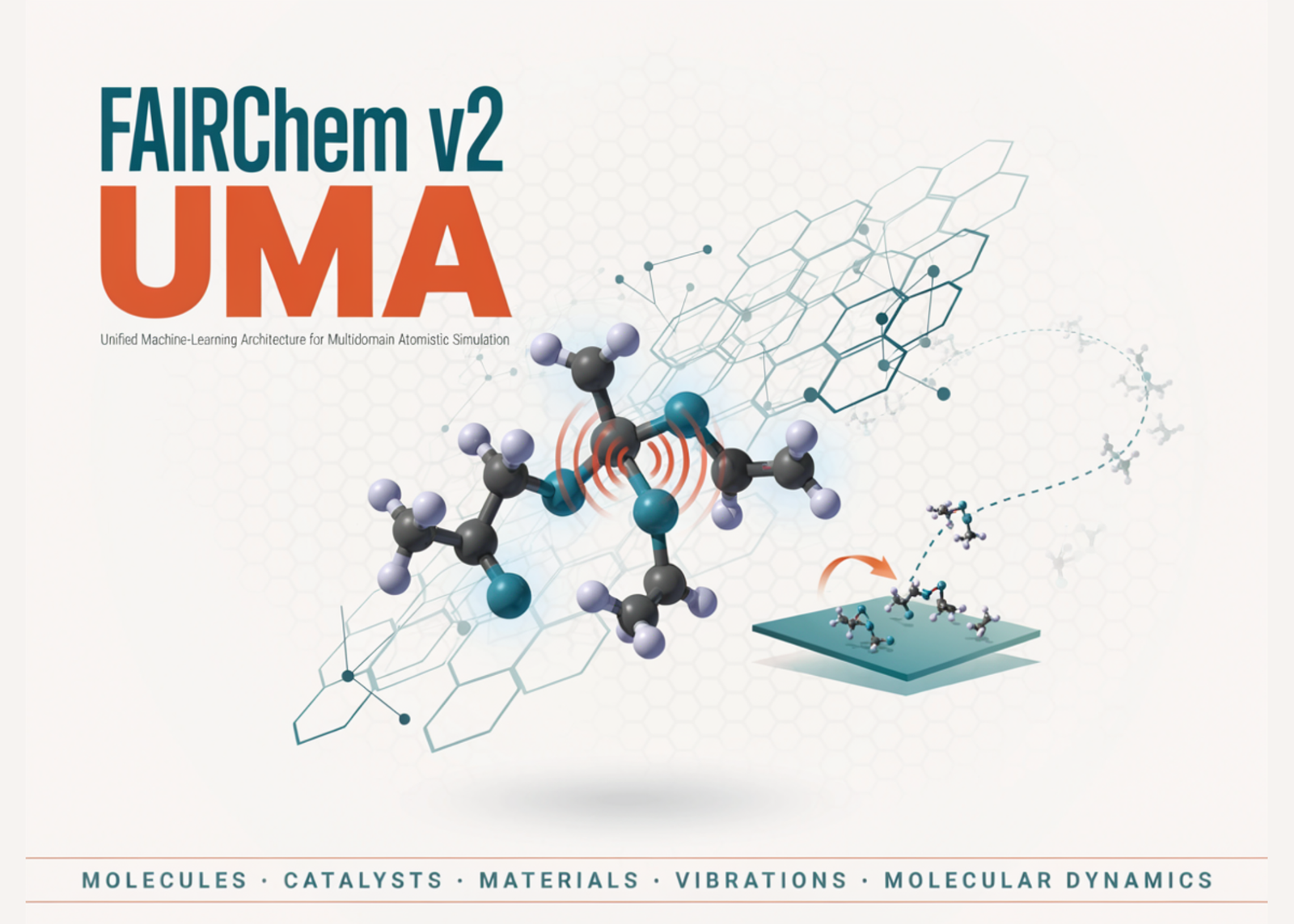
This article presents a complete workflow for atomistic simulations using FAIRChem v2 and the UMA (Universal Machine-learning) interatomic potential. The tutorial demonstrates how a single pretrained potential can be applied across multiple chemical domains—including molecular chemistry, catalysis, and inorganic materials—using a unified framework. By leveraging FAIRChem in combination with the Atomic Simulation Environment (ASE), users can perform a wide range of simulations with GPU acceleration when available.
We begin by setting up the environment, installing necessary packages, and authenticating with Hugging Face to access gated model weights. After initializing task-specific calculators for the omol (molecular), oc20 (catalysis), and omat (materials) domains, we apply the same pretrained UMA model to multiple computational chemistry tasks. These include single-point energy and force calculations, molecular geometry optimization, spin-state comparisons, reaction energy estimation, vibrational analysis, surface adsorption, crystal-cell relaxation, equation-of-state fitting, molecular dynamics, and potential-energy surface scanning.
Each section of the tutorial is accompanied by executable code snippets that illustrate practical implementation using ASE builders, optimizers, filters, and vibrational analysis tools. Key examples include:
– Calculating the energy, forces, and atomization energy of a water molecule.
– Comparing singlet and triplet states of methylene.
– Estimating the reaction energy for methane combustion.
– Computing vibrational frequencies and zero-point energy of water.
– Optimizing a CO adsorbed on a Cu(100) surface and evaluating adsorption energy.
– Relaxing and determining the bulk modulus of BCC iron using an equation of state.
– Performing Langevin molecular dynamics on a water molecule at finite temperature.
– Scanning the O–H bond stretch potential-energy surface.
Together, these examples highlight the versatility of the UMA potential and the ease with which complex simulations can be set up using FAIRChem and ASE.
—
### Frequently Asked Questions (FAQ)
**What is FAIRChem v2?**
FAIRChem v2 is an open-source framework that provides pretrained machine-learning interatomic potentials and a consistent interface for atomistic simulations. It enables accurate and efficient simulations across diverse chemical and materials systems.
**What is the UMA potential?**
UMA (Universal Machine-learning) is a single model trained on a large and diverse dataset, designed to serve multiple chemical domains such as molecules, catalysis, and materials. It allows consistent simulations across different tasks without requiring separate models for each.
**Do I need a GPU to run this tutorial?**
GPU acceleration is automatically detected and used when available, but the simulations will also run on CPU. Performance will be slower on CPU, especially for larger systems or longer molecular dynamics.
**How do I access the pretrained models?**
The tutorial uses the `huggingface_hub` library to authenticate and download gated model weights. You will need a Hugging Face access token, which can be generated from your Hugging Face account.
**Can I reuse the same calculator for different tasks?**
Yes, the same predictor (UMA model) can be reused with different `task_name` settings (`omol`, `oc20`, `omat`) to perform simulations tailored to molecular, catalysis, or materials science contexts.
**What is the role of ASE in this workflow?**
ASE (Atomic Simulation Environment) provides tools for building atomic structures, applying constraints, running optimizers and molecular dynamics, and analyzing results. It integrates seamlessly with FAIRChem calculators to manage simulations end to end.
**Are the results comparable to experimental values?**
The tutorial reports agreements with experimental trends where appropriate, but predictions are generally electronic-energy-based. For thermochemical accuracy, zero-point energy, thermal, and entropic corrections should be included when comparing with experiment.
**Can I run larger simulations or more advanced workflows?**
Yes. The tutorial outlines paths to higher-accuracy models (e.g., `uma-m-1p1`) and extensions such as multi-GPU inference, molecular crystals, metal–organic frameworks, and catalysis-specific tasks like OC20 adsorption modeling.
—
### Conclusion
This tutorial demonstrates how FAIRChem v2 and the UMA universal potential provide a unified, powerful framework for atomistic simulation across chemistry and materials science. By using a single pretrained model, users can perform consistent calculations for molecules, catalytic surfaces, and crystalline solids, while leveraging the full power of ASE for structure handling, optimization, and analysis.
The showcased workflows—from geometry optimization and reaction energetics to vibrational analysis and molecular dynamics—highlight the flexibility and practicality of this approach. With straightforward extensions, researchers can scale up to larger systems, explore more complex interfaces, and adopt higher-accuracy model variants. Ultimately, this tutorial offers a reusable and extensible foundation for modern machine-learning-driven atomistic simulations.
