



Based on the provided post content, here is a newly structured article with a clear introduction, detailed body, FAQ section, and conclusion section:
—
## **Marker 2: A Major Leap in Document Conversion Speed and Accuracy**
Datalab has unveiled Marker 2, a complete rewrite of its open-source document conversion pipeline. Designed to convert PDFs, images, PPTX, DOCX, XLSX, HTML, and EPUB files into markdown, JSON, HTML, or structured chunks, Marker 2 introduces significant performance and accuracy improvements over its predecessors and competitors. Built around three core components—Surya OCR 2, a 20M-parameter fast layout model, and a rebuilt pdftext engine—Marker 2 delivers up to 5x the throughput of MinerU and outperforms Docling and LiteParse on real-world benchmarks.
—
## **Performance Highlights**
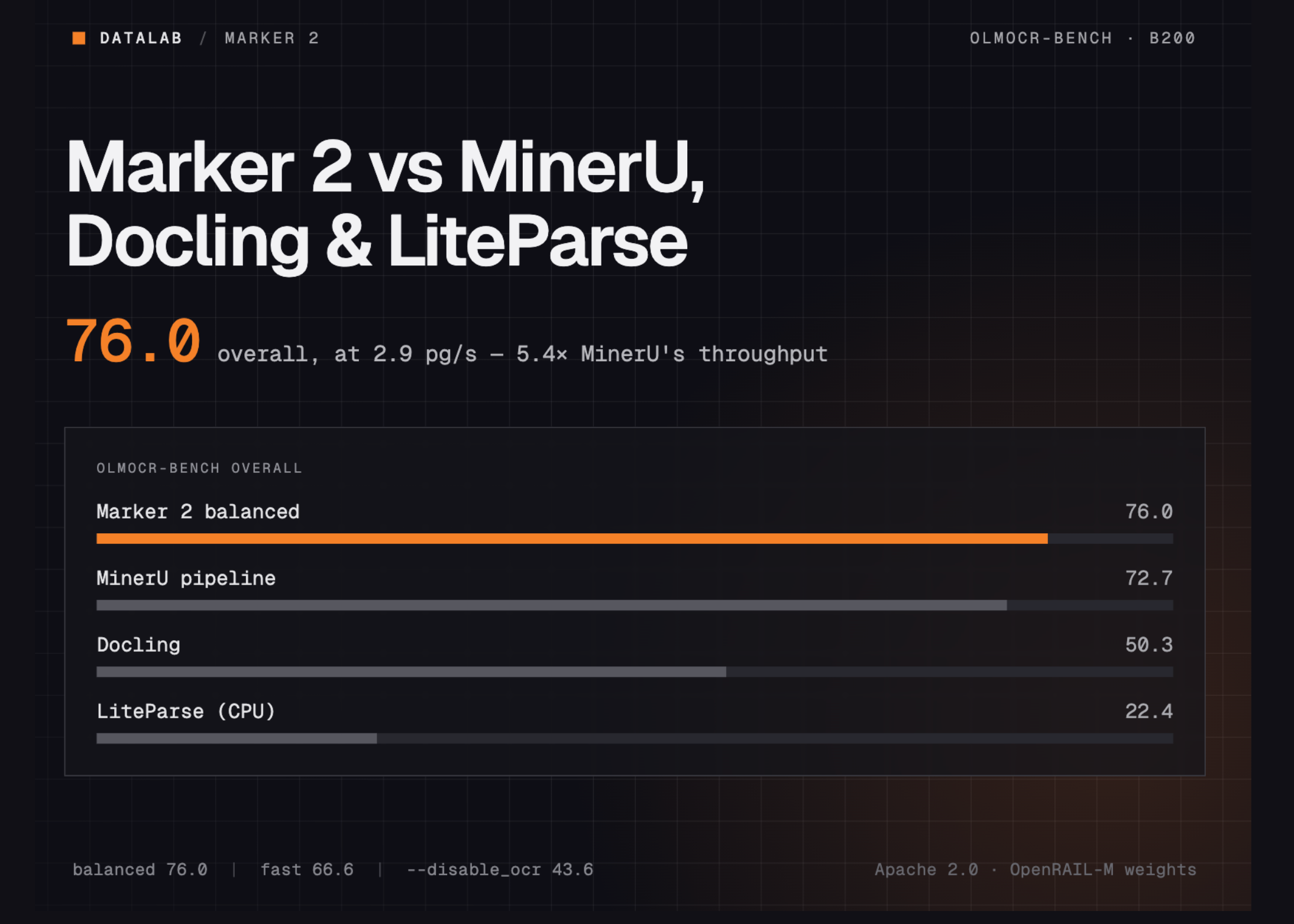
– **Benchmark Results**: In the olmOCR-bench from Allen AI, Marker 2’s balanced mode achieves **76.0% overall accuracy** and **83.5% on born-digital PDFs**, processing **2.9 pages per second** on a single B200 GPU.
– **Speed Advantage**: This is **over 5× faster than MinerU’s pipeline backend** (0.54 pg/s) and significantly faster than Docling (2.1 pg/s) and LiteParse (1721 pg/s with OCR off, but much lower accuracy).
– **Three Conversion Paths**:
– **Balanced (GPU)**: Highest quality, leveraging Surya VLM for layout and OCR, ideal for complex documents.
– **Fast (CPU/GPU)**: Lightweight layout detection with minimal VLM use, offering a balance between speed and accuracy.
– **Disable OCR (CPU-only)**: Pure text extraction, no GPU or inference server required, reaching 23.7 pg/s.
—
## **Architectural Innovations**
Marker 2 introduces a device-aware default mode system:
– **Balanced mode** on GPU
– **Fast mode** on CPU/MPS
– **Override capability** via `–mode` flag
A key architectural change is the multi-worker design, where many thin CPU workers share a single Surya inference server. This enables throughput to scale with server capacity rather than per-process VRAM, achieving ~2.9 pg/s sustained on a B200, compared to ~0.3 pg/s single-stream rate.
—
## **Comparison with Competitors**
| Competitor | Accuracy (olmOCR-bench) | Throughput (pg/s) | Key Strengths |
|——————|————————|——————-|—————|
| **Marker 2 (Balanced)** | **76.0%** | **2.9** | Best overall accuracy and speed on GPU |
| **Marker 2 (Fast)** | 66.6% | 7.4 | Fast, cost-effective, minimal VLM use |
| **MinerU (Pipeline)** | 72.7% | 0.54 | Strong open-source alternative, slower |
| **Docling** | 50.3% | 2.1 | MIT license, broad format support |
| **LiteParse** | 22.4% (CPU) | 1721 (OCR off) | Ultra-fast text extraction, no layout |
– **Vs MinerU**: Marker 2 leads by **5.4× in throughput** and slightly edges in accuracy, especially on born-digital PDFs.
– **Vs Docling**: Marker 2 surpasses Docling in both **accuracy (76.0% vs 50.3%)** and **speed (2.9 vs 2.1 pg/s)**.
– **Vs LiteParse**: LiteParse trades structure for speed, making it suitable for different use cases, such as rapid text extraction in coding agents.
—
## **Per-Category Behavior**
The mode selected influences the failure profile:
– **Math**: Fast mode reads equations from text layer, dropping accuracy from 83.9% to 23.4%; `–disable_ocr` yields 0% on math.
– **Old Scans**: The weakest category across all modes, maxing out at 43.2%.
– **General Structure**: Balanced mode consistently outperforms others on layout-heavy documents.
—
## **Licensing and Deployment**
– **Marker 2**: Apache 2.0 code with modified AI Pubs OpenRAIL-M license for model weights (free for research/personal/startups under $5M; paid for larger commercial use).
– **MinerU**: Apache 2.0-based, free up to 100M MAU or $20M monthly revenue.
– **Docling**: MIT license.
– **LiteParse**: Open source with paid cloud path (LlamaParse).
—
## **Interactive Use-Case Explorer**
A dynamic decision tool helps users choose the right parser based on:
– **Constraints**: GPU available, CPU-only, licensing, or stack integration.
– **Tools**: Marker, MinerU, Docling, LiteParse, or VLM tier.
– **Scenarios**: High-volume PDFs, air-gapped environments, math-heavy documents, and more.
—
## **Key Takeaways**
– Marker 2 balanced leads with **76.0% accuracy at 2.9 pg/s**, outperforming all competitors.
– It offers **5.4× higher throughput than MinerU** and matches or exceeds Docling in both speed and accuracy.
– LiteParse excels in raw speed but lacks structural understanding.
– The `–disable_ocr` mode enables fast, CPU-only conversion with no external dependencies.
– Licensing models vary significantly—important for enterprise and commercial deployments.
—
## **FAQ**
### **What is Marker 2?**
Marker 2 is an open-source document conversion pipeline developed by Datalab. It converts PDFs, images, and office files into markdown, JSON, HTML, or chunks using a redesigned architecture with improved layout recognition and OCR capabilities.
### **How does Marker 2 compare to MinerU?**
Marker 2’s balanced mode scores 76.0% vs MinerU’s 72.7%, while running **5.4× faster** (2.9 pg/s vs 0.54 pg/s) on the same hardware.
### **What are the three modes in Marker 2?**
– **Balanced**: High accuracy using Surya VML and OCR, best for GPU.
– **Fast**: Lightweight layout detection, suitable for CPU.
– **Disable OCR**: Text-only extraction, no GPU required.
### **Is Marker 2 free to use?**
Yes, the code is Apache 2.0. Model weights are free for research and small-scale use; commercial licenses are required for larger deployments.
### **Can Marker 2 run on CPU?**
Yes, especially the `fast` and `–disable_ocr` modes, which require no GPU and no inference server.
### **What benchmark was used for testing?**
The evaluation used **olmOCR-bench** from Allen AI, covering 1,403 PDFs and 8,400 unit tests across math, tables, headers, and scanned documents.
—
## **Conclusion**
Marker 2 represents a major advancement in document parsing, combining high accuracy with impressive throughput. Its flexible modes, open-source accessibility, and strong benchmark performance make it a compelling choice for developers and enterprises needing fast, reliable document conversion. While licensing and use-case requirements vary across tools, Marker 2 sets a new standard for pipeline-based document intelligence—delivering professional-grade results without the cost or complexity of full-VLM approaches.
—
