



# Introduction
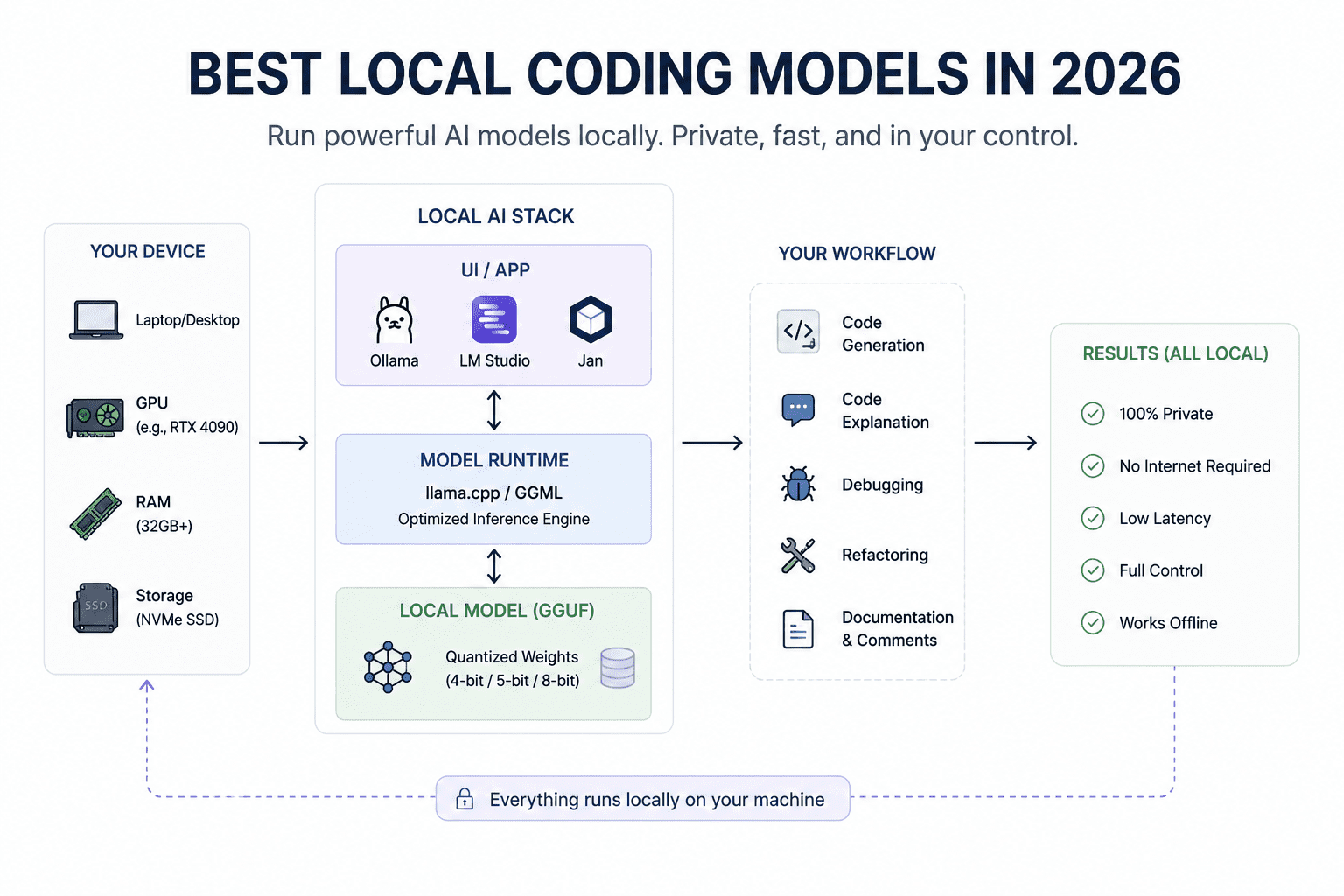
Locally-run coding models are finally maturing into practical tools. I’ve long been enthusiastic about this new generation of on-device large language models (LLMs), particularly the open-weight releases and community GGUF conversions that simplify execution on everyday hardware. We’ve reached a stage where several of these models can operate on GPUs like an RTX 3090, produce output quickly enough to feel genuinely useful, and tackle authentic coding and agentic programming challenges — not just toy examples or novelties.
If you’re aiming for a fully local coding environment and possess at least 16GB of VRAM, these models can help you reduce dependence on Claude Code, Gemini, or other cloud-hosted coding assistants. They’re fast, capable, private, and sufficiently competent for real-world development workflows.
You can already observe this transition taking shape within the local AI community. Reddit’s r/LocalLLaMA is brimming with developers running on-device coding agents, benchmarking GGUF models, spinning up OpenAI-compatible local servers, and wiring these models into their editors, terminals, and coding tools.
# 1. Qwen3.6 27B MTP
Qwen3.6 27B MTP is easily among my top picks for local coding models at the moment. I’ve put it through its paces across various configurations, and it strikes an ideal balance between footprint, inference speed, and genuine coding proficiency.
The standout advantage is that, thanks to GGUF-quantized variants, you can run it on consumer-grade hardware rather than provisioning a full cloud instance. Even with a GPU in the 16GB to 24GB VRAM range, the 4-bit editions make local deployment entirely feasible.
Reddit’s r/LocalLLaMA community is already buzzing with users experimenting with Qwen3.6 27B MTP for on-device agentic coding, accelerated inference, llama.cpp configurations, and OpenAI-compatible local servers. And frankly, the excitement is well-founded.
Qwen models have consistently excelled at coding thanks to their blend of reasoning, instruction adherence, multilingual comprehension, tool usage, and extended-context support. That combination makes Qwen3.6 27B MTP a versatile local workhorse for coding assistants, repository chat, debugging, shell commands, and agentic workflows.
# 2. Gemma 4 31B IT QAT
Gemma 4 31B IT QAT is another contender that I believe warrants a prominent spot in any local coding toolkit. Google’s open Gemma lineup has consistently appealed to those who want capable models running on their own machines, and this quantization-aware trained (QAT) GGUF release makes it even more accessible.
You get a substantial 31B-parameter model compressed into a 4-bit quantized format that loads far more easily on consumer hardware while retaining impressive quality. This isn’t mere speculation either — I’ve written about Gemma models, applied them across different workflows, and found them remarkably comparable to the Qwen family in terms of local coding and reasoning performance.
The primary reason Gemma 4 31B stands apart is that it isn’t solely a coding model. It’s also multimodal, meaning it can assist with screenshots, UI bugs, diagrams, documentation images, and web application layouts while remaining effective for code generation, debugging, and planning.
The official benchmark results further underscore its credibility, with strong coding scores on LiveCodeBench and Codeforces. If you’re after a local model that handles coding alongside visual development tasks, Gemma 4 31B IT QAT ranks among the best options available.
# 3. DiffusionGemma 26B A4B
DiffusionGemma 26B A4B is one of the freshest and most intriguing entries on this list. It’s powerful, unconventional, and architected differently from traditional token-by-token language models.
Rather than generating text in the usual autoregressive fashion, it employs a block-diffusion strategy, which is engineered to boost generation speed by denoising groups of tokens simultaneously in parallel.
That’s precisely what makes this model exciting for local coding: it represents the sort of architectural innovation that could dramatically accelerate on-device assistants, particularly for code generation, structured outputs, and rapid reasoning tasks.
The headline appeal is efficiency. DiffusionGemma houses roughly 25B total parameters yet only about 3.8B are active at any given time, so you reap the advantages of a larger Mixture of Experts (MoE)-style model without shouldering the full inference expense of a dense 26B model.
# 4. Nemotron Cascade 2 30B A3B
Nemotron Cascade 2 30B A3B is another entry that may look unusual on paper yet proves highly sensible for local coding.
It’s a 30B MoE-style model, but only around 3B parameters activate during inference. So you aren’t absorbing the full cost of a dense 30B model with every forward pass. That’s precisely the kind of design I favor for local setups: substantial enough to reason effectively, yet lean enough to actually run and experiment with on your own hardware.
What makes this model particularly compelling is that it behaves more like a reasoning engine than a mere code-completion tool. NVIDIA highlights its strength in reasoning and agentic tasks, offering both thinking and instruct modes, and even cites gold-medal-caliber performance on the International Mathematical Olympiad (IMO) 2025 and the International Olympiad in Informatics (IOI) 2025.
For developers, that distinction matters because coding today extends far beyond authoring functions. You need a model that can debug, strategize, review code, decompose multi-step problems, and reason through implementation specifics.
# 5. Qwen3.5 9B MTP
Qwen3.5 9B MTP is the most compact model on this list, but don’t dismiss it prematurely.
Within its weight class, it scores impressively and delivers a genuinely modern Qwen-style coding assistant without demanding a beefy workstation. If you’re working with a more modest local setup, this model is a treasure. It’s fast, pragmatic, and significantly easier to run than the 27B or 31B alternatives.
The GGUF variant is what makes it especially practical for everyday developers. You don’t need an elaborate configuration or a pricey cloud instance just to evaluate it. You can run it locally, hook it into your editor or terminal workflow, and use it as a private coding companion.
It won’t outperform the larger models on intricate reasoning, but for routine coding duties it’s more than adequate. It’s well-suited for small scripts, debugging, code explanations, shell commands, and quick local assistant workflows. For those just beginning with local coding models, Qwen3.5 9B MTP is likely one of the safest and most pragmatic entry points.
# 6. EXAONE 4.5 33B
EXAONE 4.5 33B is another offering that I think developers shouldn’t overlook, particularly when your work extends beyond pure code.
It’s LG AI Research’s open-weight multimodal model, and that makes it genuinely valuable for local coding workflows where you also need to interpret screenshots, PDFs, diagrams, documentation, and UI layouts.
This is where EXAONE becomes compelling. A great deal of modern coding work isn’t simply writing Python functions. You’re reading documentation, diagnosing errors from screenshots, parsing architecture diagrams, and navigating messy project files. A model that processes both text and visual input becomes considerably more useful.
If you’re seeking a local model for code alongside documents, screenshots, and enterprise-style workflows, EXAONE 4.5 33B is a strong candidate to evaluate.
# 7. North Mini Code 1.0
North Mini Code 1.0 is among the latest additions to this roster, and it shows real promise.
Cohere is now stepping into the on-device coding model arena in a serious way.
This isn’t just a general-purpose chatbot that can also generate code. It’s purpose-built for programming tasks, autonomous software development, and command-line operations. That makes it far more appealing to developers looking for a local model to handle repository modifications, terminal assistance, code reviews, and coding-agent pipelines.
It’s also a 30B-A3B model, meaning it contains 30 billion total parameters but only roughly 3 billion are active during any given inference pass. So once again, you get a nice middle ground: sharper reasoning than lightweight models, yet more resource-efficient than a full dense 30B model.
It may not be as versatile as Qwen3.6 27B or Gemma 4 31B, but when it comes to coding-specific tasks, North Mini Code 1.0 looks like a very worthwhile model to experiment with.
# Wrapping Up
This table offers a quick reference for choosing the right on-device coding model based on your hardware setup, workflow preferences, and programming needs.
| Model | Size / Type | Best Use Case | Why Pick It |
|---|---|---|---|
| Qwen3.6 27B MTP | 27B MTP | Strong local coding, reasoning, and agentic workflows | Best all-around on-device coding model |
| Gemma 4 31B IT QAT | 31B, 4-bit QAT, multimodal | Coding alongside screenshots, UI bugs, diagrams, and long-context tasks | Impressive coding benchmarks with multimodal capabilities |
| DiffusionGemma 26B A4B | 26B / ~4B active | Fast, experimental on-device coding and reasoning | Novel architecture designed for efficient generation |
| Nemotron Cascade 2 30B A3B | 30B / ~3B active | Agentic coding, debugging, planning, and reasoning-intensive tasks | Behaves more like a reasoning agent than a simple autocomplete |
| Qwen3.5 9B MTP | 9B MTP | Modest local machines and everyday coding assistance | Quick, practical, and excellent for its size class |
| EXAONE 4.5 33B | 33B multimodal | Code, documents, screenshots, PDFs, and diagrams | Ideal for document-heavy and visual coding workflows |
| North Mini Code 1.0 | 30B / ~3B active coding model | On-device coding agents, repo edits, terminal tasks, and code review | The most coding-dedicated model on this list |
On-device coding models have reached a point where they’re genuinely usable for real development work, not just experimentation or demos. If you own a capable GPU like an RTX 3090 or 4090, my straightforward recommendation is to start with Qwen3.6 27B MTP in 4-bit. It’s the strongest all-around choice for local coding, reasoning, and agentic workflows. Honestly, give that one a try before spending time bouncing between too many different models.
If you’re after the fastest on-device generation on comparable hardware, then DiffusionGemma 26B A4B is the one to keep your eye on. It’s newer and more experimental, but the architecture makes it genuinely compelling for developers who prioritize speed and efficient inference.
If you need multimodal understanding, stronger reasoning, and the ability to work with code alongside screenshots, UI layouts, diagrams, and documentation, then Gemma 4 31B IT QAT is an excellent pick. It’s more than just a coding model, which makes it valuable for modern development workflows.
And if you don’t have a high-end GPU, Qwen3.5 9B MTP is likely the top model in its weight class. Even with a simpler local setup and sufficient system RAM, it can still serve effectively as a daily coding assistant for explanations, debugging, scripts, shell commands, and general workflow support.
The remaining models are also worth exploring, depending on your specific priorities.
Nemotron Cascade 2 30B A3B is excellent if you’re after a local reasoning model for agentic coding, planning, debugging, and structured problem solving.
EXAONE 4.5 33B is a strong fit if your work revolves around documents, PDFs, screenshots, and enterprise-oriented coding workflows.
North Mini Code 1.0 is the most coding-focused option on the list, and it shows real promise for on-device coding agents, repo edits, terminal tasks, and code review. They may not be my top recommendation for everyone, but each one serves a clear and distinct purpose.
Abid Ali Awan (@1abidaliawan) is a certified data scientist professional who loves building machine learning models. Currently, he is focusing on content creation and writing technical blogs on machine learning and data science technologies. Abid holds a Master’s degree in technology management and a bachelor’s degree in telecommunication engineering. His vision is to build an AI product using a graph neural network for students struggling with mental illness.
