



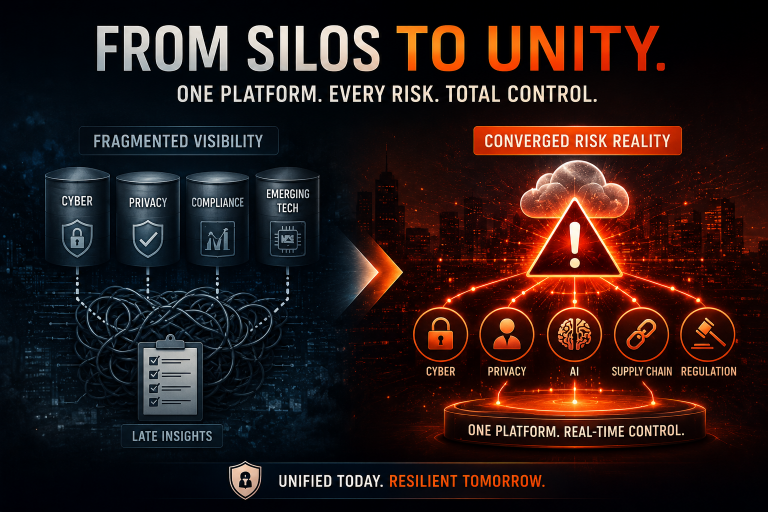
Risk has already merged—yet governance remains fragmented, and that disconnect is where disasters take root
Disclaimer: The perspectives and viewpoints presented in this article belong exclusively to the author and do not necessarily align with the positions of his employer or any associated organizations.
Contained risk is a thing of the past—today’s threats merge and cascade. Failures in identity, cloud, data, and AI don’t happen in isolation, but governance frameworks still treat them as though they do.
Over the last year and a half, a recurring trend has surfaced across high-profile security events—one that most organizations still haven’t built governance around. What starts as a single breach point—frequently rooted in identity compromise—quickly ripples across cloud infrastructures, sensitive data repositories, AI-powered workflows, partner ecosystems, and regulatory commitments. Today’s incidents don’t follow a linear path. They cascade through interconnected systems in fractions of a second—at what might be called “machine speed.”
This isn’t purely a cybersecurity challenge. Nor is it exclusively a privacy, AI, compliance, supply chain, resilience, or quantum computing concern.
It exemplifies what I refer to as Converged Digital Risk.
Converged Digital Risk arises when multiple risk categories overlap within a single business process, technology platform, operational dependency, or organizational event—producing outcomes that can no longer be adequately managed through conventional departmental silos. A single compromised identity can set off simultaneous data breaches, AI integrity failures, regulatory reporting duties, supply chain interruptions, operational outages, and reputational harm. A coming quantum computing advance could suddenly render previously secure encrypted information a lasting vulnerability. What were once perceived as independent risks now function as an interconnected web.
These risks have already fused together. Most governance frameworks, however, haven’t caught up.
Organizations continue to treat cyber risk, privacy risk, AI risk, third-party risk, compliance risk, and emerging technology risk as distinct disciplines—largely because that’s how internal departments are structured. The business itself, however, encounters these risks very differently. It faces them as an interconnected system. That mismatch is rapidly evolving into one of the most critical governance shortcomings of the digital era.
The fallout is no longer hypothetical.
Today, a single identity breach can leak corrupt AI-driven decisions, invite regulatory scrutiny, halt supply chain operations, erode customer confidence, and generate cascading business disruption. The organization is no longer handling a security event—it is juggling multiple crises erupting simultaneously across different teams, stakeholder groups, and timelines.
For the CISO, the mandate stretches well beyond containing threats. Security leaders increasingly find themselves contending with legal liability, operational breakdowns, privacy ramifications, AI reliability issues, third-party vulnerabilities, and brand damage—often without any consolidated understanding of how these impacts compound one another. Worse still, while bearing responsibility and accountability, they frequently lack the organizational authority to implement changes capable of addressing these converged digital risks.
For boards of directors, the nature of inquiry is shifting too. Directors are no longer simply asking whether an incident took place. They are asking why it wasn’t foreseen, whether the organization truly understood its dependencies, and who ultimately bears accountability for the full scope of business consequences.
Those questions lay bare an uncomfortable truth:
We are NOT dealing with a cybersecurity problem—we are dealing with a governance deficit.
The Framework Failed. Nobody Realized.
For decades, corporate governance rested on a straightforward premise: risks could be sorted into categories, delegated to specific departments, evaluated independently, and contained within organizational boundaries.
Cybersecurity fell under security teams. Privacy was the domain of legal and compliance units. Supply chain risk sat with procurement. Operational resilience was someone else’s responsibility. Emerging technologies were typically siloed within innovation groups. This framework functioned because business systems were relatively self-contained, dependencies were transparent, and the pace of change was manageable.
That landscape is gone.
The Verizon Data Breach Investigations Report consistently highlights how central identity and human behavior are to breaches. Proofpoint’s findings confirm that attackers keep targeting individuals because identity remains one of the most reliable gateways into enterprise environments. IBM’s Cost of a Data Breach research persistently demonstrates that complexity amplifies both impact and recovery expenses—especially when incidents span cloud, on-premises, and third-party settings.
If current governance models were truly keeping up with modern risk, we would be seeing swifter detection, crisper accountability, deeper visibility across interconnected environments, and diminished impact from multi-domain incidents. Instead, the opposite is happening.
Threat actors outpace organizational response capabilities. Visibility stays fractured across disparate systems. Accountability blurs when incidents cross departmental lines. Recovery costs keep climbing as complexity deepens.
These aren’t merely operational hiccups. They are indicators of a structural breakdown.
Risk has converged. Governance hasn’t.
Boards are trying to manage 2026-era risk using a 2016 playbook. The problem isn’t simply that organizations are lagging behind—it’s that many governance architectures no longer reflect the reality of how contemporary risk operates.
Where Governance Falls Apart

Legacy governance was designed for isolated risks and periodic reporting. Converged risk calls for unified visibility, real-time intelligence, and integrated controls.
The breakdown becomes apparent whenever organizations attempt to govern interconnected systems through disconnected structures.
Identity systems are frequently managed in isolation from data classification strategies—assuming Data Security Posture Management (DSPM) even exists—resulting in scenarios where organizations know who holds access but have no clarity on what that access actually permits. Cloud environments offer extraordinary scale and agility, yet often function with visibility that is disconnected from DSPM, business criticality, and third-party dependencies.
AI introduces a completely new layer of governance complexity. The rise of agentic AI further intensifies this challenge. Unlike conventional AI systems that mainly produce content or suggestions, agentic systems are growing increasingly capable of launching actions, engaging with external
services, making decisions within defined
parameters, and coordinating intricate workflows with minimal human oversight.
As companies roll out AI agents across customer support, software development, procurement, security operations, and business processes, they are bringing a new type of actor into the enterprise: one that is neither entirely human nor fully system-based. These agents can retrieve data, initiate actions, engage with external parties, and shape business results at machine speed.
The governance challenge is no longer confined to managing human access and system behavior. It now extends to overseeing autonomous and semi-autonomous digital actors operating across the enterprise.
Most organizations are still preoccupied with whether AI agents and systems are being adopted quickly enough and are delivering cost savings. A more pressing question is taking shape:
What happens when the model vanishes?
As organizations weave foundation models into customer support, software development, legal review, security operations, fraud detection, analytics, software engineering, and decision-making workflows, AI is transitioning from an experimental tool into essential business infrastructure.
Recent incidents involving advanced foundation models (not to mention frontier models) revealed how rapidly access can shift due to government action, export restrictions, safety issues, provider choices, contractual conflicts, or regulatory measures. Beyond any single provider’s situation, the takeaway is far broader.
Organizations are building operational dependencies on digital capabilities they neither own nor control.
This may represent the most profound governance shift of the coming decade.
Historically, organizations owned most of the critical technology needed to function. Today, increasingly vital capabilities sit outside organizational boundaries. AI models, cloud services, identity platforms, SaaS ecosystems, and digital supply chains are becoming deeply woven into business operations despite being owned, managed, and governed by others.
The future governance challenge is not simply safeguarding what you own. It is grasping the risks tied to what you rely upon. For years, organizations questioned whether AI could be trusted. Increasingly, they must also consider whether AI will remain available.
If a critical model becomes restricted, unavailable, degraded, retired, or substantially altered, who understands which business processes rely on it? Who vets replacement models? Who evaluates the privacy, security, operational, and regulatory consequences of switching providers? Who owns continuity planning for AI-driven operations?
In many organizations, there is no clear answer. That is not an AI problem. It is a governance problem.
The Visibility Gap Is the Real Breach
Most organizations do face a control problem (or lack one), but they genuinely face a visibility problem.
Not a shortage of dashboards, reports, or metrics, but a lack of unified understanding across identities, data, cloud environments, AI systems, third-party dependencies, and business-critical digital services.
Zscaler’s ThreatLabz research underscores the ongoing growth of encrypted traffic, SaaS adoption, and cloud workloads. Varonis research consistently reveals how widely accessible sensitive information remains within many enterprises. CrowdStrike’s reporting continues to expose attacker breakout times measured in minutes rather than days.
The outcome is a widening gulf between how swiftly risk materializes and how quickly organizations can comprehend it. Visibility that arrives after the decision window has closed is not visibility. It is post-mortem forensics.
The organizations that successfully govern Converged Digital Risk will not necessarily be those with the most tools. They will be the ones capable of converting visibility into decisive action before failures cascade and consequences compound across interconnected systems.
The Missing Executive: The Digital Risk Officer
Technology alone will not resolve a structural governance challenge. The rise of agentic AI will render this challenge even more acute. As organizations increasingly assign tasks, decisions, and workflows to autonomous digital agents that act at machine speed, accountability models built around human actors will grow increasingly difficult to sustain.
Today’s accountability models remain fragmented across cybersecurity, privacy, compliance, legal, procurement, AI governance (if it even exists), operational resilience, and enterprise risk functions. Each domain manages its own perspective. Few leaders own the full picture.
This is why I believe a new executive function will emerge over the next decade.
Just as the rise of cybersecurity gave birth to the Chief Information Security Officer, the convergence of digital risk will create a leadership role focused on governing the intersections between cyber, AI, privacy, data, resilience, third-party digital dependency, and emerging technologies.
I call that role the Digital Risk Officer.
Unlike traditional roles, the Digital Risk Officer would not own a single risk category. Instead, this executive would be responsible for understanding how digital risks interact across the enterprise and ensuring that accountability, visibility, resilience, and decision-making align with that reality.
Reporting to the Board or CEO, the role would concentrate on enterprise-wide prioritization, integrated visibility, dependency management, resilience planning, and cross-functional accountability. Most critically, it would provide decision authority when competing risk signals collide.
Because when a single event simultaneously affects identity, data, AI, compliance, third-party dependencies, and business operations, someone must own the outcome rather than merely a portion of the problem.
You cannot effectively manage Converged Digital Risk through divided ownership.
The Future of Governance
The next generation of governance will look fundamentally different from the models most organizations depend on today.
It will operate continuously rather than periodically. It will govern systems rather than categories. It will treat AI dependency as a resilience issue. It will account for quantum risk before quantum becomes operationally disruptive. It will unify visibility across identities, data, cloud environments, AI systems, third-party ecosystems, and business operations.
And it will align accountability to how risk actually behaves rather than how organizations happen to be structured.
The organizations that make this transition will be positioned to manage the complexity of the next decade. Those that do not will continue to detect too late, decide too slowly, and endure adverse impacts they never fully understood.
Final Thought
If you serve on a board, lead a business function, or oversee enterprise risk, start by asking a simple question:
Can we see, in real time, how identity, data, AI in all its forms, quantum exposure, supply chain/third-party dependencies, and business operations interact across our enterprise—and who is accountable when they fail together?
If the answer is no, governance is not operating at the level modern risk demands.
This is no longer a tooling discussion, but rather an operating model decision.
What Else Organizations Should Do Now
The challenge of Converged Digital Risk will not be solved through another policy, committee, or technology purchase. It requires a shift in how organizations understand dependencies, accountability, and visibility.
Leaders should begin by asking five questions:
1. Can we identify
What are our most vital digital dependencies? Not merely the systems we directly control, but also the AI agents and models, cloud services, SaaS vendors, identity platforms, and external partners that our business operations depend on.
2. Do we know where our risks converge? Identify the junctures where cybersecurity, data privacy, AI, operational, regulatory, and third-party risks overlap within your most essential business workflows.
3. Can we monitor those dependencies as they change in real time? Insights that take days to surface are useless for governance choices that must be made in moments.
4. Is accountability tied to business outcomes? When a single event cuts across several risk categories, who bears responsibility for the total business impact—rather than just one slice of the problem?
5. Would we still function if a key digital dependency vanished overnight? This applies just as much to AI models, cloud providers, and identity platforms as to any other externally managed capability.
The answers to these questions can form the foundation of your strategic roadmap.
The organizations that succeed over the coming decade won’t be those that manage cyber risk, AI risk, privacy risk, compliance risk, or third-party risk in isolation. They’ll be the ones that figure out how to govern the interconnected system those risks have evolved into. The next chapter of enterprise risk management won’t be shaped by who holds the most controls, the most dashboards, or the most policies.
Thriving organizations will be distinguished by their ability to cut through the noise, pinpoint what truly matters, and take action before repercussions ripple outward.
Clarity is control.
Speed is governance.
And resilience—not mere compliance—will emerge as the true benchmark of trust.
About the Author
 Jon Murphy, CISO of American Campus Communities, is an accomplished, award-winning leader in enterprise risk and resiliency with roots in Big 4 consulting. He serves as a trusted advisor to corporate boards and executive leadership. His areas of expertise span AI governance, quantum readiness, cybersecurity, regulatory compliance, enterprise risk management, privacy, and organizational resiliency. A respected technology professional, speaker, and writer, Jon has been profiled in CSO Online, CIOReview, CIO, Enterprise Security Magazine, CXO Dispatch, and Bloomberg BusinessWeek, among other publications.
Jon can be reached online at: Linkedin.com/in/jonemurphy
