



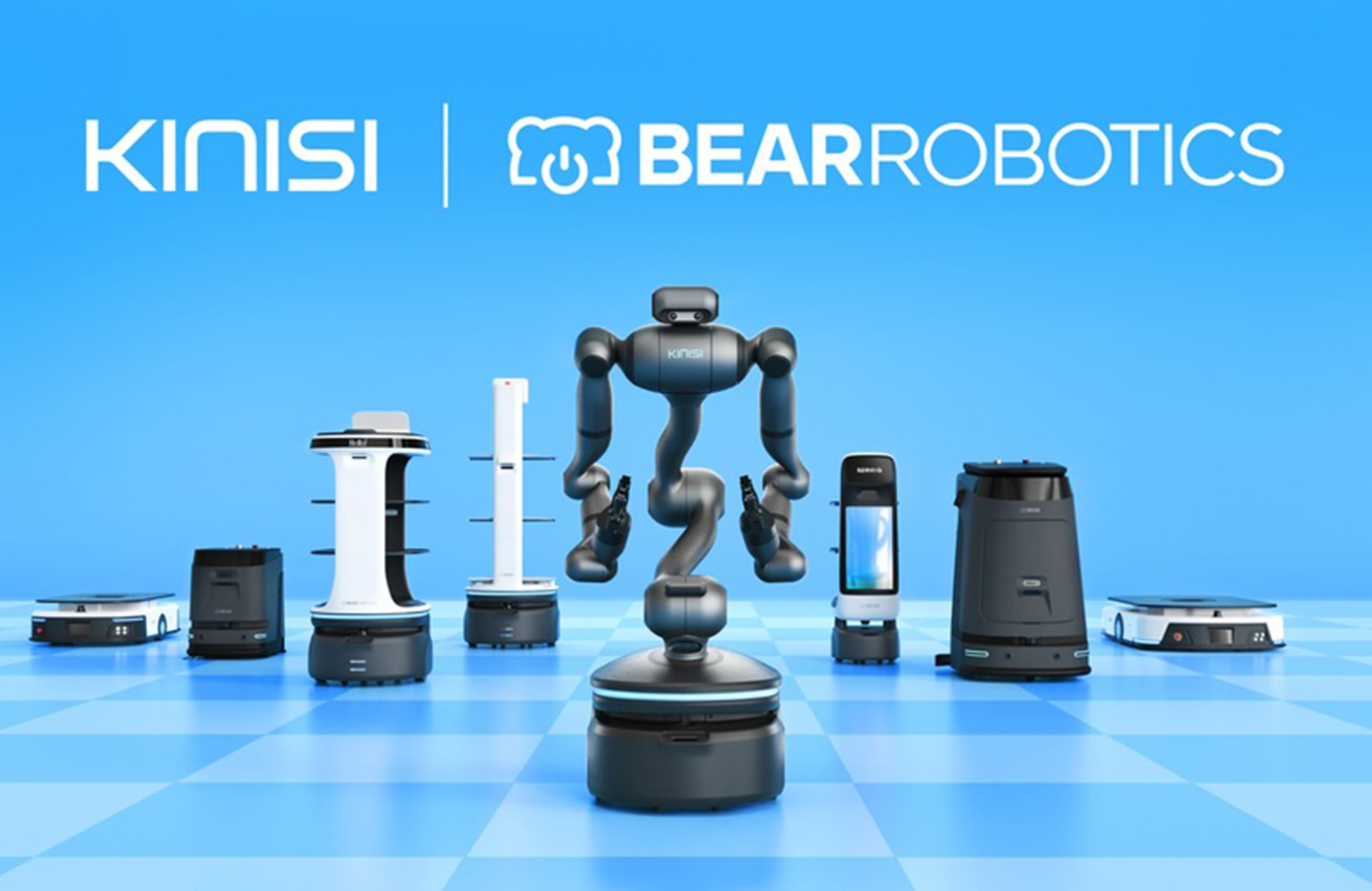
Kinisi Robotics’ KR1 will become part of Bear Robotics’ lineup of service robots. | Source: Bear Robotics
Bear Robotics has officially signed a definitive agreement to acquire Kinisi Robotics. Once the deal closes, Kinisi will become a part of Bear.
Upon completion of the transaction, Kinisi’s KR1 humanoid robot, its engineering team based in Bristol, and its physical AI expertise will be folded into Bear Robotics, finalizing Bear’s end-to-end physical AI robotics platform. The companies anticipate finalizing the deal within the next few days.
“Bear was created to deploy robots in real-world environments, and we’ve spent years developing the infrastructure to make it happen: thousands of robots in the field, a unified cloud orchestration system, genuine enterprise clients, and a manufacturing supply chain supporting them all. Kinisi rounds out that platform,” said John Ha, founder and CEO of Bear Robotics. “Its manipulation AI is the critical component that enables our robots to go beyond navigation and delivery to actually performing the tasks in front of them. While most companies are still working to move from pilot programs to finished products, we’re scaling from an already-deployed commercial fleet into comprehensive Physical AI automation. I want to thank the Kinisi team for developing the KR1, our customers and partners for their ongoing confidence in us, and our employees and investors for supporting this next phase. This marks the beginning of a much larger chapter for Bear.”
Why is Kinisi joining Bear?
From its inception, Kinisi has been developing on top of Bear’s production navigation stack — the same technology that drives Bear’s commercial fleet. This close technical partnership gave Bear an exceptionally clear perspective on the caliber of Kinisi’s engineering, the readiness of its KR1 manipulation platform, and the depth of its physical AI research.
This relationship also demonstrates why combining the two companies makes strategic sense, according to Bear. This isn’t a case of attaching a robotic arm to someone else’s hardware. Bear’s delivery robots, floor-cleaning units, and — with Kinisi — humanoid robots all operate on a single unified platform and function as one synchronized team, rather than a collection of disconnected products from multiple suppliers.
The two companies also strengthen each other: Bear’s fleet generates a continuous flow of real-world data from thousands of locations, while Kinisi’s hands-on data-capture tools add manipulation training examples affordably and efficiently. Together, the companies can train Kinisi’s AI models more rapidly than either could independently. In a single move, Bear gains the manipulation technology and research team that would have taken years to build from scratch, the company stated.
The acquisition also brings Brennand Pierce, a co-founder of Bear, back into the fold. Bear said it looks forward to welcoming Pierce and the team he has built back into the organization once the deal is finalized.
Bear has delivered over 16,000 robots globally
Since being founded in 2017, Bear has delivered more than 16,000 service robots into commercial operations around the world. Bear’s robots already function as a unified, coordinated team through agentic multi-robot orchestration, navigating freely through busy, dynamic environments rather than following predetermined paths or routes.
Most robotics companies are still struggling to transition from pilot to product; Bear has already crossed that threshold, with the robots, customers, manufacturing capabilities, and real-world data all in place. The company said Kinisi provides the missing piece — an AI that enables robots to manipulate objects. This means the same fleet can expand beyond transporting and cleaning to picking, sorting, and handling physical tasks.
Through the acquisition, Kinisi brings several key assets to Bear, including:
- The KR1 humanoid robot, a wheeled humanoid platform engineered for picking, placing, sorting, and transporting objects across industrial, logistics, and hospitality settings.
- Kinisi’s proprietary manipulation models, including a vision-language-action (VLA) model and a robot foundation model (RFM). Kinisi developed these on a modern AI infrastructure stack covering imitation learning, reinforcement learning, agentic task control, and computer vision for object detection, localization, segmentation, tracking, and classification.
- Kinisi’s in-house gripper and end-effector designs, along with a low-cost, robot-agnostic glove that captures manipulation demonstrations by hand. This approach allows the company to separate training-data collection from robot operation and scale the volume of demonstrations the models learn from.
- Kinisi’s European engineering center in Bristol, which extends Bear’s presence into the United Kingdom alongside its existing Bay Area operations.
What does this mean for Kinisi’s partners and customers?
Until the deal closes, Bear Robotics and Kinisi Robotics will continue to operate as independent, separate companies. All existing customer relationships, pilot programs, evaluations, and points of contact on both sides will remain unchanged during the interim period.
Once the acquisition is finalized, the range of tasks Bear’s robots can perform will expand significantly, all on the same platform that Bear customers already depend on. Kinisi customers’ points of contact and ongoing pilot programs will continue seamlessly under Bear, backed by Bear’s operational scale across every deployment — including production manufacturing, fleet management, deployment services, and customer support.
“Signing this agreement is the right next step for Kinisi and for the KR1. We built Kinisi on Bear’s navigation stack from the very beginning because we believed it was the strongest foundation in the industry. What Bear has that no other company can match is a real physical AI platform already operating at commercial scale — deployed robots, enterprise customers, manufacturing, and cloud orchestration,” said Brennand Pierce, founder and CEO of Kinisi Robotics. “Manipulation is the missing layer, and that’s exactly what Kinisi delivers. Together, we’re not developing a single humanoid in isolation; we’re completing an integrated, multi-robot automation platform. I’m excited about what we’re going to build.”
The Bristol office will remain a strategic engineering hub for Bear. Upon closing, Pierce will join Bear’s leadership team as Chief Robotics Officer, continuing to lead the Kinisi engineering organization with the KR1 platform under his direction.
 Submit your session idea for the 2026 RoboBusiness