



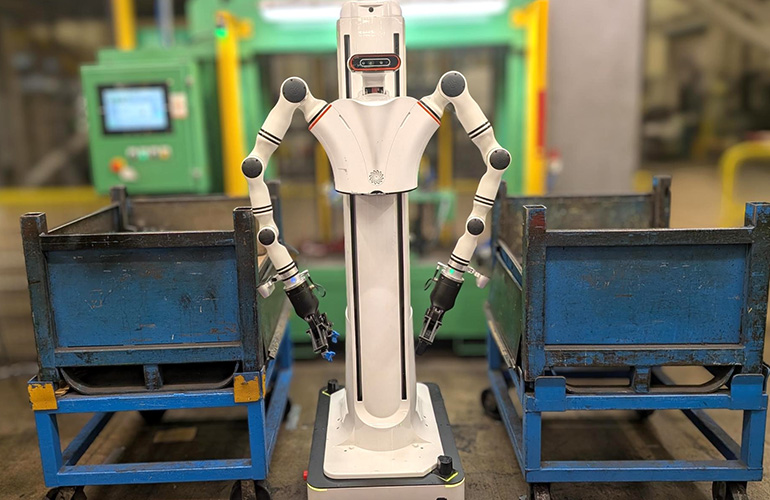
Autonomique’s AI platform and mobile manipulator are making the leap from research labs to factory floors. Source: Autonomique
Manufacturers today are grappling with a perfect storm: chronic labor shortages, escalating operational costs, and increasingly complex production requirements. Traditional automation systems, however, were designed around rigid, predictable workflows and often fall short when conditions shift, according to Autonomique Inc. The company announced today that its physical AI platform—specifically engineered to tackle these very obstacles—is advancing toward full-scale production deployment at F&P Manufacturing Inc., a Tier 1 supplier to the automotive industry.
“The robotics space is buzzing with enthusiasm right now, but much of what we see still amounts to polished demonstrations—systems that perform well in controlled settings yet consistently buckle under the pressures of actual production,” said Vikrant Tomar, co-founder and CEO of Autonomique. “Manufacturing environments demand tight precision, consistent repeatability, and absolutely no room for fragile systems. That’s the gap Autonomique was built to fill. Our intelligence layer delivers true adaptability to industrial robots while preserving the rock-solid reliability that manufacturers require.”
Tomar holds a Ph.D. in AI and previously founded and served as CTO of Fluent.ai. Spun out of SRI International in 2024, Autonomique has developed software that works independently of any specific hardware, giving industrial robots human-like dexterity and reasoning capabilities.
“Among the technologies we’ve licensed from SRI is a teleoperation system that was already deployed by the U.S. Army for bomb disposal operations, as well as adopted by pharmaceutical companies operating in cleanroom environments,” Tomar explained to The Robot Report. “The goal is seamless integration with any robotic form factor—collecting control data and using it to train AI models. The second key piece is a broader foundational engine for spatial understanding and reasoning, enabling robots to comprehend and think about the world around them.”
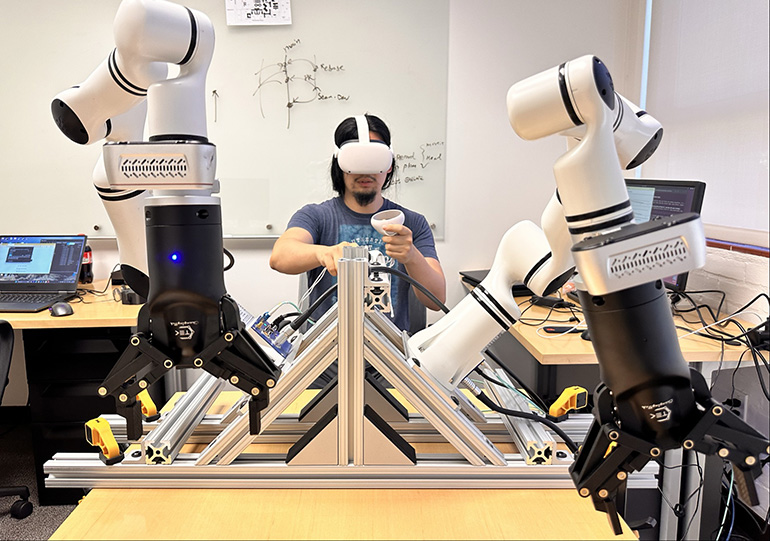
Autonomique leverages teleoperation technology rooted in SRI research. Source: Autonomique
Autonomique engineers AI for factory-floor adaptability
Autonomique’s team brings extensive expertise spanning robotics engineering, artificial intelligence, and product development. Headquartered in Menlo Park, California, the company describes its autonomy platform as following a “generalist-specialist” architecture—one that allows industrial robots to perceive their surroundings, reason through decisions, and carry out multi-step workflows, all while adjusting to new tasks on the fly without requiring extensive retraining.
“Rather than relying on a single, monolithic vision-language-action (VLA) model, we’ve designed a framework where the generalist AI can select a deterministic skill best suited for a given task,” Tomar explained. “For a precision insertion task, for instance, online reinforcement learning is the ideal approach. But when unexpected failures or edge cases arise, it might be better to draw on more flexible, modern VLA models. Our AI makes that judgment call in real time and picks the right skill for the situation.”
According to Autonomique, this approach delivers human-like adaptability while still meeting the strict cycle time, reliability, precision, and scrap-reduction benchmarks that real-world production environments demand.
Because the platform is hardware-agnostic, every deployment generates a reusable blueprint that can be scaled to additional tasks, production lines, and facilities. Autonomique claims that training on real-world data allows for rapid and cost-effective automation across automotive, electronics, and aerospace manufacturing sectors.
“Our framework doesn’t impose constraints on the type of end-effectors you use,” Tomar noted. “Some organizations invest heavily in robotic hands, but there are plenty of scenarios where you need the versatility to switch between different tools—or where a simple magnetic gripper is far better suited for picking up flat metal components than fingered grippers would be.”
The company is already integrating its platform with robotic arms from Denso, Staubli, and RealMan Robotics, and is forging partnerships with Holiday Robotics, Rainbow Robotics, and several North American firms. Conversations are also underway with humanoid robot developers, though Tomar noted that those platforms aren’t yet mature enough for commercial deployment.
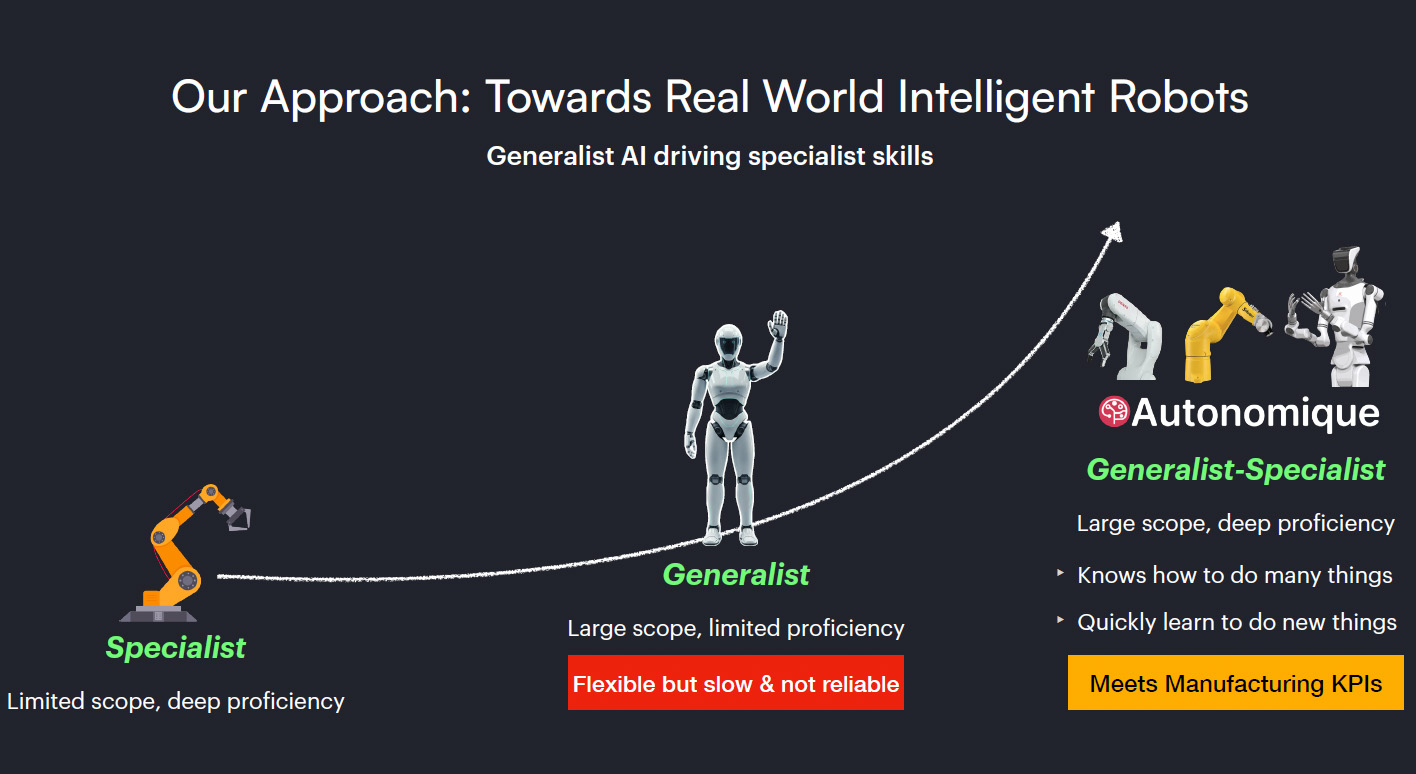
Autonomique employs a ‘generalist-specialist’ strategy for physical AI in manufacturing. Source: Autonomique
F&P transitions from pilot phase to worldwide deployment
Based in Tottenham, Canada, F&P Mfg. specializes in chassis and suspension systems supplied to major automakers including Honda, Toyota, and General Motors. The company operates as a subsidiary of F.tech Inc., a publicly traded, Japan-headquartered Tier 1 automotive supplier established in 1947, with manufacturing facilities spanning North America, Asia, and Latin America.
“As a Tier 1 supplier serving the world’s top automakers, our production standards simply don’t allow for mistakes,” said Luis Mideros, general manager at F&P. “We put numerous robotics solutions to the test, and Autonomique distinguished itself by offering both the versatility of a generalist system and the exacting precision our production lines require. As we move toward full-scale production deployment, the priority is achieving measurable improvements in efficiency and productivity across an expanding set of tasks and facilities within our global operations.”
F&P’s
Partnership with Autonomique kicked off in late 2025 through a paid trial featuring a two-armed wheeled robot handling key assembly operations, accurately grabbing components from several bins. The mobile manipulator monitored the press machine and surroundings at 10 hertz and placed completed parts into bins.
“Once fully up and running, every part this robot produces will end up in a vehicle from a major OEM within just a few hours. There’s zero room for mistakes—this is a just-in-time manufacturing setup,” explained Tomar. “We’re demonstrating ROI [return on investment] in 18 months, versus the usual 24 to 36 months seen in this sector. F&P is keen to scale this to additional production lines.”
Autonomique, headquartered in Montreal, stated that both companies are advancing toward a strategic alliance where its AI and robotic systems would be deployed across various tasks and F.tech facilities.
 Submit your session idea for the 2026 RoboBusiness
Seasoned investors support flexible automation
Autonomique reported it is bringing on new clients, broadening its platform to additional production operations, and “laying the foundation to serve as the intelligence backbone for the next wave of self-running factories globally.”
The startup is backed by international investors with a track record in funding robotics, AI, and deep-tech ventures, spearheaded by White Star Capital, alongside Garage Capital, iNovia Capital, and Innovobot IRV Fund.
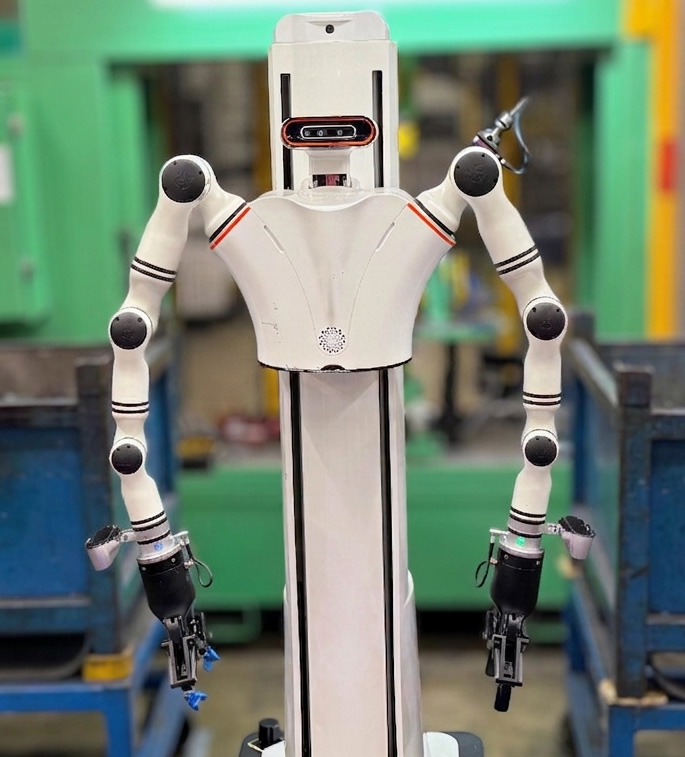
Autonomique is building robot-agnostic general-specialized AI. Source: Autonomique
“We invested in Autonomique because of its uncommon ability to blend generalist AI-driven flexibility with industrial-grade accuracy—combined with an outstanding founding team and a massive market opportunity in automotive manufacturing and beyond,” said Catherine Ouellet-Dupuis, general partner at White Star Capital. “The industrial automation sector is primed for an intelligence layer, and Autonomique is constructing it.”
Additional investors include Ryan Gariepy, Matt Rendall, and Bryan Webb, co-founders of Clearpath Robotics and OTTO Motors, both acquired by Rockwell Automation in 2023.
“Contrary to popular belief, integrating AI into real-world industrial settings involves much more than simply gathering more data and building larger models,” said Gariepy, chief technology officer of Clearpath and OTTO and vice president of robotics at Rockwell. “Autonomique’s distinctive method of merging deterministic dependability with AI-driven adaptability is exactly the kind of solution the industry needs to achieve autonomous manufacturing at scale.”
