



## Understanding Sleep Risk: A New Era in Sleep-Related Health Prediction
Recent advances in sleep science have introduced a transformative approach to understanding sleep-related health risks. By leveraging a novel foundation model for polysomnography (PSG), researchers have moved beyond traditional metrics like the apnea-hypopnea index (AHI) to uncover deeper, clinically meaningful insights. This new methodology analyzes high-dimensional physiologic embeddings derived from PSG data, stratifying patients into distinct risk groups that show strong, monotonic associations with a wide range of adverse health outcomes, including cardiovascular, neurologic, and psychiatric conditions. Unlike standard AHI categories, which have shown limited predictive value, this embedding-based approach reveals consistent and robust risk gradients that apply across diverse patient populations and independent cohorts.
### Foundation Model Development and Validation
The core of this advancement is a transformer-based foundation model designed specifically for PSG analysis. Trained on multiple simultaneous signals—including EEG, EOG, EMG, ECG, and various respiratory and oxygenation metrics—the model generates comprehensive physiologic embeddings. Unlike earlier approaches that froze pre-trained weights, this model was fine-tuned end-to-end for sleep staging, respiratory event detection, and oxygen desaturation tracking. This enables it to capture complex, multimodal patterns that reflect overall sleep physiology rather than isolated respiratory disturbances.
Model performance was validated across three key supervised tasks:
– **Sleep staging**, which achieved high accuracy (macro F1: 0.75, micro F1: 0.86),
– **Respiratory event detection**, yielding moderate performance (F1: 0.65),
– **Oxygen desaturation detection** (F1: 0.59).
While these intermediate task performances were not perfect, they were consistent with prior studies and sufficient to produce embeddings suitable for downstream clustering and outcome prediction. Importantly, modality sensitivity analyses demonstrated that the embeddings integrate information across multiple physiologic systems, not just respiratory signals.
### From Embeddings to Risk Groups
Using unsupervised clustering on these embeddings, researchers identified five stable and clinically distinct patient groups, labeled Risk Groups 1 through 5 (RG1–RG5). Rigorous validation techniques—including silhouette scores, consensus matrices, and longitudinal outcome analyses—confirmed that a five-cluster solution offered the most robust and informative stratification.
The risk groups showed a clear gradient of clinical severity:
– **RG1 and RG2** represented low-risk profiles with minimal abnormalities.
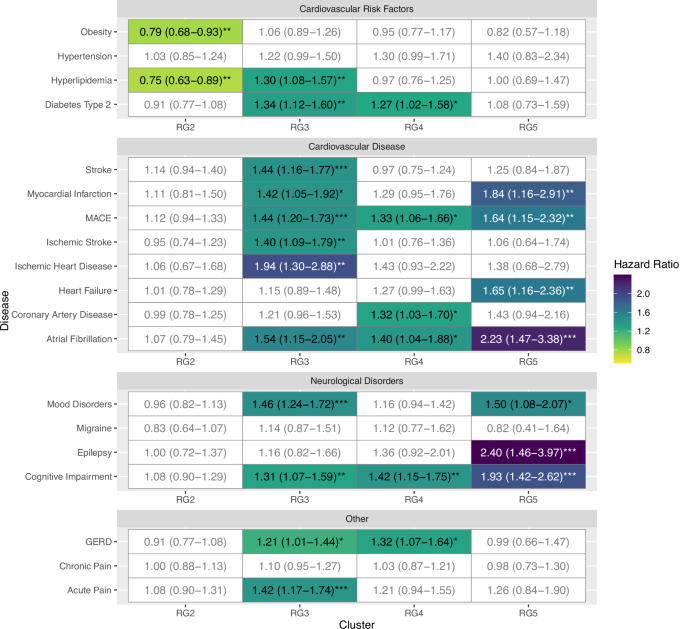
– **RG3 and RG4** reflected moderate increases in risk, associated with higher rates of type 2 diabetes, cardiovascular events, and other comorbidities.
– **RG5** was a smaller but high-risk group characterized by severe sleep disruption and significantly elevated risks of cardiovascular disease, neurological conditions, and mortality.
Longitudinal analyses across two independent cohorts—STARLIT-10K and SHHS—consistently demonstrated that higher risk groups had progressively worse survival and incident disease outcomes.
### Limitations of Traditional AHI Metrics
A major finding of this study was the limited prognostic utility of conventional AHI severity categories. Unlike the embedding-derived risk groups, AHI categories (mild, moderate, severe) showed no consistent or significant association with mortality or most clinical outcomes. Even after adjusting for AHI, the risk gradients from the five embedding-derived groups remained strong and significant. This suggests that traditional AHI thresholds fail to capture the full complexity of sleep-related physiologic disruption.
In contrast, standard PSG metrics like AHI, arousal index, and spectral sleep fragmentation were largely insufficient to reproduce the nuanced stratification achieved by the embedding-based model. While these conventional measures performed well for simple two-group distinctions, they fell short in identifying the richer, multidimensional phenotypes captured by the foundation model.
### External Validation and Broader Implications
The robustness of this approach was further validated using the independent SHHS cohort, where embedding-derived risk groups again demonstrated strong, consistent associations with all-cause mortality and incident heart failure. These findings held across different datasets, despite differences in PSG recording modalities and signal quality.
Overall, this research highlights a paradigm shift in sleep medicine—from relying on single-metric thresholds to leveraging multimodal, embedding-driven phenotyping. The foundation model not only improves risk stratification but also uncovers sleep-related physiologic subtypes that traditional methods overlook.
—
## Frequently Asked Questions (FAQ)
**What is a foundation model for sleep?**
A foundation model for sleep is a transformer-based neural network trained on raw polysomnography (PSG) time-series data. It learns to generate high-dimensional physiologic embeddings by simultaneously optimizing for sleep staging, respiratory event detection, and oxygen desaturation prediction.
**How are patients stratified into risk groups?**
Patients are stratified using unsupervised clustering (k-means) on the PSG-derived embeddings. This process identifies five stable clusters, which are then labeled as risk groups (RG1–RG5) based on their associations with clinical outcomes.
**What outcomes are associated with higher risk groups?**
Higher risk groups (particularly RG5) show significantly increased risks of cardiovascular events, neurologic conditions (such as stroke and cognitive impairment), psychiatric disorders, heart failure, and all-cause mortality. The risk increases monotonically from RG1 to RG5.
**How does this approach compare to traditional AHI categories?**
Unlike AHI categories, which show little to no predictive value, embedding-derived risk groups demonstrate strong, consistent, and monotonic associations with clinical outcomes. The embedding-based method captures multidimensional sleep physiologies that AHI alone cannot explain.
**Was the model validated externally?**
Yes, the approach was validated using the independent Sleep Heart Health Study (SHHS) cohort, where the same embedding-derived risk groups retained their prognostic power across different populations and data collection protocols.
**Can these findings change clinical practice?**
While further research and clinical integration are needed, this framework offers a promising foundation for more precise, physiology-driven risk assessment in sleep medicine, potentially guiding earlier interventions and personalized care.
—
## Conclusion
This study represents a significant advancement in sleep-related health risk prediction. By adopting a foundation model approach to PSG analysis, researchers have identified five stable, clinically meaningful risk groups that outperform traditional AHI categories in predicting cardiovascular, neurologic, psychiatric, and mortality outcomes. The embedding-derived risk gradients are robust across cohorts and demonstrate the power of multimodal, transformer-based learning in uncovering hidden sleep phenotypes. As this framework evolves, it holds the potential to transform how sleep data is used in clinical risk assessment and precision medicine.
