



Here is a paraphrased version of the article in HTML format, maintaining the original structure and images while rewording the text for improved clarity and readability:
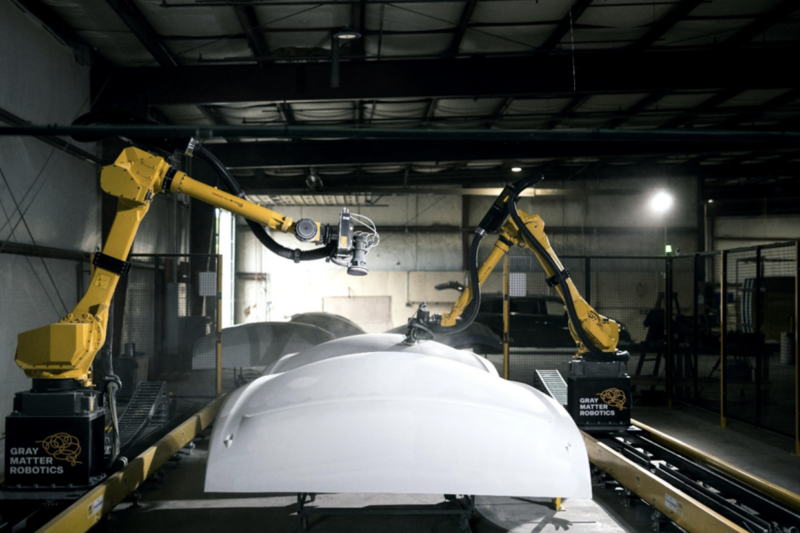
Many industries rely on manufacturing methods like sanding, polishing, blasting, grinding, coating, and painting. These tasks are physically demanding for workers and come with notable health and safety concerns (refer to the image above).
There is growing interest in employing robots to handle these demanding jobs. When dealing with large components, the robotic arm must be moved around to cover the entire surface effectively.
Frequently, people wonder if humanoid robots are suitable for manufacturing tasks involving large components. Let us assess the various features of humanoids and determine how useful they are in these manufacturing processes.
Legs: Legs are not the most effective way for a robot to move across the flat spaces of a production facility. Moreover, robots used in manufacturing often need a physical connection (tethering) to supply power to their tools, such as grinding wheels. If a legged robot requires a tether, it loses much of its mobility. Consequently, legs are not the most practical form of transportation in a factory setting.
Regardless, tethered options like floor-mounted rails or mobile bases are superior for moving robotic arms during production. Legs add unnecessary complexity and safety hazards without providing any real advantage. Therefore, legs are not necessary for manufacturing tasks on the factory floor.
 Submit your session idea for the 2026 RoboBusiness
Multi-Fingered Hands: While hands with multiple fingers provide flexibility for handling objects, they are also costly. Many manufacturing processes—such as sanding, grinding, blasting, coating, and screw-driving—are focused specifically on managing tools, not delicate handling. A multi-fingered hand might not offer the firm grip required for high-speed operation of surface finishing tools.
Instead, it is more efficient to attach the tool directly to the robotic arm using a simpler connector, which also reduces hardware costs by eliminating the need for complex hands.
Heads: The head of a humanoid robot is compact, meaning cameras must be placed very close together. For better coverage and precision, it is more effective to distribute cameras and sensors throughout the work area. Sensors mounted on the arm near the tool or positioned above the part often provide much better results.
Thus, a humanoid head does not add significant value in manufacturing environments.
Dual Arms: Having two arms is highly beneficial when working on large components. To maximize coverage and speed up the finishing process, the arms should be positioned far enough apart to avoid collisions and expand the working area. This setup differs from the arm configuration typically found on humanoids. An effective robot layout for surface finishing is shown in the image below:
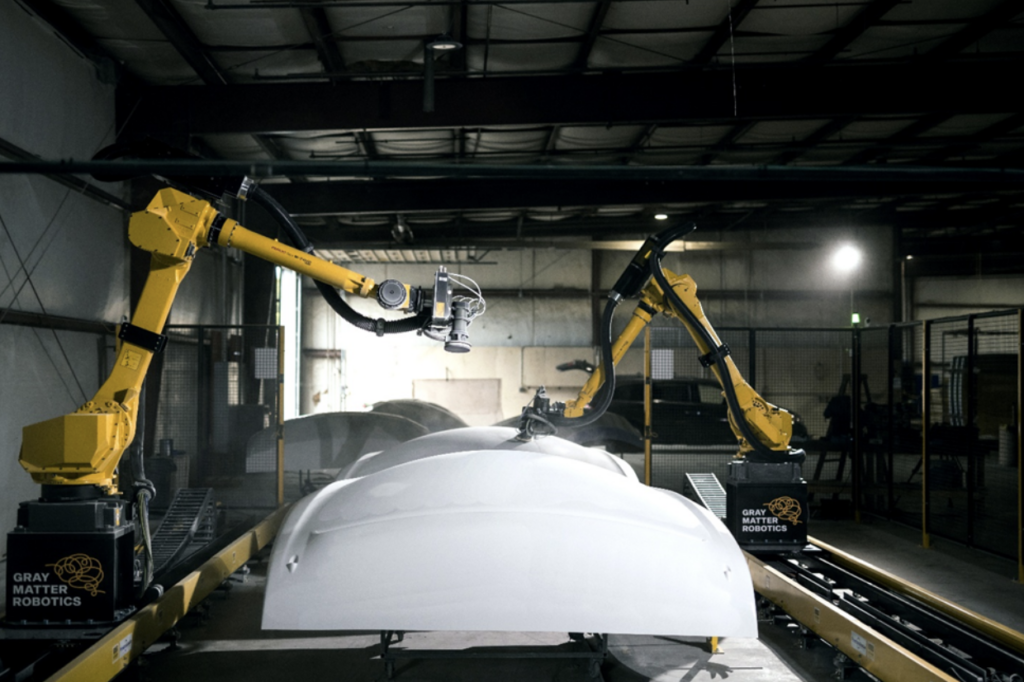
This setup uses dual arms, a mobility system to reposition them, and vision technology to interpret the workspace. However, the arrangement of these components is quite different from that of a humanoid. Some argue that humanoids benefit from economies of scale, but the configuration above uses standard robot arms, rails, cameras, and force sensors—all of which already benefit from mass production. Therefore, humanoids are not required to achieve cost efficiency in manufacturing.
Most manufacturing operations aim to shorten cycle times to boost output. For this reason, general-purpose industrial robots that exceed human capabilities are often the preferred choice.
These robots can work four to five times faster than humans and exert much greater force. They have already proven their reliability in highly demanding tasks. Thus, designing manufacturing workcells with industrial robot arms in optimal configurations appears to be the most effective approach. As a result, humanoids are unlikely to be the best solution for manufacturing tasks where precision, performance, and speed are the primary requirements.
About the author
 Dr. Satyandra K. Gupta is co-Founder and chief Scientist at GrayMatter Robotics. He also holds the Smith International Professorship at the Viterbi School of Engineering at the University of Southern California and serves as the founding Director of the Center for Advanced Manufacturing. His research focuses on Physical AI and human-centered automation. He has authored over five hundred technical papers in journals, conference proceedings, and edited books. He also holds twenty-eight US patents.
He is a fellow of the American Association for the Advancement of Science (AAAS), American Society of Mechanical Engineers (ASME), Institute of Electrical and Electronics Engineers (IEEE), National Academy of Inventors (NAI), Society of Manufacturing Engineers (SME), and Solid Modeling Association (SMA). He currently serves as a member of the Technical Advisory Committee for Advanced Robotics for Manufacturing (ARM) Institute and a member of the Association for Advancing Automation (A3) Robotics Technology Strategy Board.
He has received numerous honors and awards for his scholarly contributions, including the Presidential Early Career Award for Scientists and Engineers in 2001 from President Bush, the Lifetime Achievement Award from the ASME Computers and Information in Engineering Division in 2024, the Eli Whitney Productivity Award in 2025, and the ASME William T. Ennor Manufacturing Technology Award in 2025.
