




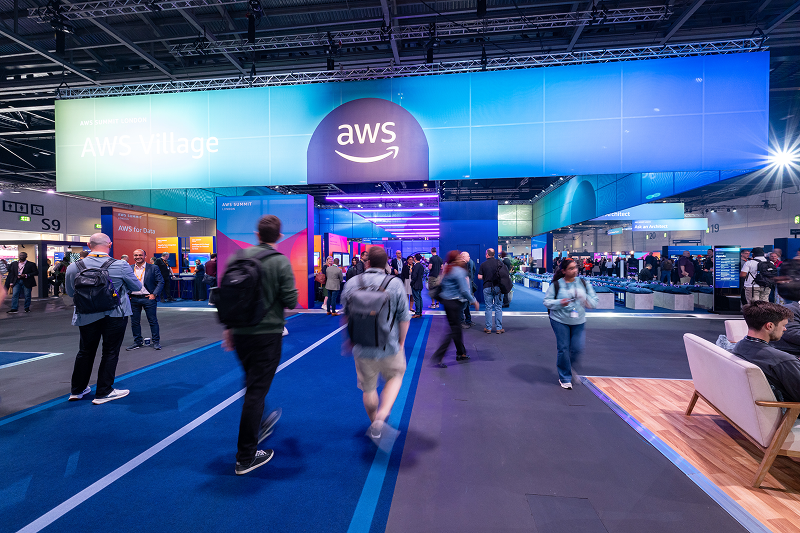
This week, the AWS Summit comes to New York City, gathering developers, customers, and AWS teams for a full day of announcements, demonstrations, and technical sessions at the Javits Center. I’ve written blog posts covering several of the launches happening at the Summit, so I’m thrilled to see them go live this week. The only catch is — I won’t actually be at the Javits Center to watch them. Instead, I’ll be at a four-day music festival, keeping up with the launches on my phone while wrestling with tent poles. If you’re in the same boat and can’t attend in person, the keynote livestream on June 17 has you covered. Dr. Swami Sivasubramanian (VP of Agentic AI) and Chet Kapoor (VP of Security Services and Observability) will walk through the newest additions across developer tools, AI infrastructure, and security.
Let’s wrap up what happened this week.
Headlines
How leading teams are reshaping AI-native development — Swami published an in-depth post this week based on data collected from experiments spanning hundreds of Amazon engineering teams. If you’re thinking about how to guide AI adoption within your own organization, this one deserves a close read.
A compact team of six engineers rebuilt the Amazon Bedrock inference engine in just 76 days — a task originally estimated to need 30 developers over 12 to 18 months. Across structured pilot programs with Amazon Stores teams, the median productivity improvement was 4.5 times in normalized deployment velocity, with some teams even surpassing 10 times. The Perfect Order Experience team slashed their feature cycle from two weeks to a single afternoon. The Worldwide Grocery division went from spending five days on design documents to completing them in just a few hours.
The article boils these lessons down to five core practices for becoming a leading-edge team. First, set up agent context properly: create steering files, define coding standards, and curate structured repositories before tackling production code. Second, be prepared for an initial speed dip as your workflows adapt — and push through it. Third, keep a steady queue of clearly scoped tasks so agents can operate in parallel without needing constant oversight. Fourth, articulate intent upfront through structured specifications before code generation kicks off. Fifth, shift testing earlier in the pipeline so agents can self-correct before code merges.
The post closes by noting that commit velocity only tells part of the story, and that a follow-up piece will address release management, operations, security procedures, and end-of-life upgrades.
AWS FinOps Agent is now available in preview — The AWS FinOps Agent is a brand-new agent tailored for FinOps practitioners and engineering teams. It answers questions about costs, highlights optimization opportunities, investigates unexpected cost spikes, and runs recurring FinOps workflows on a set schedule. Use it to query your AWS spending, generate cost reports for both finance and engineering stakeholders, and extract rightsizing suggestions, idle resource alerts, and Savings Plans recommendations from AWS Cost Optimization Hub and AWS Compute Optimizer. The agent can even open Jira tickets on your behalf based on those recommendations. When a cost anomaly surfaces, the FinOps Agent can automatically dig into the root cause and post its findings to a Slack channel.
Earlier launches
I’ll kick things off with one I authored this week, then spotlight the other launches that stood out:
- Amazon EC2 M9g and M9gd instances are now generally available — Built on AWS Graviton5 processors and the sixth-generation AWS Nitro System, M9g instances offer up to 25% better compute performance versus Graviton4-based counterparts, with up to 35% speed improvements for web applications, up to 35% for machine learning inference, and up to 30% for databases. Graviton5 is the first processor in the AWS fleet to support PCIe Gen6 and DDR5-8800 memory, and it comes with a 5x larger L3 cache compared to its predecessor. M9g and M9gd instances deliver up to 15% more network bandwidth and 20% higher Amazon EBS bandwidth on average across all sizes compared to M8g. This release also introduces the Nitro Isolation Engine, an advancement in the Nitro System that leverages formal verification to deliver mathematically proven isolation between virtual machines — making it the first formally verified cloud hypervisor in existence. M9gd instances include up to 11.4 TB of local NVMe SSD storage with 30% higher IOPS than M8gd. Both instance families support Instance Bandwidth Configuration (IBC), allowing you to adjust bandwidth allocation between EBS and VPC networking by up to 25%.
- Anthropic Claude Fable 5 on Amazon Bedrock — Claude Fable 5 went live on Amazon Bedrock on June 9, bringing extended asynchronous task execution, advanced vision capabilities that work across diagrams, charts, and PDFs, and built-in self-verification. To use it, you’ll need to opt into data sharing through the Data Retention API before calling the model; Anthropic mandates a 30-day retention window for inputs and outputs of its Mythos-class models. Important note on availability: On June 12, Anthropic directed AWS to revoke access to both Claude Fable 5 and Claude Mythos 5 for all users to comply with a US Government export control directive. All other models, including Opus 4.8, remain unaffected. Check the Anthropic statement for full details. AWS will share additional updates as they become available.
- Gemma 4 models are now available on Amazon Bedrock — Google DeepMind’s Gemma 4 family is now accessible on Amazon Bedrock in three variants: Gemma 4 31B (dense architecture with a 256K-token context window, ideal for reasoning and coding workloads), Gemma 4 26B-A4B (mixture-of-experts design targeting cost- and latency-sensitive applications), and Gemma 4 E2B (the smallest variant, built for low-latency interactive scenarios). All three support native function calling, structured output, reasoning, response streaming, multimodal input spanning text, image, video, and audio, and more than 35 languages.
- Amazon OpenSearch Service launches MCP Apps for agentic observability — Amazon OpenSearch Service now supports MCP Apps, bringing observability workflows directly into agentic IDEs like Claude Desktop and VS Code. An AI agent running locally can investigate incidents using logs, traces, metrics, and alerts stored in OpenSearch domains, collections, and Amazon Managed Service for Prometheus. Each MCP App tool call returns a dual response: a text summary the agent can reason over, plus an interactive visualization rendered right in the same conversation thread. Available MCP App tools cover log, metrics, and trace investigation; service performance; topology; dynamic visualizations; agent health; cluster health; and instrumentation scoring.
Other AWS news
Here are a few more posts and updates worth noting:
- AWS CLI v1 enters maintenance mode — As CLI v1 moves into maintenance mode, the botocore and s3transfer dependencies will be bundled directly into the CLI v1 codebase rather than installed as standalone packages. This means updating CLI v1 will no longer refresh the separate botocore or s3transfer packages, and installing those independently won’t affect the versions CLI v1 uses. Environments running both CLI v1 and boto3 will end up with separate copies of these libraries. Future CLI v1 releases will be limited to critical bug fixes and security patches. The recommended path forward is migrating to AWS CLI v2.
- AWS Workload Credentials Provider is now available — The new AWS Workload Credentials Provider lets workloads obtain short-term AWS credentials without needing long-term access keys. This is designed for credential management of applications running outside AWS, enabling teams to follow least-privilege access patterns for workloads hosted in third-party or on-premises environments.
- Kiro Pro Max is now available — Kiro has rolled out a new Pro Max tier with higher usage caps, access to the latest frontier models, and expanded agentic capabilities for development teams. Kiro Pro Max is built for professional developers who need sustained, high-volume usage across coding, specification generation, and agent-driven tasks.
Upcoming AWS events
Mark your calendar and register for these upcoming AWS events:
- AWS Summits — AWS Summits are free in-person events covering cloud and AI. Coming up: New York City (June 17), Hong Kong (June 17), Shanghai (June 23–24), Japan (June 25), Washington, D.C. (June 30 – July 1), Taipei (July 15), and Bogotá (July 30).
- AWS Community Days — Community-led conferences organized and delivered by community leaders. Upcoming events include Montreal, Canada (June 20), Indianapolis, USA (June 24), Hangzhou, China (June 28), Bengaluru, India (July 11), and Yaoundé, Cameroon (July 25).
Head over to the AWS Builder Center to connect with fellow builders, share solutions, and discover resources to keep your projects moving forward. You can also browse upcoming AWS-led in-person and virtual events, plus developer-focused sessions.
— Esra
This post is part of our Weekly Roundup series. Check back each week for a quick roundup of interesting news and announcements from AWS!
