



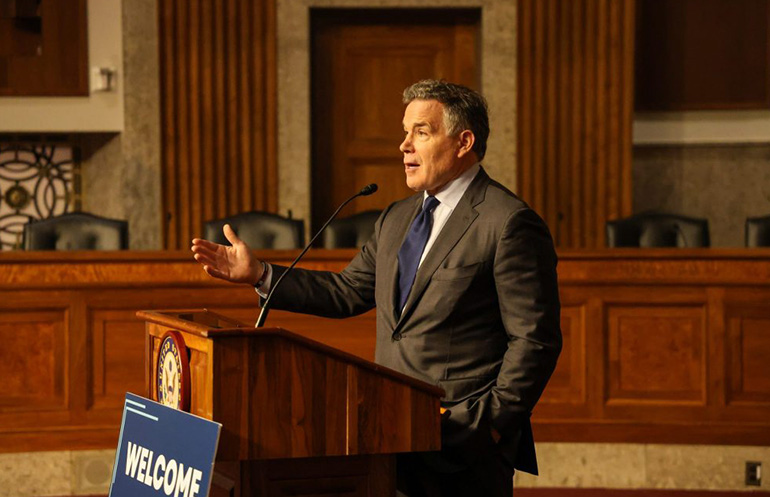
Sen. Dave McCormick (R-Pa.), who co-sponsored a bipartisan bill to establish a National Commission on Robotics.
Robotics plays a key role in bolstering both the American economy and national defense, yet cohesive federal guidance has been slow to develop. This may soon change, as a bipartisan group of senators—Dave McCormick (R-Pa.), John Hickenlooper (D-Colo.), Todd Young (R-Ind.), and Martin Heinrich (D-N.M.)—recently proposed legislation to form an independent panel dedicated to evaluating U.S. competitiveness in the field and proposing strategies to reinforce its leadership.
“Robotics advancements are quickly reshaping daily life and the workplace,” said Sen. Hickenlooper. “To lead in the coming years, we need a clearer grasp of the opportunities and obstacles we’ll face—spanning supply chains, national security, and workforce readiness.”
“Pennsylvania, and Pittsburgh in particular, is a remarkable center for robotics expertise and illustrates how American leadership in this field generates well-paying jobs, strengthens U.S. supply chains, and fuels sustainable growth,” continued Sen. McCormick. “The Commission on American Leadership in Robotics will assemble top experts to help make sure the United States keeps its technological lead over rivals and develops the skilled workforce required to succeed in an increasingly tech-focused world.”
National Commission on Robotics would evaluate U.S. priorities
Representatives Jay Obernolte (R-Calif.), Jennifer McClellan (D-Va.), and Bob Latta (R-Ohio) had earlier put forward the companion National Commission on Robotics Act in the U.S. House of Representatives as H.R. 7334 in February. They belong to the recently revived Congressional Robotics Caucus.
The commission would be tasked with reviewing and advising on:
- How competitive the U.S. is in robotics and the health of the domestic market
- Whether the nation is equipped to secure and sustain a technological edge across industrial, consumer, and commercial applications
- International moves and policies that advance robotics abroad
- Whether specific partnerships between robotics industries, government, and academic institutions could boost economic competitiveness and production capabilities
- Initiatives and incentives to attract and retain leading robotics talent and related STEM professionals
- Supply chain vulnerabilities and policies to expand domestic robot manufacturing
Recent data from the International Federation of Robotics (IFR) and the Association for Advancing Automation (A3) shows that orders for industrial automation and robot density—measured as robots per 10,000 workers—have both grown in North America since 2024. Nevertheless, mounting competitive pressure from China, which is reported to have deployed more robots than every other country in the world combined, continues to intensify.
 Submit your session idea for the 2026 RoboBusiness
Industry leaders express support for the proposed legislation
“Robotics is quickly becoming essential infrastructure for modern economies,” noted Aaron Prather, director of the Robotics & Autonomous Systems Program at ASTM International, in an interview with The Robot Report. “Similar to other countries, the United States would gain from a national plan that aligns research, workforce initiatives, standards, and real-world deployment.”
“My straightforward advice is that if we are committed to bringing manufacturing back home, we must place equally strong emphasis on advancing robotics,” stated Robert Little, chief of robotics strategy at Novanta Inc. and a 2026 Joseph F. Engelberger Robotics Award recipient. “America possesses the talent, academic institutions, companies, and manufacturing base to take the lead.”
“Yet improved coordination among industry, government, academia, and the public sector is essential,” he added. “Without it, we risk rebuilding factories while still relying on foreign sources for the crucial technology that makes them competitive.”

Source: Sen. Dave McCormick (R-Pa.).
“We’re very enthusiastic about the potential for a National Robotics Commission, which could represent the first major milestone toward a comprehensive U.S. National Robotics Strategy,” said Jeff Burnstein, president of A3. “I hope this legislation moves rapidly through Congress. Each day without a national plan increases the risk of the U.S. falling further behind in its effort to lead in robotics—one of the defining technologies of the 21st century.”
“The absence of such a strategy also hampers progress in artificial intelligence, since robots serve as the ‘physical’ dimension of physical AI,” he explained to The Robot Report. “While many other measures will be needed alongside the Robotics Commission, this would mark a critical step forward.”
“Pittsburgh has long stood at the forefront of robotics innovation, which is why Agility has invested significantly in its presence there,” remarked Peggy Johnson, CEO of Agility. “Sen. McCormick and Sen. Hickenlooper’s introduction of the National Commission on Robotics Act demonstrates a solid understanding of the strategic value of U.S. leadership not just in developing, but in implementing, robotics—including humanoids—at scale. We urge the Senate to act swiftly and across party lines to advance this vital legislation.”
“This is a pivotal moment for robotics, as artificial intelligence is enabling rapid breakthroughs and sophisticated new uses,” stated Brendan Schulman, vice president of policy and government relations at Boston Dynamics. “A congressional commission is an important step in crafting the kind of national robotics strategy that Boston Dynamics and others have advocated.”
Other policy efforts continue
Last year, the U.S. Department of Commerce launched investigations into whether tariffs should“`xml
New tariffs may be imposed on imported robotics, industrial machinery, personal protective equipment, and medical devices. The public comment period for the Section 232 investigation ended in October, but no official conclusions have been announced yet.
Meanwhile, a June 1 presidential proclamation adjusted duty levels on metals based on their U.S. content and temporarily lowered tariffs for mobile industrial equipment and machinery.
Last year, the Special Competitive Studies Project (SCSP) submitted an open letter to the White House outlining recommended national technology priorities. This year, the Arlington, Va.-based think tank established the National Security Commission on Robotics for Advanced Manufacturing.
Also this year, Senators Bill Cassidy (R-La.) and Chris Coons (D-Del.) introduced the Humanoid Robotics Oversight and Blocking of Obtainment from Totalitarians Act of 2025 (S. 3275). This bill would ban the federal government from purchasing AI-integrated humanoid robots supplied by military contractors linked to China, Iran, North Korea, or Russia.
There are growing indications of investment in domestic robotics production. For example, FANUC America announced a $90 million commitment in March to build a new manufacturing facility in Pontiac, Michigan.
Last month, Robots for America was launched following an initiative by the Office of Science and Technology Policy, the Department of Commerce, the Small Business Administration, and the U.S. Senate.
The newly formed industry coalition includes founding members such as Formic, Machina Labs, Standard Bots, Dexterity, Medra, Path Robotics, AMP Sortation, Chef Robotics, GrayMatter Robotics, Mytra, Mujin, CreateMe, and Viam. Its mission is to position robotics as a core component of U.S. industrial policy, advocate for American factory operators in Washington, D.C., ease public concerns about automation adoption, and expand access to automation solutions for mid-sized manufacturers.
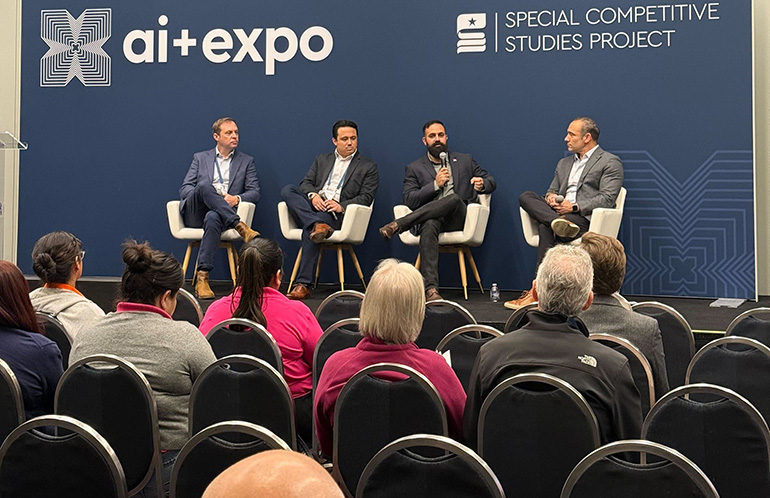
Robots for America founding members at AI+ Expo, from left to right: Micah Murphy of New American Industrial Alliance, Nick Ayala of GrayMatter Robotics, Edward Mehr of Machina Labs, and Dean Banks of Formic. Source: Business Wire
“`
