



# Introduction
Time series data is everywhere — energy usage tracked by the hour, financial transactions captured in thousandths of a second, patient vital signs monitored during hospital visits, inventory counts refreshed daily, and much more. Being able to analyze, model, and forecast this type of data ranks among the most sought-after capabilities in today’s job market.
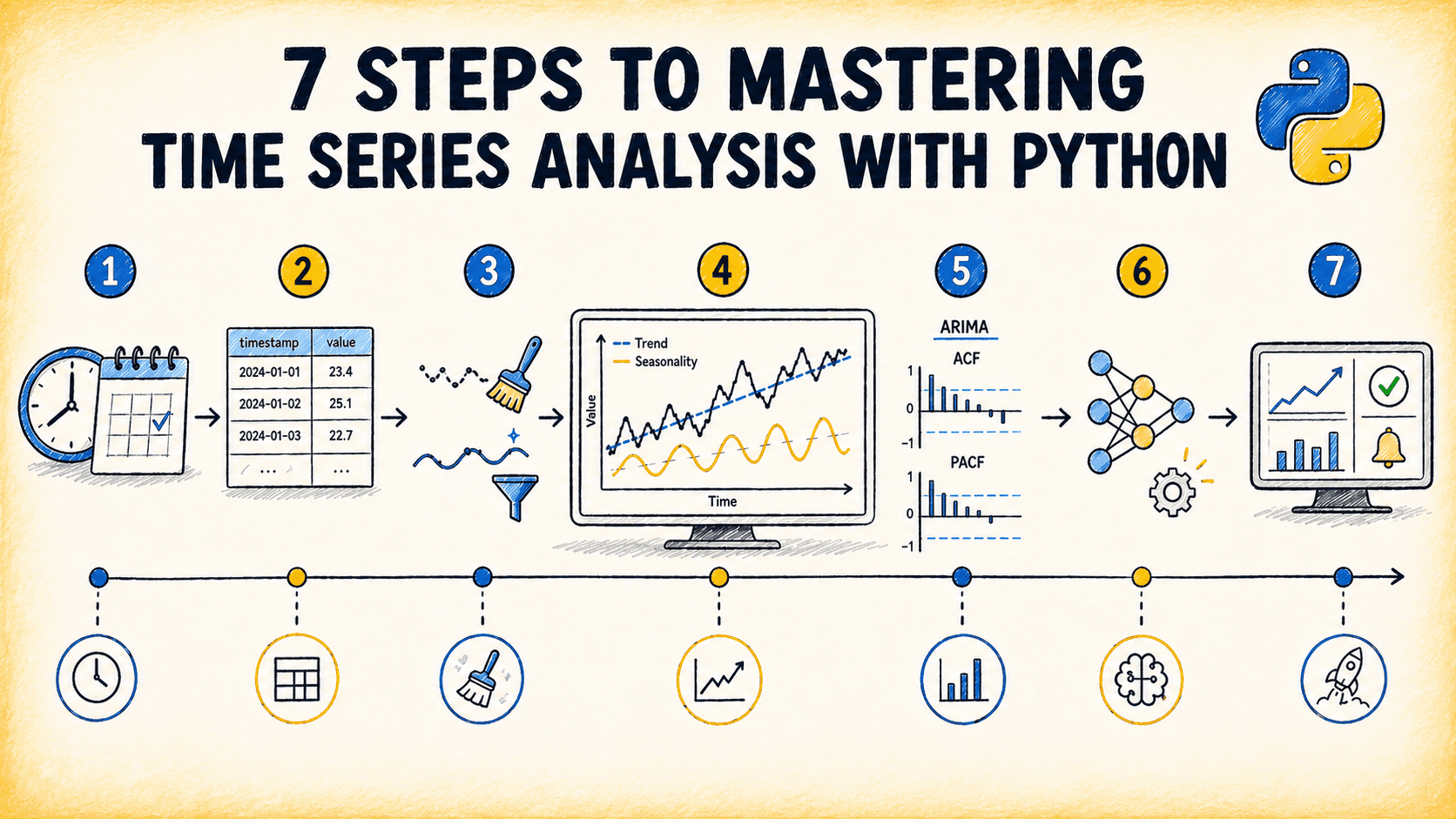
What sets time series apart from general data science work is the need for a distinct mindset at each phase of the process. Concepts like temporal ordering, autocorrelation, seasonality, and non-stationarity are structural characteristics that simply don’t come into play with regular tabular data, yet they shape everything about how time series behave. The seven steps described here will walk you through the fundamentals and help you build solid expertise in time series analysis using Python.
# Step 1: Understanding What Makes Time Series Data Different
Your first task is to grasp the core properties that make time series structurally different from ordinary tabular data. Many practitioners skip over this foundation, assuming that standard machine learning principles carry over directly — but they rarely do without careful adaptation.
Three key structural properties are outlined below:
| Property | What it means | Why it matters |
|---|---|---|
| Temporal dependence | Data points aren’t isolated from each other; yesterday’s value is closely linked to today’s | In standard machine learning, rows are treated as independent — applying that assumption blindly here leads to unreliable outcomes |
| Stationarity | Key statistical measures stay consistent across the timeline | The majority of classical forecasting methods rely on stationarity; real-world data typically doesn’t satisfy this, calling for differencing or transformation techniques |
| Seasonality and trend | Predictable recurring cycles or seasonality paired with an overall upward or downward trajectory or trend | Isolating these patterns from the unpredictable remainder is often the central challenge in the analysis |
Resource: Rob Hyndman and George Athanasopoulos’s freely available online textbook Forecasting: Principles and Practice (3rd ed.) is an excellent in-depth reference. If you’re committed to mastering time series analysis, consider bookmarking it before moving on to any modeling stage.
# Step 2: Mastering Time Series Data Structures in Python
Working effectively with time series in Python requires fluency with pandas’ time-aware data structures — namely DatetimeIndex, PeriodIndex, along with resampling and rolling-window operations.
The difference between DatetimeIndex and PeriodIndex is more significant than it initially seems.
DatetimeIndexpinpoints exact instants in time.PeriodIndexrepresents stretches or intervals of time.
Understanding when each type applies, how to switch between them, and how to parse, slice, and resample time-indexed data upfront will save you considerable headaches down the road — most modeling libraries come with their own strict format expectations.
Resampling and aggregation is an area where many analysts inadvertently introduce serious mistakes. Shrinking minute-level records to hourly data, for example, demands picking the right summary method, and a poor choice will compromise the entire analysis. It’s well worth applying several aggregation approaches to the same data until the underlying logic feels natural.
Rolling and expanding windows — .rolling() and .expanding() — are core pandas tools for generating lag features and running totals or means. It’s a good idea to manually compute rolling averages, standard deviations, and lag shifts before leaning on library shortcuts: getting a feel for how these operations work at the index level helps you avoid a particularly sneaky class of data leakage issues that are maddening to troubleshoot once they’ve crept into your pipeline.
Resource: Run through the pandas Time Series and Date Functionality guide using an actual dataset before moving forward.
# Step 3: Learning to Clean and Prepare Time Series Data
Real-world time series data typically comes in messy — you’ll encounter gaps in timestamps, sensor failures, duplicate records, and outliers. Every cleaning decision you make here will ripple through every stage that follows, and because the time dimension imposes a strict sequence on every operation, the techniques differ significantly from what you’d use on ordinary tabular data.
A missing timestamp and a NaN sitting at an existing timestamp are not the same issue. The missing timestamp problem requires reindexing against a defined frequency grid before any imputation method can account for it. When it comes to NaN values, the right approach depends on gap duration and signal nature: use time-based interpolation for brief gaps in smoothly varying signals, forward fill for variables that stay constant between changes like equipment on/off states, and seasonal decomposition-based imputation for extensive gaps in strongly cyclical series.
Outlier detection in time series calls for a local rather than a global perspective:
- Single global thresholds often fail to flag anomalies in data whose baseline shifts over time.
- Z-scores calculated on a rolling basis and IQR boundaries applied over moving windows can spotlight values that appear abnormal relative to their immediate surroundings.
- For multi-channel sensor data, the Isolation Forest algorithm can uncover anomalies that aren’t obvious in any single channel but stand out when features are considered together.
Frequency alignment deserves careful thought when combining series sampled at different intervals — hourly meter readings joined with daily weather observations, for example. The choice of aggregation method is just as critical as the join itself, and taking the time to document your downsampling logic pays off, since that choice quietly shapes your model inputs in ways hidden inside the merged result.
Resource: The sktime transformations documentation covers the most commonly used preprocessing transformations along with practical examples.
# Step 4: Developing Intuition Through Exploratory Analysis
You can’t effectively model what you haven’t first taken the time to understand — and understanding a time series demands a structured exploratory approach before fitting any model. Exploratory data analysis for time series goes well beyond simple summary statistics.
Decomposition should be your starting point in any rigorous analysis. Tools like statsmodels.tsa.seasonal.seasonal_decompose or the more outlier-resilient STL decomposition break a series apart into trend, seasonal, and residual elements, and each component deserves its own close inspection.
- Does the trend follow a straight line, or does it curve?
- Is the seasonal strength steady, or does it wax and wane over the observation period?
- Do the residuals look like random noise, or do they still contain patterns that the decomposition didn’t fully capture?
Autocorrelation analysis
Autocorrelation analysis is the other essential diagnostic tool. The autocorrelation function (ACF) and partial autocorrelation function (PACF) plots are the primary methods for understanding temporal dependence:
- A gradually declining ACF indicates non-stationarity.
- Prominent spikes at lag 24 in hourly data indicate daily seasonality.
- PACF cutoffs point to the appropriate autoregressive (AR) order.
Interpreting these plots with confidence is essential for any classical modeling effort.
Stationarity testing completes the exploratory workflow. The Augmented Dickey-Fuller (ADF) test and Kwiatkowski–Phillips–Schmidt–Shin (KPSS) test offer statistical evidence for or against stationarity, and running both is recommended since they evaluate complementary hypotheses. The findings guide whether differencing or transformation is required before modeling begins.
Resource: The statsmodels time series analysis documentation covers the decomposition, ACF/PACF plotting, and stationarity testing functions you will rely on most frequently.
# Step 5: Building Classical Statistical Forecasting Models
Classical statistical models — ARIMA, Exponential Smoothing, and their variants — should be the first models you develop. They are often remarkably competitive with more complex methods on clean, well-understood series, and they require engagement with the structure of the data in ways that machine learning models typically do not.
Exponential Smoothing (ETS) is the ideal starting point. ETS models apply exponentially decreasing weights to past observations and accommodate a broad range of patterns through additive and multiplicative components for trend and seasonality. Fitting a model with statsmodels.tsa.holtwinters.ExponentialSmoothing and inspecting its components provides immediate insight into the series’ structure.
ARIMA and SARIMA follow as natural next steps. ARIMA captures the autocorrelation structure of a stationary series through autoregressive and moving average terms; SARIMA extends this framework to handle seasonal patterns.
Evaluation discipline is just as important as model selection. Random cross-validation on time series yields optimistic and unreliable estimates; walk-forward validation — training on historical data, forecasting the next window, then advancing the window — replicates how the model would actually perform in production. TimeSeriesSplit from scikit-learn or sktime’s forecasting cross-validation utilities both handle this correctly.
Resource: Forecasting: Principles and Practice, Chapters 7–9 for ETS and ARIMA, and the statsmodels State Space documentation for Python-specific implementation details.
# Step 6: Progressing to Machine Learning and Deep Learning Models
Once reliable classical baselines are established, machine learning models enable richer feature sets, capture complex non-linear relationships, and scale to large collections of series that would be impractical to model one at a time.
Tree-based models such as LightGBM and XGBoost deliver strong forecasts when supplied with well-crafted lag features, rolling statistics, and calendar variables. They capture non-linearity and feature interactions automatically, but data leakage is the primary concern; lags must be built exclusively from past values relative to the prediction timestamp. sktime’s make_reduction wraps scikit-learn regressors as forecasters safely and manages this bookkeeping correctly.
Global models become relevant when the problem involves hundreds or thousands of related time series — store-level sales, device-level sensors, regional energy demand. Training a single global model across all series frequently outperforms individual per-series models by sharing statistical strength, and NeuralForecast supports this approach natively.
Deep learning architectures have demonstrated the strongest performance on benchmark datasets and handle multi-seasonality, covariates, and long-horizon forecasting more effectively than classical models. NeuralForecast implements all of these with a consistent API and proper temporal cross-validation support. The right moment to adopt deep learning is after simpler models have reached their limits, not before.
Resource: Kaggle M5 Forecasting competition notebooks are an excellent starting point, and the top solutions cover the full pipeline from feature engineering to ensembling on a real retail forecasting problem and are freely available.
# Step 7: Deploying and Monitoring Forecasting Systems
The operational challenges unique to time series differ from general machine learning deployment.
Concept drift and distribution shift are inherent risks rather than edge cases in time series, because the series are non-stationary by nature. Tracking forecast error metrics on a rolling basis and configuring automated alerts when error rates surpass thresholds is the minimum standard. Scheduled retraining pipelines are essential in any production forecasting system.
Forecast storage and versioning require careful design. Production forecasting systems generate predictions continuously, and storing forecasts alongside the actuals they predicted — rather than just the final model outputs — enables retrospective accuracy computation at every horizon and reveals exactly where the model degrades over time.
Backtesting as a deployment gate is the discipline that distinguishes experiments from production-ready systems. Before any model goes live, a thorough backtest should simulate the full deployment window using only data that would have been available at each step. A model that performs well on a held-out test set but fails a proper backtest is not ready for production.
Resource: Evidently AI’s model monitoring guide for machine learning monitoring including data and prediction drift detection.
# Wrapping Up
Time series analysis rewards sequential learning more than most data science disciplines.
| Step | Why it matters |
|---|---|
| Core properties of time series data | Without grasping temporal dependence, stationarity, and seasonality, every subsequent decision rests on uncertain ground |
| Pandas time-aware data structures | Accurate indexing, resampling, and window operations are prerequisites for every analysis and modeling task |
| Cleaning and preparation | Mistakes introduced here propagate silently through the entire pipeline; temporal ordering makes them harder to detect than in tabular cleaning |
| Exploratory analysis | Decomposition, autocorrelation plots, and stationarity tests uncover the structure that determines which models are appropriate |
| Classical statistical models | Require structural engagement with the data; often competitive with complex methods and always valuable as a baseline |
| Machine learning and deep learning models | Expand capability to non-linear patterns, rich feature sets, and large collections of series once classical baselines are established |
| Deployment and monitoring | A model that cannot be maintained in production is not a finished product; time series systems demand domain-specific operational discipline |
Foundation models for time series — pre-trained on large corpora of diverse series and fine-tuned for specific tasks — are substantially transforming how practitioners approach forecasting. Building strong fundamentals in classical and machine learning-based approaches will certainly prove valuable going forward.
Bala Priya C is a developer and technical writer from India. She enjoys working at the intersection of math, programming, data science, and content creation. Her areas of interest and expertise include DevOps, data science, and natural language processing. She loves reading, writing, coding, and coffee! Currently, she is focused on learning and sharing her knowledge with the developer community by authoring tutorials, how-to guides, opinion pieces, and more. Bala also creates engaging resource overviews and coding tutorials.
