



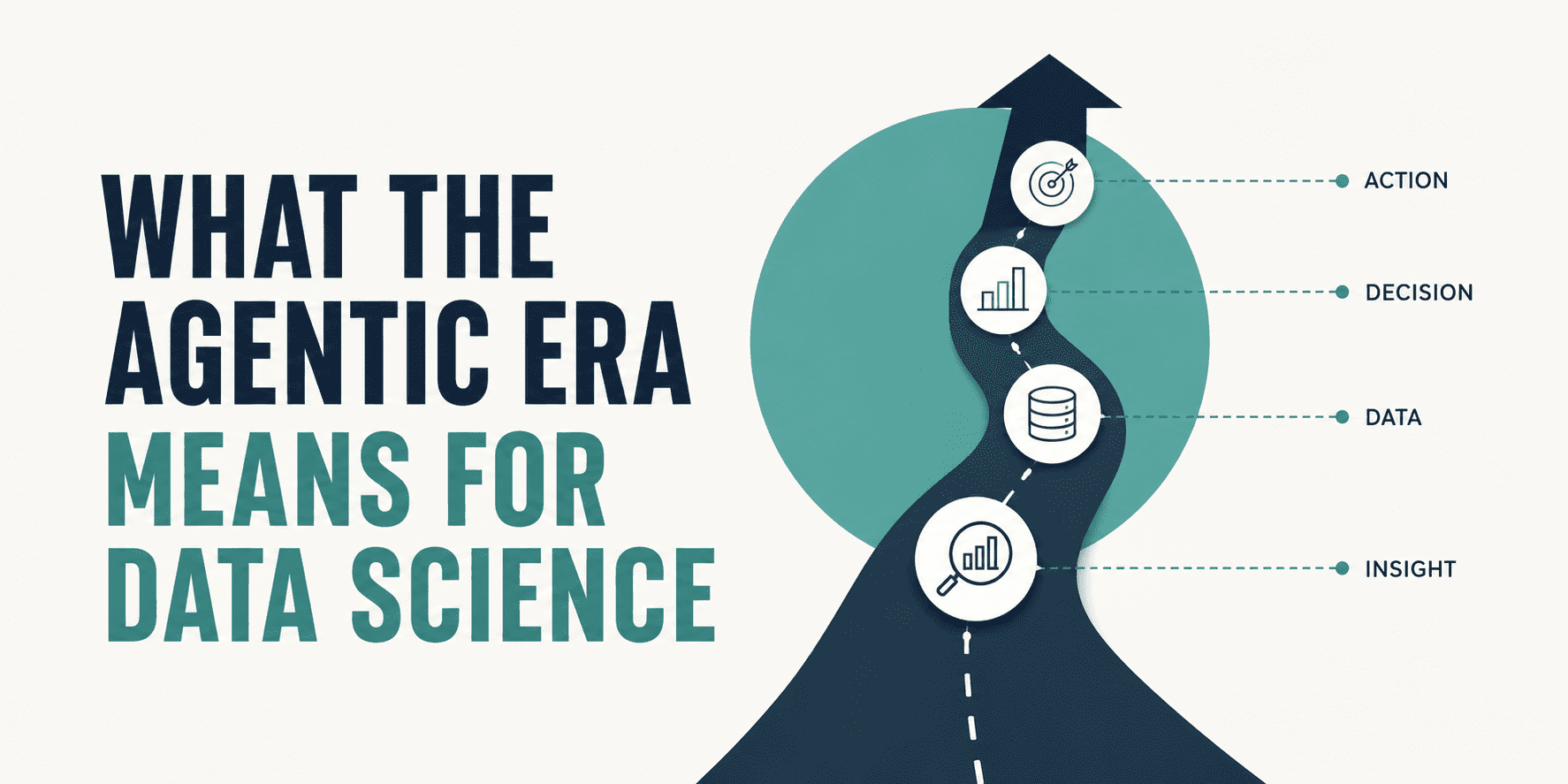
# Introduction
A fundamental change is underway where AI meets data science, and it’s transforming how professionals in the field carry out their work. The AI systems being put into production today don’t simply produce an answer and call it done. They strategize. They carry out multi-step processes. They invoke external tools, assess their own results, and circle back when outcomes don’t measure up.
We’re no longer approaching the agentic era — we’re already in it. This new phase is characterized by AI systems that carry out self-directed, purpose-driven actions, and it has fundamentally altered what data scientists do on a daily basis.
The profession has always required an uncommon blend of statistical reasoning, coding skills, and subject-matter knowledge. Now a fourth capability has become table stakes: the skill to build, launch, and assess systems that take independent action on behalf of users. Overlook this evolution, and you’ll find yourself falling behind colleagues who’ve embraced it. Lean into it deliberately, and your impact multiplies across every project you work on.
# Redefining the Baseline
To grasp what’s at play, consider what an AI agent actually does in a live production setting. An agent is a system that takes in its surroundings, thinks through its next step, carries out actions through available tools, and reviews the outcomes.
This differs sharply from a conventional large language model (LLM) exchange, where you provide a prompt and get back a single, fixed reply. An agent works through ongoing, repeating cycles. It takes in a goal, picks a tool, watches the outcome, refines its thinking, and either adjusts course or moves ahead. This loop can play out over dozens of individual steps happening behind the curtain.
What sets this approach apart is built-in tool integration. In today’s data science landscape, an agent can pull in a dataset, clean it, conduct exploratory analysis, train an initial model, assess the findings, and generate a formatted report — all without a person stepping in during the procedural stages.
# The Orchestration Ecosystem
The frameworks enabling this have grown from experimental codebases into robust, production-ready orchestrators. They all share the same foundational idea — giving a model organized access to tools and the reasoning capability to wield them — but each takes a different path depending on the workflow.
| Framework | Design Philosophy | Primary Data Science Use Case | 2026 Context |
|---|---|---|---|
| LangGraph | Graph-based workflow orchestration. | Complex, conditional pipelines requiring state management. | The go-to choice for production-grade workflows — both single-agent and multi-agent — where precise state tracking and conditional branching are essential. |
| AutoGen | Multi-agent conversational patterns. | Collaborative setups where agents challenge or validate each other’s outputs. | Well-suited for built-in review stages, where a critic agent scrutinizes a coder agent’s logic. Keep in mind: the v0.2 and v0.4/AG2 architectures differ substantially, so verify which version your documentation refers to before getting started. |
| smolagents | Code-first, minimalist execution. | Code-intensive tasks leveraging the full Python scientific ecosystem. | An intuitive choice for data scientists who are already at home in pure Python environments. |
# Shifting the Workflow: From Procedural to Evaluative
The most tangible change to everyday work is the automation of repetitive processes. Consider a typical exploratory data analysis (EDA) workflow. A data scientist would historically load data by hand, compute summary statistics, create distribution plots, and search for outliers. Now, a properly configured agent carries out each of those steps on command, records findings in organized formats, and highlights anomalies for a person to examine.
This carries over into machine learning engineering as well. Workflows that once required hands-on iteration across preprocessing decisions, algorithm selection, and hyperparameter tuning are now largely handled by agentic orchestration — cutting down on, though not removing, the need for human judgment at critical junctures.
That distinction is important. This doesn’t make the data scientist obsolete. It redirects the role toward higher-level decision-making. Agents take on the procedural burden; you keep the evaluative burden. Agents deal with the “how do I repeat this” tasks that eat up hours. You deal with the “should we even be doing this” calls that no model can make in your place.
# The 2026 Skill Stack
Core technical skills in Python, statistics, and machine learning remain the non-negotiable foundation. But the agentic landscape calls for an additional layer of competencies stacked on top of that base.
- System Design and Prompt Engineering: Agents do what they’re told, and the structure of those instructions determines the upper limit of output quality. This goes far beyond crafting a well-worded prompt. When you design an agent, you’re making choices that shape how it performs across hundreds of different scenarios: how to break a high-level goal into concrete sub-tasks, how to set boundaries so the agent doesn’t improvise where it shouldn’t, and how to define output formats so later steps can use the results without confusion. Approach prompt engineering with the same rigor you’d apply to software design. Track versions of your prompts, test them against edge cases, and record your rationale. A prompt that works on ten examples but fails on the eleventh isn’t ready for production.
- Tool Design and Integration: An agent is only as effective as the tools at its disposal. A tool is any function an agent can invoke to interact with the outside world — a database query, a web scraper, an API call, or a script that runs a statistical test. If your tool swallows bad inputs without complaint or returns unclear outputs, the agent will carry those mistakes forward through every subsequent step. Solid tool design means clearly typed inputs, structured error messages the agent can interpret, and predictable return formats. Think of each tool as an agreement: here’s what I expect, here’s what I deliver, and here’s what happens when something goes wrong.
- Agent Observability: When an agent works through a long sequence of steps, debugging demands structured evaluation frameworks. Agent failures are frequently subtle. A conventional software bug throws an error at a specific line. An agent failure might appear as a completely reasonable chain of steps that yields a slightly
A stalled agent often reveals its issues only several steps after the initial error. Without detailed logs, reconstructing the sequence of events becomes impossible. At the very least, record the following: the inputs and outputs for every tool invocation, the agent’s decision-making process at each junction, and the final result in relation to the original objective. LangSmith and Langfuse are two valuable platforms to familiarize yourself with for this purpose. Armed with this information, you can construct methodical evaluations and pinpoint exactly where the agent tends to deviate.
- Multi-Agent Architecture: Intricate tasks are commonly distributed among dedicated agents — for example, one agent retrieves data, another performs statistical analysis, and a third generates reports. The rationale is practical rather than experimental: it mirrors the principle of modular code design. Specialized units are simpler to test and simpler to understand independently. The key design challenge lies in coordination. Agents must communicate intermediate results clearly across the workflow, necessitating well-defined interfaces established from the outset. You should also plan your error handling strategy in advance: if one component fails midway, should the system attempt a retry, switch to an alternative path, or escalate the issue to a human for review? Addressing these questions early prevents substantial rework down the line.
# The Transformation of Career Roles
None of this signals the elimination of data science positions. Instead, it elevates the level of output a single practitioner can deliver. The emerging career paths influenced by this change reflect a growing distinction between those who operate agents and those who construct them.
- AI Systems Designers outline agent behaviors, establish performance benchmarks, and manage multi-agent workflows, merging strong data science fundamentals with a broad systems-oriented mindset.
- AgentOps Engineers represent a focused development of machine learning operations (MLOps), dedicated to the deployment, tracking, and oversight of self-directed workflows in live environments—where risks are inherently less predictable than in conventional machine learning systems.
- Domain-Specialized Agent Developers occupy the most resilient niche: a data scientist possessing substantial expertise in finance or healthcare who develops tailored agent-based pipelines for their specific sector. This unique blend of skills is difficult to duplicate.
# Staying Current
For practitioners still adapting, the most practical entry point is intentionally straightforward. Don’t attempt to automate all of your responsibilities at once.
Begin with a single-agent setup using smolagents or LangGraph. Equip it with two or two tools that relate to a task you currently perform manually, and apply it to a scenario where the correct result is known. Assess its performance critically. Once it demonstrates consistent reliability, add a second agent to address a different function. Configure your logging mechanisms, establish your performance metrics, and conduct structured testing.
The data scientists best positioned to succeed are those who gain direct practical experience with these platforms and cultivate the critical judgment needed to deploy autonomous solutions responsibly. The most effective way to remain current is to engage actively in building these systems.
Vinod Chugani is an AI and data science educator who connects cutting-edge AI innovations with real-world application for working professionals. His areas of focus include agentic AI, applied machine learning, and workflow automation. As a technical mentor and instructor, Vinod has guided data professionals through career pivots and capability-building initiatives. His instructional approach integrates quantitative finance expertise with hands-on methodology. His insights highlight practical strategies and established frameworks that working professionals can put into practice right away.
