



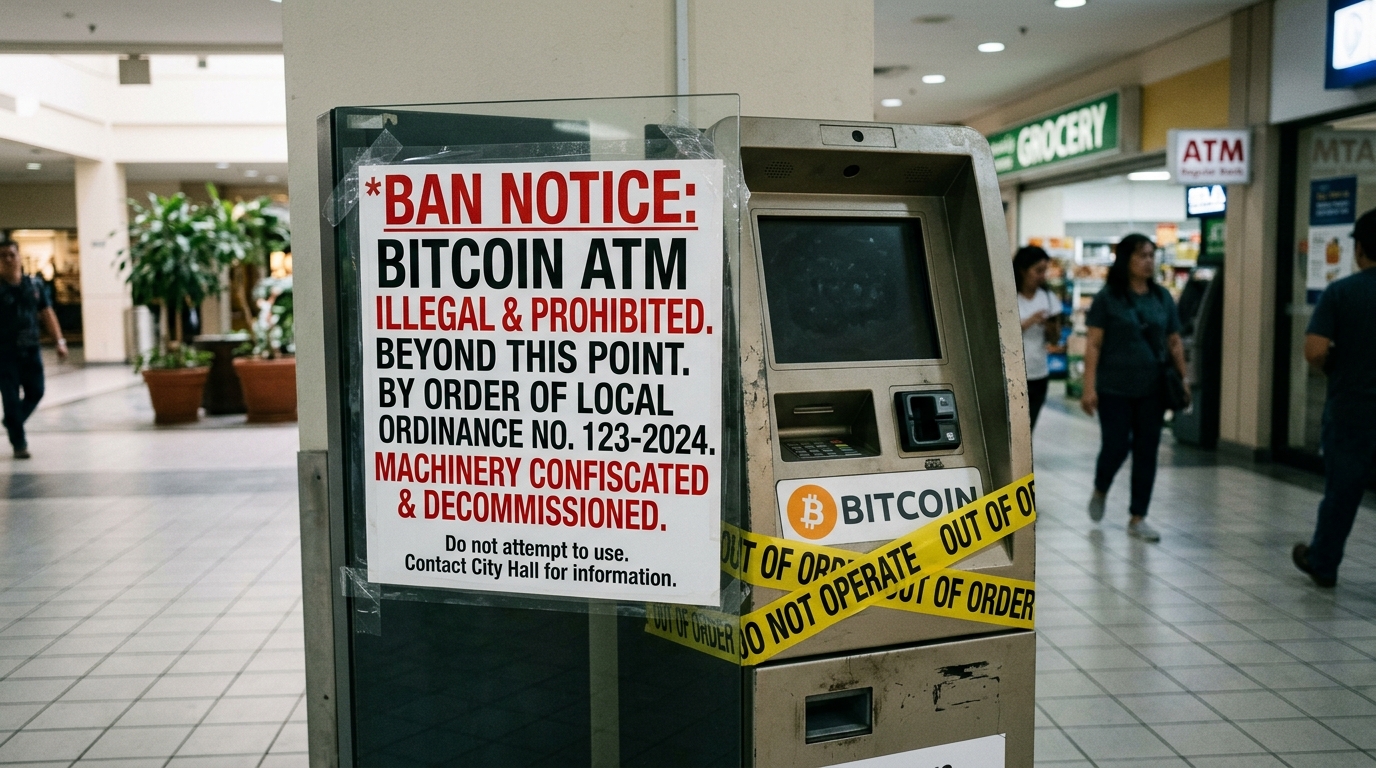
State regulators have been silently outlawing Bitcoin ATMs. A significant segment of the Bitcoin ecosystem is being declared criminal and dismantled. And because there’s little overlap between digitally native users and those who buy Bitcoin with cash, this crackdown is largely flying under the radar. Yet the Bitcoin ATM sector alone channels $3.63 billion?with a ‘B’?into Bitcoin annually, and that figure only covers the United States.
Beyond the numbers, Bitcoin ATMs play a crucial role in preserving financial self-sovereignty. They offer something no traditional financial service can: the ability to walk up with cash, no bank account required, no credit check, no exchange sign-up, and leave with Bitcoin in a wallet you alone control.
Maybe it’s precisely this self-sovereignty that regulators find threatening. Instead of addressing that, they’re pointing to the usual scapegoat: fraud.
Outright bans rendering Bitcoin ATMs illegal have already passed in Indiana, Tennessee, and Minnesota. Meanwhile, de facto prohibitions?regulatory conditions that make profitable operations impossible?are active in California, South Dakota, Wisconsin, and Virginia.
All these restrictions are framed as “consumer protection,” yet fraud continues unabated. The fraud trail is highly traceable, and Bitcoin ATM operators are actively tracking it, uniting to form a coalition and push back against overreach.
No sector faces stricter oversight than a fully licensed Money Services Business (MSB) holding Money Transmission Licenses (MTLs), operating cash-based services under FinCEN’s AML/KYC rules.
The fraud excuse is weaponized selectively against Bitcoin ATMs because it’s politically convenient. It’s also entangled in the influence of the AARP and its $2 billion annual budget. But the data tells a different story: across the traditional financial system, fraud rates typically range from 3% to 5%. At Bitcoin ATMs, the rate is just 1.2%. That means 98.8% of transactions are perfectly legitimate.
So why aren’t states banning Western Union, Visa gift cards, or robocalls?
The typical Bitcoin ATM transaction is around $300; 80% stay under $1,000. Most users are investing modest sums?$50, $100, $500 at a time?into an asset that appreciates over time, mirroring dollar-cost averaging on an exchange. Repeat purchases happen every 24 days on average, and lifetime customer spending totals about $12,000. According to the Federal Reserve, Bitcoin ATMs primarily serve the 24.6 million unbanked and underbanked Americans, who are disproportionately Black, Hispanic, immigrant, rural, and low-income. They’re dropping $20$100 at a gas station kiosk because they lack bank access. States aren’t banning speculative instruments?they’re cutting off essential financial tools for the most underserved communities.
Fraud is merely a smokescreen?a Trojan horse. The suppression won’t end with ATMs. A “canary in the coal mine” signals imminent danger. While the President proclaims the U.S. the “Bitcoin capital of the world,” his own Justice Department has jailed industry innovators. That’s a dangerous precedent we must resist.
For Bitcoin to flourish, every part of its ecosystem must thrive. And for the industry to grow in the U.S., states must retain their regulatory autonomy.
If these bans go unchallenged, they’ll spread far beyond ATMs. This is a trial run for a “ban now, justify never” policy. Both current and past administrations have introduced numerous bills targeting other pillars of the ecosystem, threatening the freedoms of nearly everyone interacting with the Bitcoin network.
A snapshot of near-miss legislation:
S.5267 Digital Asset Anti-Money Laundering Act of 2022: Would have classified wallet providers, miners, and validators as MSBs, subjecting them to KYC/AML mandates.
S.2669 Digital Asset Anti-Money Laundering Act of 2023: Repeated the prior approach of treating digital asset facilitators as BSA-regulated financial institutions. S.2355 CANSEE Act: Aimed at DeFi backers, seeking to impose AML/sanctions rules on decentralized protocols.
S.3867 Digital Asset Sanctions Compliance Enhancement Act: Targeted transaction platforms for sanctions enforcement.
And H.R.3684 Infrastructure Investment and Jobs Act: Enacted into law, it ignited controversy over “exchange” and “broker” definitions that initially swept up miners, node runners, and developers?even though compliance would have been technically unfeasible. Treasury and IRS later narrowed the scope before rollout. But how many in the industry realized how close we came to disaster?
We must resist redefining self-custody wallets as “money laundering tools,” peer-to-peer exchanges as “unlicensed money transmitters,” Lightning nodes as “unregulated payment processors,” or Bitcoin ATMs as “fraud hubs.”
Bitcoin’s core promise is that no one can prevent you from holding or using your own money. The Bitcoin ATM is where that promise becomes tangible reality. With just cash and a phone, anyone can join a global, censorship-resistant financial network?no permission needed.
Let’s protect that right.
If states can eliminate the sole path from cash to self-custody, then self-sovereignty becomes a privilege?available only to those with bank accounts and exchange access, meaning only those who already have permission. The Bitcoin ATM is the canary. If it goes silent and no one listens, the entire ecosystem is next.
This is a guest post by Michelle Weekley. Opinions expressed are entirely their own and do not necessarily reflect those of BTC Inc or Bitcoin Magazine.
