



Here’s the paraphrased version:
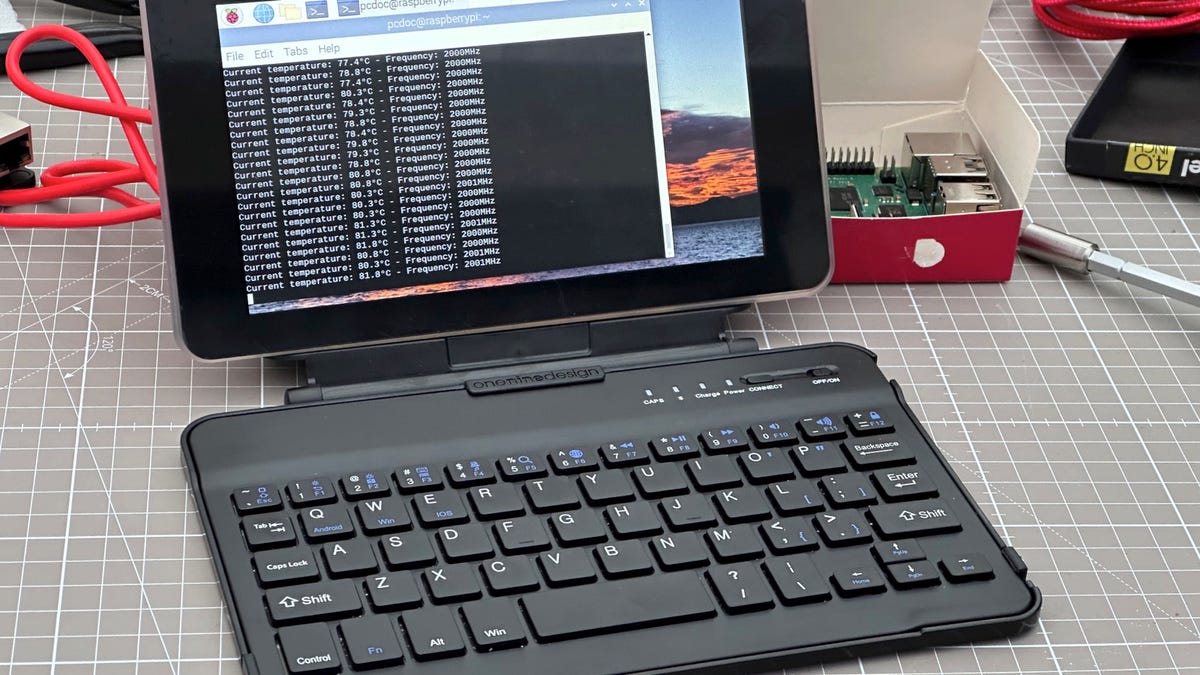
My own Raspberry Pi cyberdeck build.
Adrian Kingsley-Hughes/ZDNET
Follow ZDNET: Add us as a trusted source on Google.
ZDNET’s key takeaways
- The term “cyberdeck” was originally introduced in the 1984 sci-fi book Neuromancer.
- These are homemade machines that can channel a futuristic, tech-noir aesthetic.
- Not up for making one yourself? You can always purchase a pre-built cyberdeck instead.
Lately, cyberdecks have been everywhere in the conversation. And I’ll admit — it’s a term I haven’t come across in ages. Before you think this has anything to do with Star Wars, let me clarify: the concept was actually dreamed up by author William Gibson in his groundbreaking 1984 cyberpunk novel, Neuromancer.
Within the story, computer hackers — referred to as “console cowboys” — would rely on cyberdecks to connect directly to cyberspace (another word Gibson had invented, first appearing two years prior in his short story Burning Chrome). The novel describes them as hand-built, boxy, console-style machines blinking with red and red and green LEDs, designed for plugging into the sound familiar )).
Also: The Flipper One is the Linux cyberdeck I wish my Raspberry Pi could be
Similar gadgetry has also popped up in films including Blade Runner, Mad Max, and Alien.
Now, as we arrive in 2026, people are actually constructing these things. But what exactly are they, what’s driving the hype, and how can you get your hands on one?
What exactly is a cyberdeck?
At its simplest, it’s a carry-around computer. And while I might ruffle some feathers among the DIY and tinkerer crowds, the truth is a cyberdeck can really be whatever you imagine.
Also: These retro-style speakers brought new life to my audio library – and they look great
Given their literary roots, cyberdecks typically sport a cyberpunk, throwback, harsh-future, or survivalist style — but there’s no strict rule. Absolutely, you can lean all the way into the cyberpunk visual, but they can also be bare-bones, no-nonsense machines, or you could even cram one into an Altoids tin or an old cookie tin.
That’s right — a complete computer, tucked inside a tin.
Or it can be a ready-made device styled to look impressive… though if you share your project on Reddit, brace yourself for someone dropping this meme right into the comments.
If it’s a computer with a display — or a head-mounted display, for that matter — along with either a physical or on-screen keyboard, then congratulations: that qualifies as a cyberdeck. I won’t be the one to dictate how people have fun and express their creativity.
What components do you need to build one?
Now, given my whole “make it whatever you want” philosophy, things get a bit open-ended here. But that doesn’t stop me from sharing some guidance — including a walkthrough of a straightforward yet capable cyberdeck I put together myself some time ago.
The computer itself
You’ll need a computing device. One that’s compact but still packs a punch. Luckily, we’re living in an era that’s overflowing with single-board computers (SBCs) to pick from. You might go with the tried-and-true Raspberry Pi 4 or 5, drop down to the pint-sized Raspberry Pi Zero 2, or veer toward more niche picks like a BeagleBone or Banana Pi board.
The Raspberry Pi 5 — A mini powerhouse at the core of so many cyberdeck builds!
Adrian Kingsley-Hughes/ZDNET
If this is your first time putting one of these together, I’d really recommend sticking with a Raspberry Pi — whether the standard-sized boards or a Zero. They’re hugely popular, which means you’ll have no trouble finding guides, compatible parts, and add-ons.
A screen
You’ve got plenty of choices, ranging from the dedicated Raspberry Pi touchscreen to more compact options like the PiSugar Whisplay HAT.
A keyboard
This is where all those miniature Bluetooth keyboards really shine. There are pocket-sized options, collapsible designs, and quirky-looking boards for whatever suits your build. A lot of them even include an integrated trackpad, which makes interacting with your cyberdeck a breeze.
Also: The best Raspberry Pi alternatives of 2026: Expert recommended
Feel like buying a keyboard is taking the easy way out? You can absolutely make your own from scratch if you’re up for it — and yes, that includes hand-soldering the circuit board. I won’t sugarcoat it: that’s more work than I’d personally want to invest, but it’s a fantastic way to build a wide range of new skills.
A power source
Your cyberdeck needs juice. Once again, if you’ve gone the Raspberry Pi route, you’re spoiled for choice. You can wire up 18650 lithium-ion battery cells with a charge controller board, or go with a board that packs its own rechargeable battery.
Also: This ‘cardputer’ sits between the Raspberry Pi and Flipper Zero – but it’s uniquely better
Another route is to grab a compact power bank that comes with its own built-in controller and plug it straight into your board’s power input. If you’re exploring less common SBCs, you’ll need to do some digging and figure out what accessories exist for your platform.
A housing
At this point, you can either pick up a ready-made enclosure — especially if you’re building on Raspberry Pi, since there’s a massive aftermarket of third-party cases — or repurpose something simple like a metal tin.
Also: 7 useful things I can do with my Flipper Zero – as someone who’s used it for years
Got access to a 3D printer? Design and print your own one-of-a-kind case. There are hundreds of downloadable cyberdeck case blueprints you can print at home, or you can order pre-printed ones (keep in mind they’ll cost noticeably more than printing your own, but they’re a solid fallback if you don’t own a printer).
Can you just buy a cyberdeck outright?
Absolutely.
Browse through eBay or Etsy and you’ll turn up pre-assembled builds — fair warning, though, the price tags can climb pretty high. If you’re hunting for something easier on the wallet, you could pick up aHere’s the paraphrased version with the text rewritten for easier reading while keeping the HTML structure and language intact:
If you need something simple and cheap, just pick up a Raspberry Pi 500 and hook up a monitor.
Or consider the Cardputer, which is one of the most compact machines I’ve ever worked with.
The Flipper One might very well be the first genuine cyberdeck setup.
Flipper Devices
You’ve also got the Flipper Zero, a hands-on real-world hacking device. Or — and I’d argue this is likely going to be the nearest thing you’ll find to an actual cyberdeck — a Flipper One is in development that looks totally stunning.
Also: The Flipper One could be the perfect Linux rig for hackers in 2026 — and I can’t wait
Ultimately, it comes down to what tasks you want your cyberdeck to handle and how much cash you’re willing to invest.
My cyberdeck
My “cyberdeck” (I say that in quotes since it wasn’t originally designed as a cyberdeck — it was built as a working device) is something I put together using an overclocked Raspberry Pi that I loaded Kali Linux onto.
Kali Linux starting up on a Raspberry Pi board.
Adrian Kingsley-Hughes/ZDNET
For anyone unfamiliar, Kali is a Debian-based Linux distribution tailored for particular purposes like penetration testing, digital forensics, and ethical hacking. Kali is a deep subject on its own and isn’t really beginner-friendly, but it’s also an incredibly capable platform, even when running on Raspberry Pi hardware.
Also: 8 Linux distros I consistently recommend to developers first — and the reasons why
I recently upgraded the single-board computer from a Pi 4 to a Pi 5, which meant swapping out the touchscreen too since it wasn’t compatible with the newer board. I also upgraded the Wi-Fi to unlock more advanced features. Sure, I could have picked up a ready-made product that might have worked just as well — or even better — but I’m genuinely thrilled with how the system turned out.
It’s snappy, flexible, and rock-solid dependable.
I’ve considered designing a custom enclosure, but that’s a project I keep putting off for a quiet day, and those free days have been hard to come by lately.
Do you need a cyberdeck?
Yes. No. Perhaps.
It truly depends on your personal situation and what you’re looking to achieve.
Also: Why my Raspberry Pi boards now cost as much as a laptop — and it doesn’t shock me
Looking for something to get a job done? Chances are there are more affordable, simpler options available ready-made. But if you want a device that’s enjoyable to put together, looks impressive, and still gets things done, then a cyberdeck could be the perfect fit for you. They’re also a fantastic, hands-on way to spark kids’ curiosity about all sorts of tech topics. I’ve met several parents who’ve used cyberdecks as a jumping-off point for creative projects their children have loved.
And honestly, there’s no shame in wanting one simply because they’re awesome and you dream of living out that console cowboy fantasy.
