



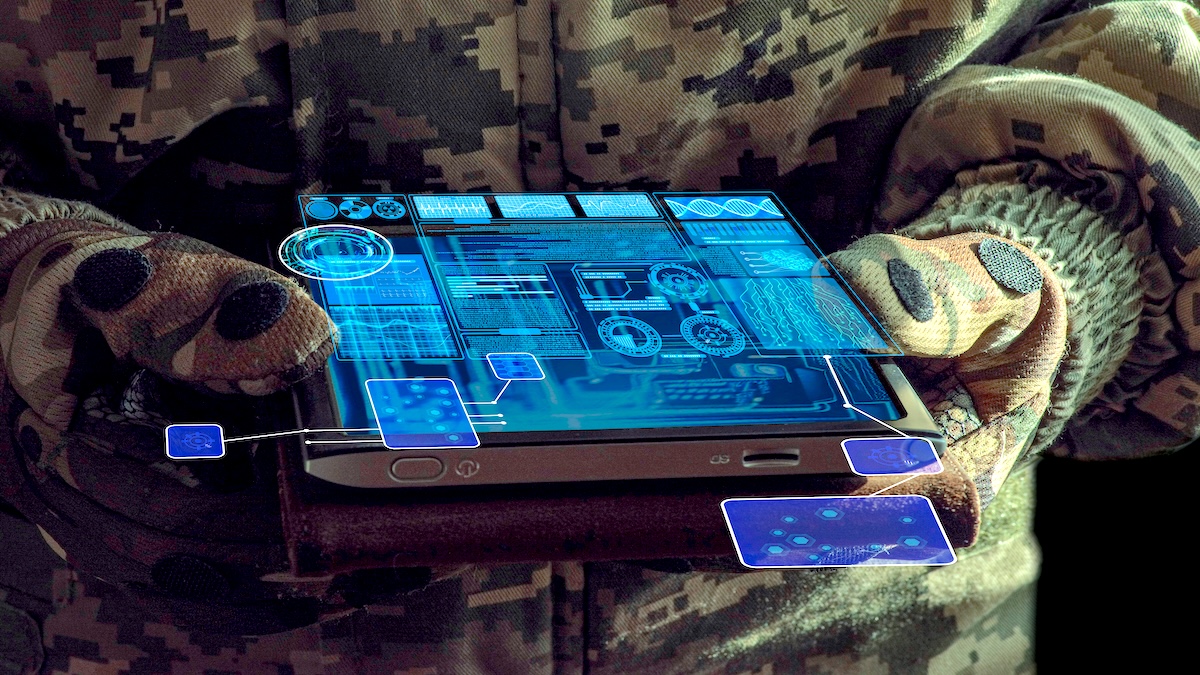
The Trump administration is working to harness artificial intelligence for U.S. military operations, even as some tech firms urge stronger safeguards and senior military leaders urge caution about the fast-evolving technology.
Adm. Frank Bradley, commander of U.S. Special Operations Command, warned at a recent special forces conference in Tampa, Florida, that service members “must exercise great care in how we adopt AI and integrate it into lethal operations.”
Bradley acknowledged a future where AI could identify targets but stressed that “we, as humans, must have full confidence that… it will apply force only where we intend it to.”
His comments on the need for safeguards come as Defense Secretary Pete Hegseth pushes to rapidly modernize the military through AI—a drive that has sparked tensions with technology companies concerned about safety protocols.
Hegseth has argued the Pentagon should be free to use AI in any lawful manner. Speaking to SpaceX employees in January, he rejected AI models “that prevent you from waging war” and advocated for systems free from “ideological restrictions that hinder legitimate military uses.”
The military’s use of AI is part of the Republican administration’s broader effort to expand a capability it views as a distinct American advantage, even amid pressure to implement responsible oversight.
President Donald Trump abruptly canceled plans to sign a new AI executive order just hours before a scheduled White House event, fearing the measure might weaken America’s lead in AI development.
“We’re ahead of China, we’re ahead of everyone, and I don’t want to do anything that jeopardizes that lead,” Trump told reporters.
Two contrasting views on AI in the military
When questioned about Bradley’s remarks, a Pentagon official stated the focus is on developing AI-powered battlefield tools that help troops identify targets faster and accelerate strikes. The official spoke anonymously to provide more candid insights.
Special Operations Command leaders described AI not as a tool for eliminating targets but as a means to give operators more time to concentrate on their missions.
Sgt. Maj. Andrew Krogman, the command’s senior enlisted leader, said he envisions AI handling administrative duties to free up operators or modernizing command operations.
Melissa Johnson, the command’s top acquisition official, said AI should “reduce the cognitive burden of routine tasks.”
“We’re increasingly using AI, but not to replace operator judgment—to enhance it,” she added.
Helen Toner, interim executive director at Georgetown University’s Center for Security and Emerging Technology, noted that both perspectives on military AI are accurate.
“There are countless potential applications for AI in administrative contexts, which the U.S. military is actively exploring,” Toner said.
Lt. Gen. Michael Conley, head of Air Force Special Operations Command, told a congressional committee in May that his forces used AI “bots” to declassify top-secret intelligence to secret level in seconds, enabling faster sharing with ground drone operators during the Iran conflict.
However, there’s no question AI is also aiding the military in locating and engaging targets.
Toner’s center published a case study two years ago showing how the Army’s 18th Airborne Corps used AI to direct artillery strikes “just as effectively as the best unit in recent U.S. history” with 2,000 fewer personnel.
“Human operators still make critical decisions, but AI… enables operations at unprecedented speed and scale,” she said.
AI safety sparks public clash between Pentagon and Anthropic
The debate over integrating AI into the military, who controls the technology, and the ethics of its use has played out unusually publicly under the Trump administration.
Hegseth and Anthropic are locked in a heated contract dispute over the company’s concerns about unrestricted government use of its technology, including risks from fully autonomous armed drones and AI-driven mass surveillance that could monitor dissent.
After CEO Dario Amodei refused to yield on concerns about how the chatbot Claude is used in classified Pentagon networks, both Trump and Hegseth accused Anthropic of threatening national security.
The Pentagon officially designated the San Francisco-based firm a supply chain risk—terminating its $200 million defense contract and barring other government contractors from working with the company.
Anthropic sued, alleging the Pentagon is illegally retaliating by labeling the company with a designation intended to counter sabotage of national security systems by foreign adversaries. The Pentagon has since shifted to Anthropic competitors—including Google, OpenAI, and SpaceX—to secure AI technology that can “enhance warfighter decision-making in complex operational settings.”
Toner, a former OpenAI board member ousted after a dispute with CEO Sam Altman, said “the public often underestimates how cautiously the U.S. military approaches new technologies.”
“Commanders want their missions to succeed, which means both delivering lethal effects at scale and avoiding unintended consequences like friendly fire, civilian casualties, or misidentifying targets,” she said.
Learn More at the AI Risk Summit | Ritz-Carlton, Half Moon Bay
