



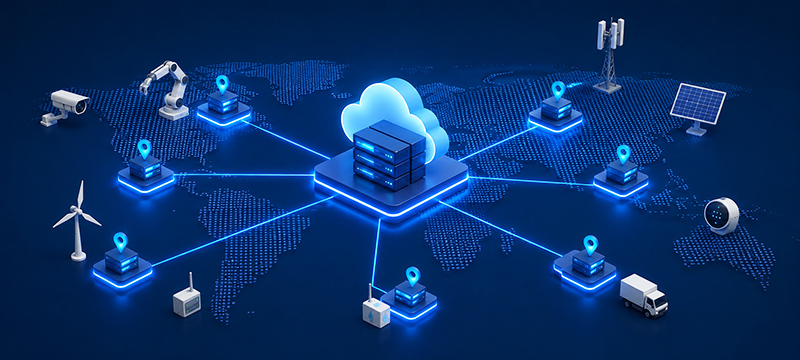
IoT once felt like a modest experiment: a handful of sensors in a single building, one monitoring screen, and a small team keeping watch. Now, the landscape has flipped. Today’s IoT rollouts stretch across numerous locations, involve multiple suppliers, connect thousands or even millions of gadgets, and demand constant real-time performance.
That’s the point where teams face a hard reality: expanding IoT isn’t simply about connecting more hardware. It’s about dependably shuttling data, software patches, and instructions across unstable networks in various regions without blowing up your cloud expenses or overwhelming your support staff.
This is precisely why CDN networks are turning into a vital component for growing IoT systems.
IoT data doesn’t behave like typical web traffic
When folks picture “IoT data,” they think of small sensor pings. But actual deployments involve far more than simple measurements:
- Firmware and over-the-air updates — hefty files pushed to entire device fleets
- Device setup profiles — updated often, must stay uniform
- Certificates and encryption keys — security-critical, time-sensitive
- Logs and diagnostic data — unpredictable bursts, usually during emergencies
- Edge-to-cloud interfaces — delay-sensitive, with repeated attempts and surges
Now stretch that across thousands of devices scattered over areas with inconsistent network quality. You’re not merely running a program; you’re managing a spread-out system where breakdowns are common and timing is crucial.
CDNs cut delay where it truly counts
IoT doesn’t always demand microsecond precision, but lag can trigger tangible issues:
- An automated production line stalled waiting for a configuration file
- A vehicle device draining its battery from constant timeouts
- Photo or video feeds from distant locations choking the upload channel
- An instruction arriving too late to be of any use
CDNs assist by storing and delivering content nearer to devices, so rather than everything drawing from one central source, gadgets retrieve from a local edge node. That “shorter route” can mean the gap between seamless functioning and endless reattempts.
The major breakthrough: OTA updates without mayhem
Question any IoT crew what keeps them awake at night and the answer is “updates.”
When you deploy firmware across a large fleet, infrastructure gets strained.
- You can’t send a 200MB firmware file to 200,000 gadgets from one source without careful preparation.
- You can’t expect every device to download flawlessly on the initial attempt.
- You require speed controls, resumable transfers, and steady performance.
A solid CDN provider excels at spreading large files dependably. They handle demand surges, ease the burden on your main servers, and boost completion rates, particularly in areas where connections are unreliable. Put simply: it transforms OTA updates from a “major event” into a standard procedure.
Improved durability during failures and demand surges
IoT systems act up during crises because that’s when every device tries to reconnect simultaneously.
Scenarios:
- A glitch sets off a wave of reconnection tries
- A sensor hub drops offline and then floods the network with queued data upon return
- An area suffers packet loss and gadgets begin retry avalanches
CDN edge systems can relieve stress on your central infrastructure by managing caching and local delivery. This won’t fix every issue — you still need sensible retry strategies — but it offers breathing room when situations get messy.
Security is another factor CDNs are essential
Growing IoT securely isn’t just “enable TLS and move on.” You’re handling device credentials, certificates, and trust relationships continuously.
CDN platforms typically include tools that support this:
- DDoS defense
- Web application firewall and bot blocking — valuable for safeguarding management interfaces and dashboards
- TLS handling and up-to-date encryption standards
- Request throttling and bandwidth management
For IoT, security isn’t abstract. A hijacked device fleet can become a serious threat rapidly, and management endpoints are attractive targets.
Edge computing is driving CDN adoption even deeper
Many IoT configurations are moving toward “edge-first” processing, screening data, executing analysis, or making rapid choices locally. CDNs are increasingly intersecting with this trend through edge functions and spread-out computing power.
This is significant because not every IoT transmission needs to reach a central cloud hub. Occasionally you need local routing, local verification, local summarization, and local rule enforcement. Even if you’re not leveraging edge computing now, building with edge distribution in mind prepares you for the future.
A hands-on way to view it
If your IoT rollout is expanding, you’ll likely run into one — or several — of these obstacles:
- “Our main server can’t cope with OTA update surges.”
- “Gadgets in specific areas constantly time out.”
- “Support requests jump every time we push changes.”
- “We need tougher DDoS/security measures for device-facing services.”
- “We can’t justify routing everything through a single region anymore.”
CDNs aren’t a cure-all, but they’re a tested infrastructure element for tackling precisely these challenges at internet scale.
Closing thought
IoT growth is less about sensors and more about dependability at the edge. The larger your device fleet becomes, the more you require distribution, caching, fault tolerance, and security woven into the delivery layer. That’s why CDN networks are shifting from “optional” to “essential” in contemporary IoT designs.
