



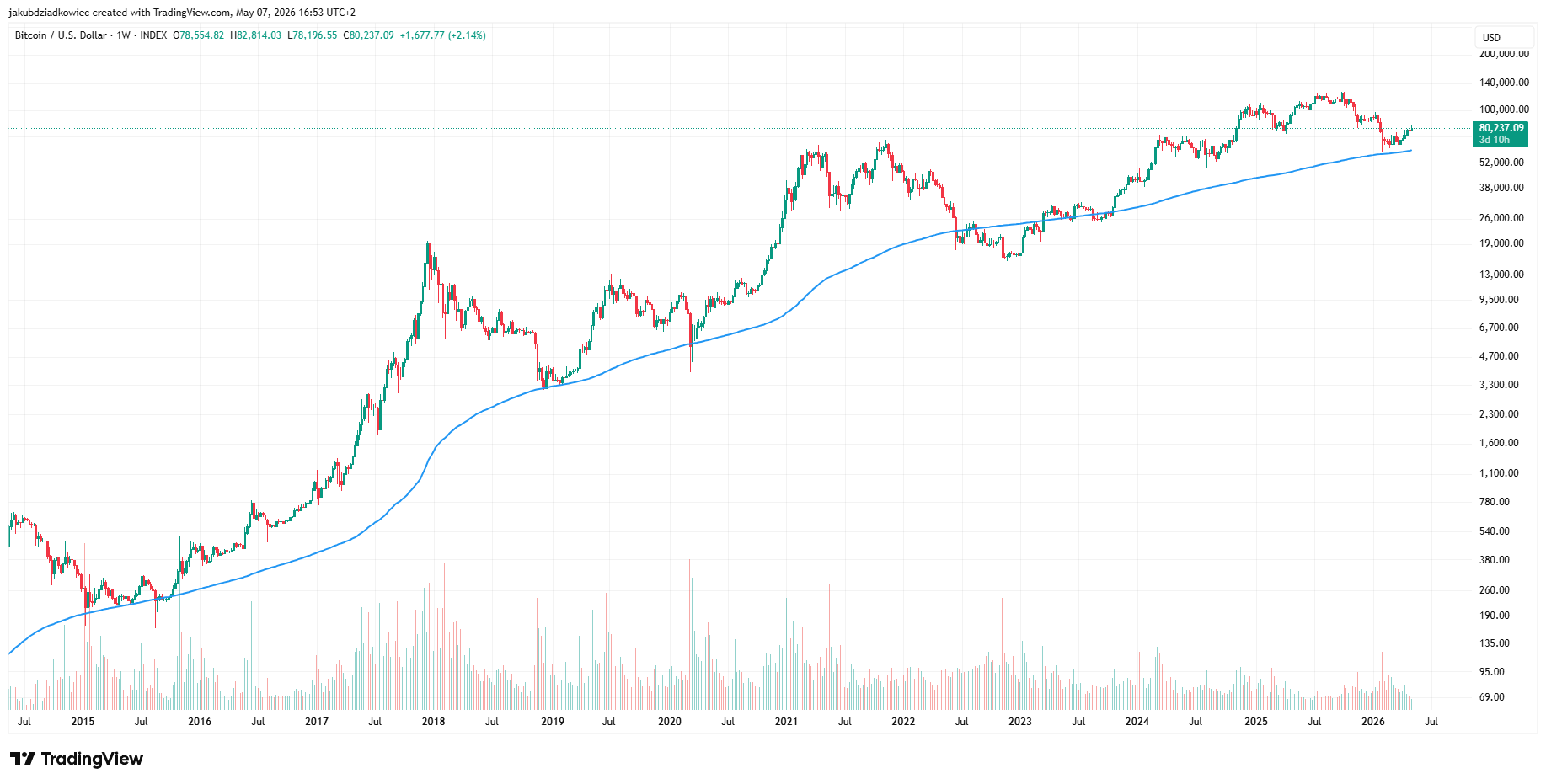
Bitcoin’s on-chain metrics have reached extreme value levels typically associated with market cycle bottoms, despite the price having only fallen about 40% from its peak. This decline is significantly smaller than the 75% to 85% drops that characterized previous bear markets.
Six popular indicators are now telling the same story. They depict a market that has corrected sharply without an euphoric peak, while long-term holders showed no signs of selling.
Bitcoin Cycle: A Reset Without a Meltdown
Three indicators measuring the relationship between price and trend all confirm the same message.
The Mayer Multiple Z-Score compares Bitcoin’s (BTC) price to its 200-day moving average. The reading recently fell to around -1.5 standard deviations. Such extreme values have occurred only twice before in Bitcoin’s recent history.
The first was in March 2020, when prices hovered around $3,000. The second came during the FTX collapse in late 2022, near $19,000. The recent reading showed up at roughly $62,000. BTC has since rebounded toward $80,000.

The Bitcoin Sharpe Ratio also reinforces this picture. The indicator has dipped into the “Low Risk” range, the same territory that marked the 2015, 2019, and 2022 cycle bottoms.
Each previous occurrence in this zone preceded a substantial rally, though the sample size remains limited.
The percentage of Bitcoin supply sitting at a loss has climbed to roughly 39%, based on data from In The Cryptoverse. This level has historically appeared during the later stages of bear markets, not when the price remains in six figures. The gap between the high price level and widespread holder pain stands out as this cycle’s most unusual feature.

Bitcoin’s 200-week moving average provides a fourth confirmation. This line has historically acted as the base for every past cycle. It broke briefly in 2018 and was briefly breached in 2020 and 2022. This time, the 200WMA was touched but held without a decisive break.
A Bitcoin Cycle Without a Clear Peak
The capitulation signals are particularly striking because they lack a matching counterpart: the euphoric top.
The CBBI Bitcoin Bull Run Index combines multiple cycle-related metrics into a single composite. During the current run, the index never entered its extreme zone above 80. Every earlier bull cycle, including 2013, 2017, and 2021, crossed that threshold decisively. The current chart clearly highlights the missing signal with an X.

Glassnode’s Net Unrealized Profit and Loss (NUPL) data paints a similar picture. The metric uses color-coded zones ranging from blue (euphoria) to red (capitulation). The 2024 to 2026 run peaked in the green “belief” zone without ever entering the blue.
By that measure, the market never reached the widespread greed levels that historically marked a cycle high. NUPL has since declined into the orange zone, which corresponds to mid-bear or pre-bottom positioning.
This trajectory resembles the path NUPL followed in 2018 and 2022, though the underlying price action differs considerably.

The Cohort That Wouldn’t Sell
The most notable signal is found in long-term holder behavior.
Glassnode classifies long-term holders (LTH) as wallets that have held Bitcoin for at least 155 days. In every previous cycle, this group distributed heavily near the top. The LTH supply curve fell as new buyers absorbed the coins. This pattern played out consistently in 2014, 2018, and 2021.

This cycle deviated from that pattern. LTH supply dipped modestly in 2024 but has since climbed back to record levels, exceeding 14.5 million BTC. Long-term holders now display peak conviction while price sits well above the 200-week moving average.
This behavior can be interpreted in two ways. The optimistic view is that long-term holders are anticipating a higher peak that hasn’t materialized yet. The structural explanation is that the LTH cohort has changed in composition, now including ETF cold storage, sovereign reserves, and corporate treasuries governed by non-cyclical strategies.
Both interpretations support the idea that this cycle follows a different pattern, and neither by itself justifies a continued bearish outlook from current levels.
An Asymmetric Setup
Taken together, six on-chain charts present an unusual combination. Capitulation-level readings show up in three price-derived indicators.
No euphoria appears in two sentiment-based indicators. And no distribution is visible in the cohort that historically defines the top.
Markets rarely display all three conditions simultaneously.
The simplest interpretation is that Bitcoin has undergone a deep on-chain reset without forming an euphoric peak, and the holders most inclined to sell have held firm.
Historically, this combination has led to positive outcomes.
A counterargument is worth considering. If the four-year cycle model is truly broken, the same reasoning could apply to the prior cycle bottom signals.
The Mayer Z, Sharpe Ratio, and capitulation readings have worked as buy zones because they reflect recurring market psychology. A structurally different cycle could mean those signals carry less predictive power than historical results imply.
For long-term observers, the on-chain picture still tilts favorably. Price sits well below the cycle high yet remains above the 200-week moving average.
Holder conviction remains strong, and historically rare buy signals have aligned. Whether the cycle produces another rally or enters a prolonged consolidation, the current data stands out as the strongest on-chain bottom signal Bitcoin has generated in years.
The post Bitcoin Cycle Breaks Pattern as On-Chain Metrics Hit 4-Year Low appeared first on BeInCrypto.
