



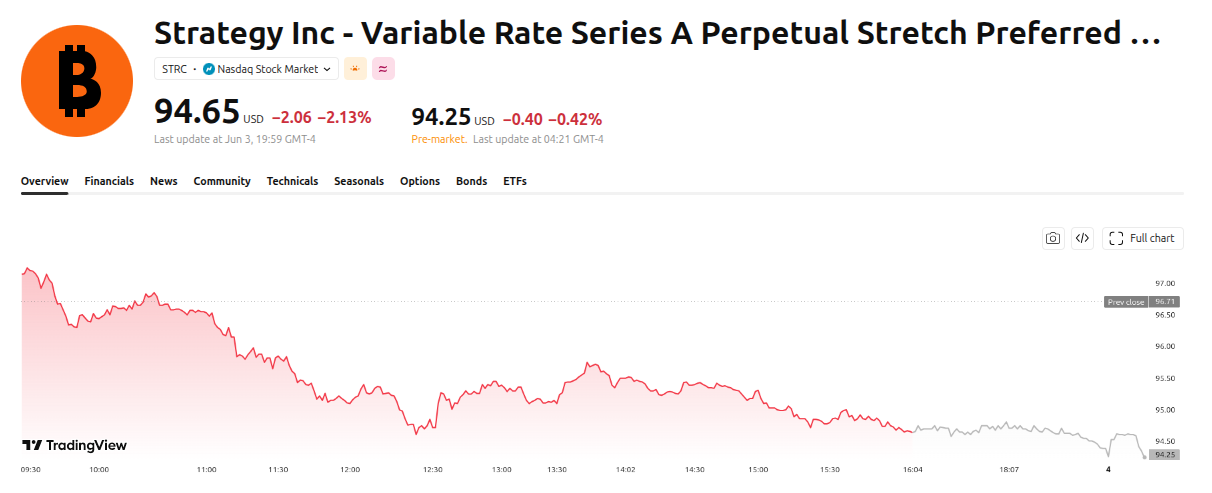
On June 3, 2026, MicroStrategy’s preferred stock STRC dipped under $95 for the first time in three months, ending the day at $94.65. This drop came as Bitcoin plunged to $62,000, sparking over $1.66 billion in liquidations across the market.
Here’s a clear breakdown of what STRC is, why its price fell, and what this shift could mean for Bitcoin investors today.
What Pushed STRC Below Its Target Range
STRC stands for Strategy’s Variable Rate Series A Perpetual Stretch Preferred Stock. It carries a $100 par value and is built to offer a high variable yield of roughly 11.5% per year. The product is aimed at income-seeking investors who want indirect exposure to Bitcoin without the sharp swings that come with holding MSTR directly.
The stock relies on flexible dividend adjustments to keep its price hovering close to par. When demand softens and the price slips, the company can boost the yield to gradually draw the price back upward, preserving the original design of the instrument.
That mechanism is now facing a real test. STRC fell more than 2%, closing at $94.65 and breaking through a psychological threshold that investors had grown accustomed to during a stretch of relative calm over the past few months.
Stay up to date by following us on X
Well-known trader Scott Melker, often called “The Wolf of All Streets,” offered some helpful perspective on social media. “STRC’s $100 par value is not a guaranteed floor,” he noted.
“A 5% discount to par doesn’t mean something is wrong. It simply means investors are pricing in higher risk, demanding a better yield, or reacting to current market conditions — which is exactly how preferred stocks are supposed to behave,” he added.
The decline lined up with broader market chaos. Bitcoin slid as low as $62,000 over a 24-hour span, setting off more than $1.66 billion in crypto liquidations, with the majority coming from long positions on major derivatives exchanges.
Strategy also added to the pressure by offloading Bitcoin for the first time since 2022 to help cover preferred dividend payments. While the amount was small, it shook the “never sell” story that Executive Chairman Michael Saylor has long promoted to markets worldwide.
How STRC Trading Below Par Weighs on Bitcoin Sentiment
The STRC discount is significant because it directly impacts Strategy’s ability to keep accumulating Bitcoin. With shares trading below $95, issuing new preferred stock becomes much less appealing, effectively narrowing one of the company’s key avenues for raising capital.
Analyst Juan Rodríguez shared a blunt take on social media. “STRC is adding bearish pressure on Bitcoin’s price,” he wrote. “It signals risk rather than future BTC buying. Investors are pulling out capital at $95 and taking losses.”
Economist Peter Schiff, a well-known Bitcoin critic and gold advocate, pointed out the mechanical risks built into the structure. As STRC’s price drops further, Strategy will need to raise the dividend rate even more aggressively to pull the share price back toward $100.
According to Schiff, this would speed up the company’s cash burn and push Bitcoin sales forward to fund the higher payouts.
The math is simple. When STRC trades at or above par, new share issuance efficiently funds additional BTC purchases. Below par, the company must offer higher yields to attract buyers, which increases cash outflows at a time when Bitcoin’s price is already struggling.
Strategy’s capital structure was designed to thrive in a rising Bitcoin environment. The current setup — with BTC at $63,500, a recent small sale to cover dividends, and STRC trading below its target range — presents a far less favorable picture than during the recent rally.
The firm still holds over 843,706 BTC and maintains sizable cash reserves. However, MSTR common shares have also come under selling pressure, highlighting how closely MicroStrategy’s layered capital structure and Bitcoin-focused corporate identity are intertwined.
For income-focused investors, the current discount delivers a higher effective yield approaching 12%. Still, that yield comes with paper losses and growing uncertainty about whether dividends can be sustained if Bitcoin’s weakness persists in the months ahead.
STRC’s Critical Shareholder Vote Looms Large
This latest round of weakness in STRC is playing out with just days to go before a pivotal shareholder vote on a proposed change to the dividend schedule.
With the June 7 deadline rapidly approaching, holders of both STRC and MSTR shares are being asked to approve a switch from monthly to semi-monthly dividend payments — keeping the 11.5% annualized rate the same but distributing payouts roughly every two weeks. The timing could hardly be worse.
As STRC trades at a multi-month low and Bitcoin continues to face headwinds, the amendment is intended to reduce reinvestment delays, tighten price movement around par, and provide more predictable cash flow for income-oriented investors.
That said, the slide in preferred shares has intensified worries about the broader capital structure, with critics warning it could accelerate cash burn and force earlier Bitcoin sales if the stock fails to bounce back.
MicroStrategy insists the change will strengthen its “capital turbine” model, yet the current market stress has turned the upcoming vote into a crucial test of investor confidence at an especially fragile moment.
The post MicroStrategy’s STRC Slips Below $95, Adding New Pressure on Bitcoin Amid the Market Sell-Off appeared first on BeInCrypto.
