



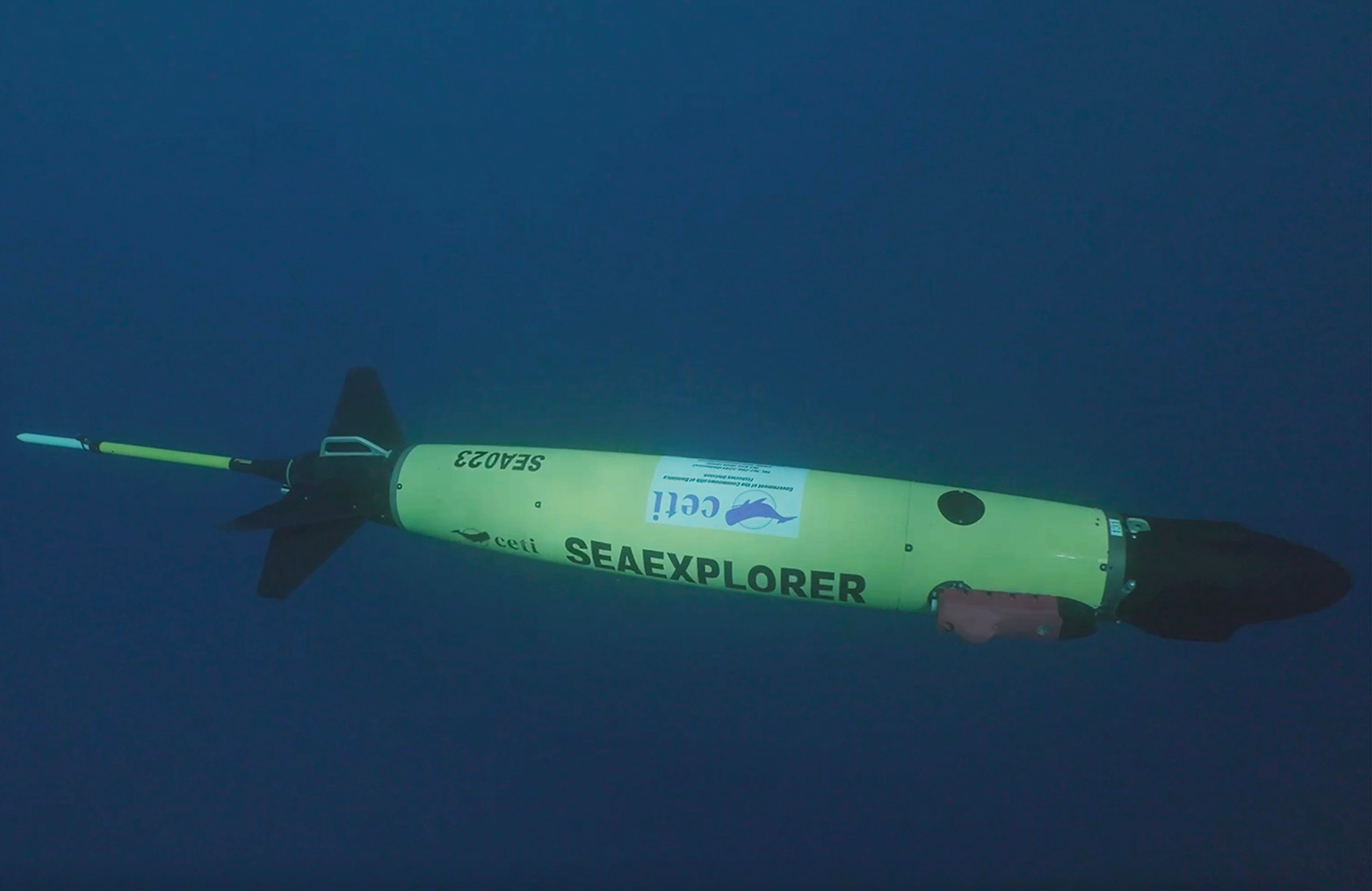
When the Project CETI glider surfaces periodically, it communicates with the research team. | Source: Project CETI, David Gruber
The Cetacean Translation Initiative, commonly referred to as Project CETI, announced yesterday that it is partnering with French robotics developer Alseamar to deploy underwater gliders that track sperm whales by listening to their vocalizations. The team also released a peer-reviewed study detailing its latest findings.
Until now, Project CETI has relied on several different technologies to monitor whale movements, including deploying buoys or boats to gather data and attaching tags to whales via drones. With the addition of the underwater glider, the organization can now follow whales beneath the ocean’s surface.
“Tracking whales comes with many challenges, since they only spend about 10 minutes at the surface before diving for roughly 50 minutes,” said David Gruber, founder and president of Project CETI, in an interview with The Robot Report. “Forecasting exactly when and where they’ll be in that vast three-dimensional ocean space is one of our toughest obstacles.”
Project CETI has installed its Backseat Driver system into the gliders. This technology picks up whale calls and steers the glider to trail the animals autonomously.
“The first deployment of a SEAEXPLORER glider in Dominica was already a significant milestone,” said Jérémy Sitbon, systems architect at Alseamar. “On top of that, working with Project CETI gave us access to an extraordinary depth of knowledge in sperm whale monitoring.”
“This collaboration was also notable because Project CETI was one of the first teams to harness an intelligent acoustic platform while running its own algorithms directly onboard,” he added. “It was also among the earliest long-term acoustic monitoring missions ever carried out using the SEAEXPLORER platform.”
What led Project CETI to adopt a glider?
According to Roee Diamant, underwater acoustics lead at Project CETI, buoys, boats, and tags all come with drawbacks when it comes to capturing whale vocalizations. Both buoys and boats frequently pick up unwanted background noise—such as friction—making it harder for the team to isolate whale sounds.
“Tags are useful. We do use them on the whales in Project CETI, but they only last a short time. You can attach a tag for maybe around 24 hours or so,” Roee explained. “The problem is that tags don’t capture the bigger picture of interaction, because you only hear the whale you’ve tagged. It’s extremely difficult to engineer a tag that can listen to both the tagged whale and the whales around it, since the sound levels are so intense.”
In contrast, the glider can detect whale sounds, determine the direction they’re coming from, track them, and eventually even pinpoint which specific whale is calling.
“Unlike powered vehicles such as underwater drones or surface vessels, the glider propels itself by adjusting its buoyancy. It shifts its center of mass to move up or down,” Roee explained. This motion causes the glider to travel in a sawtooth-like pattern through the water. When riding along with ocean currents, the glider can move at up to half a knot faster than the surrounding water, he noted.
“The great advantage of this method is that it uses very little energy, so the battery lasts for extended periods. Some gliders can monitor the ocean for as long as six months,” Roee said. “Every couple of hours—typically two to four—it surfaces and transmits data via satellite.”
This mode of travel is also exceptionally quiet, meaning the glider’s presence doesn’t disturb the whales. “The glider is like having a gentle, unobtrusive observer silently recording and listening in,” Gruber said. “It’s a way of peering into their world without disrupting it.”
How the undersea glider listens in on whales
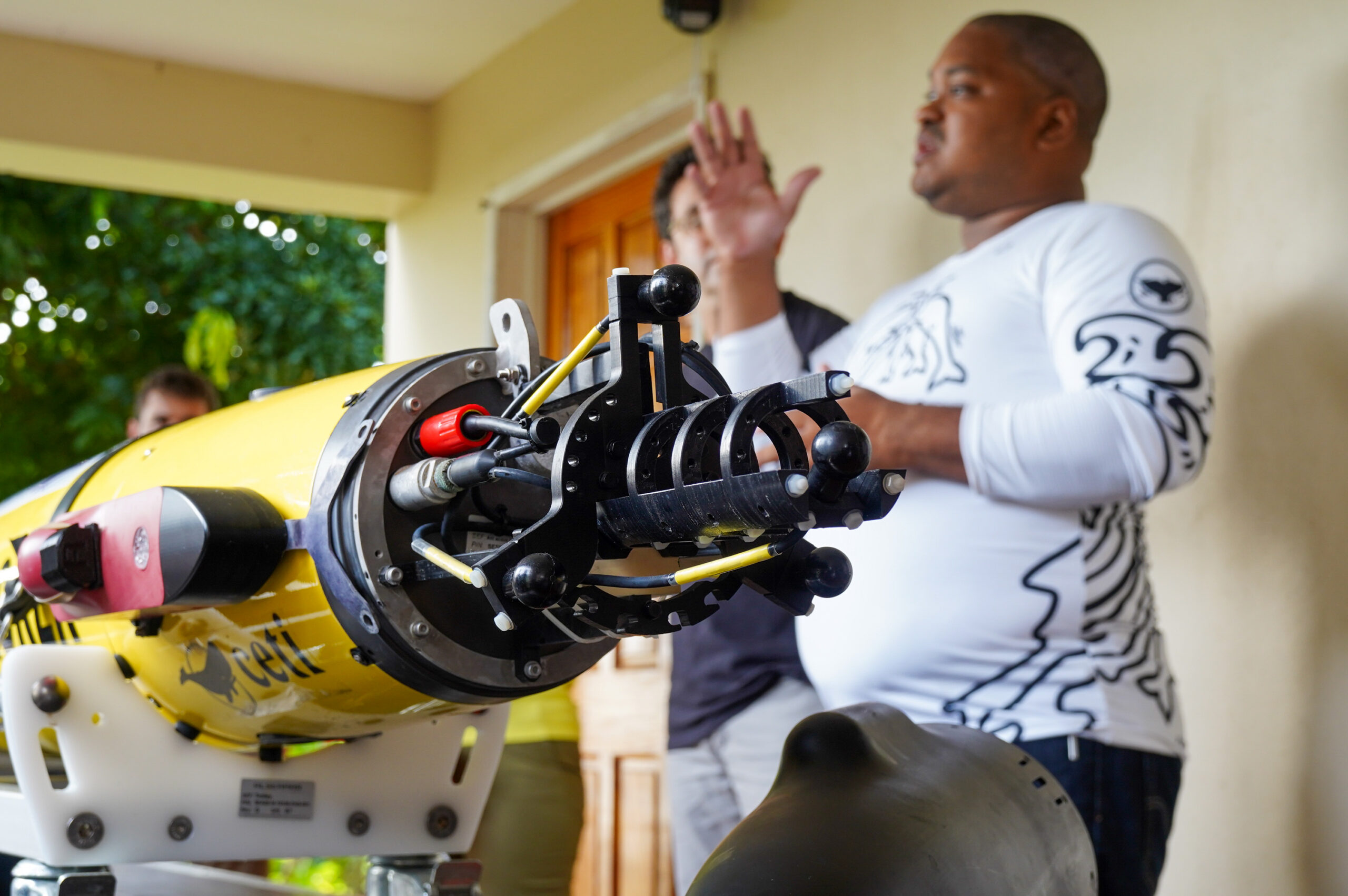
Project CETI custom-designed the sensor array positioned at the front of the glider. | Source: Project CETI, Ashley Zafaranlou
Mounted at the glider’s nose is a sensor stack featuring four tetrahedral microphone arrays. The CETI team had to carefully decide both the placement and the spacing of these microphones so that the glider could accurately determine the direction from which sounds originate, Gruber explained.
“Once the glider detects a whale, it can approach using several strategies. It selects a whale of interest and calculates its angle of arrival,” Roee said. “This process happens continuously without any human involvement—every decision is made entirely by the glider on its own.”
Currently, Project CETI can detect whale vocalizations from distances of around 12 km underwater, though this range varies depending on the type of call the whale produces.
“What we’re really focused on right now is improving our ability to pinpoint where the whales are located, separate the sounds of different whales from one another, and—most importantly, moving toward CETI’s ultimate goal—accurately classify individual whales,” said Roee. “So if we pick up a particular whale call, can we determine exactly which whale is making it?”
Alseamar’s flexibility and open-source approach were key
Gruber noted that Alseamar wasn’t the only underwater glider provider Project CETI evaluated.
The team was excited to explore potential partnerships, and Alseamar stood out for its readiness to team up with Project CETI on developing glider technology.
“This collaboration between academia and industry has been truly one-of-a-kind. While we handle some components like the whale tags entirely in-house, we don’t have the expertise to build a glider from scratch—and there’s no reason to reinvent what already works,” explained Gruber. “Instead, we partnered with Alseamar, who helped us design and integrate the four microphones mounted on the front of the glider—the acoustic payload—which was a key innovation.”
The gliders used by Project CETI rely on two separate systems: a science computer and a navigation computer. A major modification developed by Alseamar was enabling these two computers to exchange data with each other.
“A critical requirement was supporting onboard algorithm integration,” said Sitbon. “Standard gliders use a closed software system and only receive commands via satellite (Iridium) when they surface. For this initiative, we reengineered that approach so external researchers could upload their own algorithms directly onto the glider. This allowed the robot to adjust its actions in real time while submerged—boosting its effectiveness in tracking sperm whale behavior.”
“Alseamar has been incredibly adaptable in pioneering new methods and tech for our glider,” Roee remarked. “They gave us the freedom to customize the nose of the glider and add extra hydrophones to enable the Backseat Driver feature—a capability that no other glider currently offers, and one that didn’t exist when we started.”
Project CETI Conducts Initial Field Trials with Glider
To date, Project CETI has deployed two gliders for real-world testing. The first trials took place off the coast of southern France, where controlled experiments were run to see if the robot could track underwater sound signals emitted by boats.
“After validating performance in that controlled setting, we moved on to extended deployments around Dominica Island,” said Roee. “Our longest mission lasted over a week, during which we collected far more data than in any previous outing.”
During that week-long mission, Roee noted that the glider detected whale vocalizations 40% of the time it was submerged. Going forward, the team hopes to leave the gliders operating for months at a stretch. Last year, using drones and underwater microphones, Project CETI made history by capturing audio of a live whale birth—an event never before documented by humans.
“Observing that birth was like hitting the ultimate goal—the most complex natural behavior we hope one day to decode,” Gruber reflected. With the enhanced gliders, the team aims to record even more extraordinary marine moments.
Scientists Aim to Boost Robotic Platform Performance
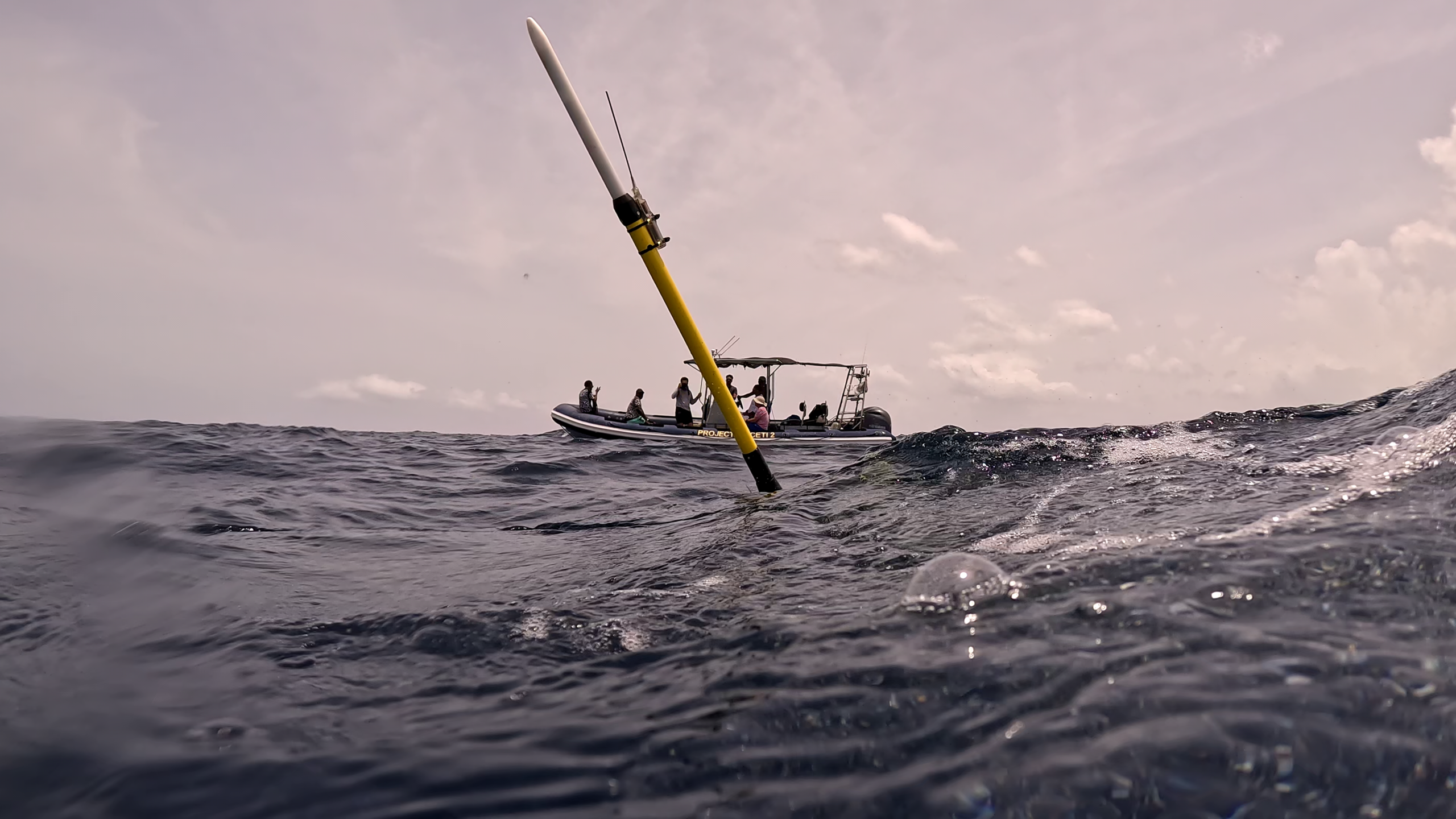
The Project CETI Glider reemerges from the ocean in Dominica after a mission. | Source: Project CETI, Zahrek Gonzalez-Peltier
In the near future, Project CETI plans to focus on refining its artificial intelligence systems and expanding the capabilities of its gliders.
“Our next big step in robotics is getting all our different tools—gliders, small sensor buoys, tags, and drones that deploy the tags—to work together seamlessly,” Roee explained. “And we want this coordination to happen entirely on its own, without human intervention.”
The group also intends to maintain its partnership with Alseamar.
“We absolutely plan to keep this collaboration going, especially when it comes to training and sharing technical knowledge,” Sitbon shared. “Although the glider platform is already well-developed, we’re always working to improve its durability, energy efficiency, and overall reliability. Our goals include adding new sensors, boosting consistency between missions, and cutting power use so the gliders can operate longer.”
Gruber added that he’s eager to connect with other forward-thinking robotics innovators. “We’re looking for creative minds—people who think differently and aren’t afraid to tackle challenges others might consider impossible,” he said.

