



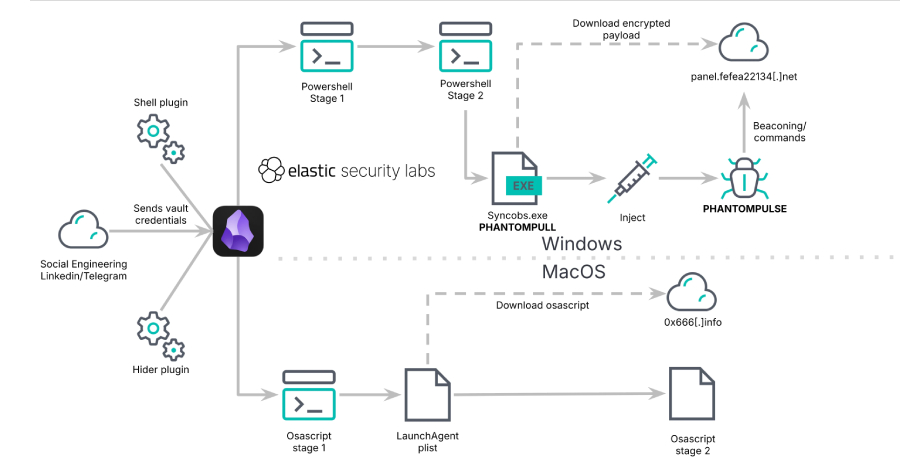
A “novel” social engineering marketing campaign has been noticed abusing Obsidian, a cross-platform note-taking software, as an preliminary entry vector to distribute a beforehand undocumented Home windows distant entry trojan referred to as PHANTOMPULSE in assaults focusing on people within the monetary and cryptocurrency sectors.
Dubbed REF6598 by Elastic Safety Labs, the exercise has been discovered to leverage elaborate social engineering techniques via LinkedIn and Telegram to breach each Home windows and macOS techniques, approaching potential people underneath the guise of a enterprise capital agency after which shifting the dialog to a Telegram group the place a number of purported companions are current.
The Telegram group chat is engineered to lend the operation a smidgen of credibility, with the members discussing subjects associated to monetary companies and cryptocurrency liquidity options. The goal is then instructed to make use of Obsidian to entry what seems to be a shared dashboard by connecting to a cloud-hosted vault utilizing the credentials offered to them.
It is this vault that triggers the an infection sequence. As quickly because the vault is opened within the note-taking software, the goal is requested to allow “Installed community plugins” sync, successfully inflicting malicious code to be executed.
“The threat actors abuse Obsidian’s legitimate community plugin ecosystem, specifically the Shell Commands and Hider plugins, to silently execute code when a victim opens a shared cloud vault,” researchers Salim Bitam, Samir Bousseaden, and Daniel Stepanic mentioned in a technical breakdown of the marketing campaign.
Provided that the choice is disabled by default and can’t be remotely turned on, the attacker should persuade the goal to manually toggle the group plugin sync on their machine in order that the malicious vault configuration can set off the execution of instructions via the Shell Instructions plugin. Additionally used along side Shell Instructions is one other plugin named Hider to cover sure consumer interface parts of Obsidian, comparable to standing bar, scrollbar, tooltips, and others.
“While this attack requires social engineering to cross the community plugin sync boundary, the technique remains notable: it abuses a legitimate application feature as a persistence and command execution channel, the payload lives entirely within JSON configuration files that are unlikely to trigger traditional AV [antivirus] signatures, and execution is handed off by a signed, trusted Electron application, making parent-process-based detection the critical layer,” the researchers mentioned.
Devoted execution paths are activated relying on the working system. On Home windows, the instructions are used to invoke a PowerShell script to drop an intermediate loader codenamed PHANTOMPULL that decrypts and launches PHANTOMPULSE in reminiscence.
PHANTOMPULSE is a synthetic intelligence (AI)-generated backdoor that makes use of the Ethereum blockchain for resolving its command-and-control (C2) server by fetching the newest transaction related to a hard-coded pockets deal with. Upon acquiring the C2 deal with, the malware makes use of WinHTTP for communications, permitting it to ship system telemetry knowledge, fetch instructions and transmit the execution outcomes, add information or screenshots, and seize keystrokes.
The supported instructions are designed to facilitate complete distant entry –
- inject, to inject shellcode/DLL/EXE into goal course of
- drop, to drop a file to disk and execute it
- screenshot, to seize and add a screenshot
- keylog, to begin/cease a keylogger
- uninstall, to provoke removing of persistence and carry out cleanup
- elevate, to escalate privileges to SYSTEM by way of the COM elevation moniker
- downgrade, to transition from SYSTEM to elevated admin
On macOS, the Shell Instructions plugin delivers an obfuscated AppleScript dropper that iterates over a hard-coded area checklist, whereas using Telegram as a lifeless drop resolver for fallback C2 decision. This method additionally provides added flexibility because it makes it attainable to simply rotate C2 infrastructure, rendering domain-based blocking inadequate.
Within the last step, the dropper script contacts the C2 area to obtain and execute a second-stage payload by way of osascript. The actual nature of this payload stays unknown on condition that the C2 servers are at the moment offline. The intrusion was finally unsuccessful, because the assault was detected and blocked earlier than the adversary may accomplish their targets on the contaminated machine.
“REF6598 demonstrates how threat actors continue to find creative initial access vectors by abusing trusted applications and employing targeted social engineering,” Elastic mentioned. “By abusing Obsidian’s community plugin ecosystem rather than exploiting a software vulnerability, the attackers bypass traditional security controls entirely, relying on the application’s intended functionality to execute arbitrary code.”
