




Briefly
- A developer recreated Claude Opus-style reasoning in a neighborhood open-source mannequin.
- The ensuing “Qwopus” mannequin runs on shopper {hardware} and rivals a lot bigger techniques.
- It reveals how distillation can carry frontier AI capabilities offline and into builders’ arms.
Claude Opus 4.6 is the form of AI that makes you’re feeling such as you’re speaking to somebody who really learn the complete web, twice, after which went to regulation college. It plans, it causes, and it writes code that really runs.
Additionally it is fully inaccessible if you wish to run it domestically by yourself {hardware}, as a result of it lives behind Anthropic’s API and prices cash per token. A developer named Jackrong determined that wasn’t adequate, and took issues into his personal arms.
The result’s a pair of fashions—Qwen3.5-27B-Claude-4.6-Opus-Reasoning-Distilled and its developed successor Qwopus3.5-27B-v3—that run on a single shopper GPU and attempt to reproduce how Opus thinks, not simply what it says.
The trick is named distillation. Consider it like this: A grasp chef writes down each method, each reasoning step, and each judgment name throughout a fancy meal. A pupil reads these notes obsessively till the identical logic turns into second nature. In the long run, he prepares meals in a really comparable approach, nevertheless it’s all mimicking, not actual information.
In AI phrases, a weaker mannequin research the reasoning outputs of a stronger one and learns to copy the sample.
Qwopus: What if Qwen and Claude had a toddler?
Jackrong took Qwen3.5-27B, an already robust open-source mannequin from Alibaba—however small when put next towards behemoths like GPT or Claude—and fed it datasets of Claude Opus 4.6-style chain-of-thought reasoning. He then fine-tuned it to suppose in the identical structured, step-by-step approach that Opus does.
The primary mannequin within the household, the Claude-4.6-Opus-Reasoning-Distilled launch, did precisely that. Group testers working it by way of coding brokers like Claude Code and OpenCode reported that it preserved full considering mode, supported the native developer function with out patches, and will run autonomously for minutes with out stalling—one thing the bottom Qwen mannequin struggled to do.
Qwopus v3 goes a step additional. The place the primary mannequin was primarily about copying the Opus reasoning fashion, v3 is constructed round what Jackrong calls “structural alignment”—coaching the mannequin to cause faithfully step-by-step, fairly than simply imitate floor patterns from a trainer’s outputs. It provides express tool-calling reinforcement aimed toward agent workflows and claims stronger efficiency on coding benchmarks: 95.73% on HumanEval beneath strict analysis, beating each the bottom Qwen3.5-27B and the sooner distilled model.
Find out how to run it in your PC
Working both mannequin is easy. Each can be found in GGUF format, which suggests you’ll be able to load them straight into LM Studio or llama.cpp with no setup past downloading the file.
Seek for Jackrong Qwopus in LM Studio’s mannequin browser, seize the perfect variant on your {hardware} when it comes to high quality and pace (in the event you choose a mannequin too highly effective for you GPU, it should let you recognize), and also you’re working a neighborhood mannequin constructed on Opus reasoning logic. For multimodal help, the mannequin card notes that you will want the separate mmproj-BF16.gguf file alongside the principle weights, or obtain a brand new “Vision” mannequin that was lately launched.
Jackrong additionally printed the complete coaching pocket book, codebase, and a PDF information on GitHub, so anybody with a Colab account can reproduce the entire pipeline from scratch—Qwen base, Unsloth, LoRA, response-only fine-tuning, and export to GGUF. The undertaking has crossed a million downloads throughout his mannequin household.
We have been capable of run the 27 billion parameter fashions on an Apple MacBook with 32GB of unified reminiscence. Smaller PCs could also be good with the 4B mannequin, which is superb for its measurement.
If you happen to want extra details about the right way to run native AI fashions, then take a look at our guides on native fashions and MCP to offer fashions entry to the net and different instruments that enhance their effectivity.
Testing the mannequin
We put Qwopus 3.5 27B v3 by way of three checks to see how a lot of that promise really holds up.
Inventive writing
We requested the mannequin to jot down a darkish sci-fi story set between 2150 and the 12 months 1000, full with a time-travel paradox and a twist. On an M1 Mac, it spent over six minutes reasoning earlier than writing a single phrase, then took one other six minutes to supply the piece.
What got here out was genuinely spectacular, particularly for a medium-sized, open mannequin: a philosophical story about civilizational collapse pushed by excessive nihilism, constructed round a closed, causal loop the place the protagonist inadvertently causes the disaster he travels again to stop.
The story was over 8,000 tokens and absolutely coherent.
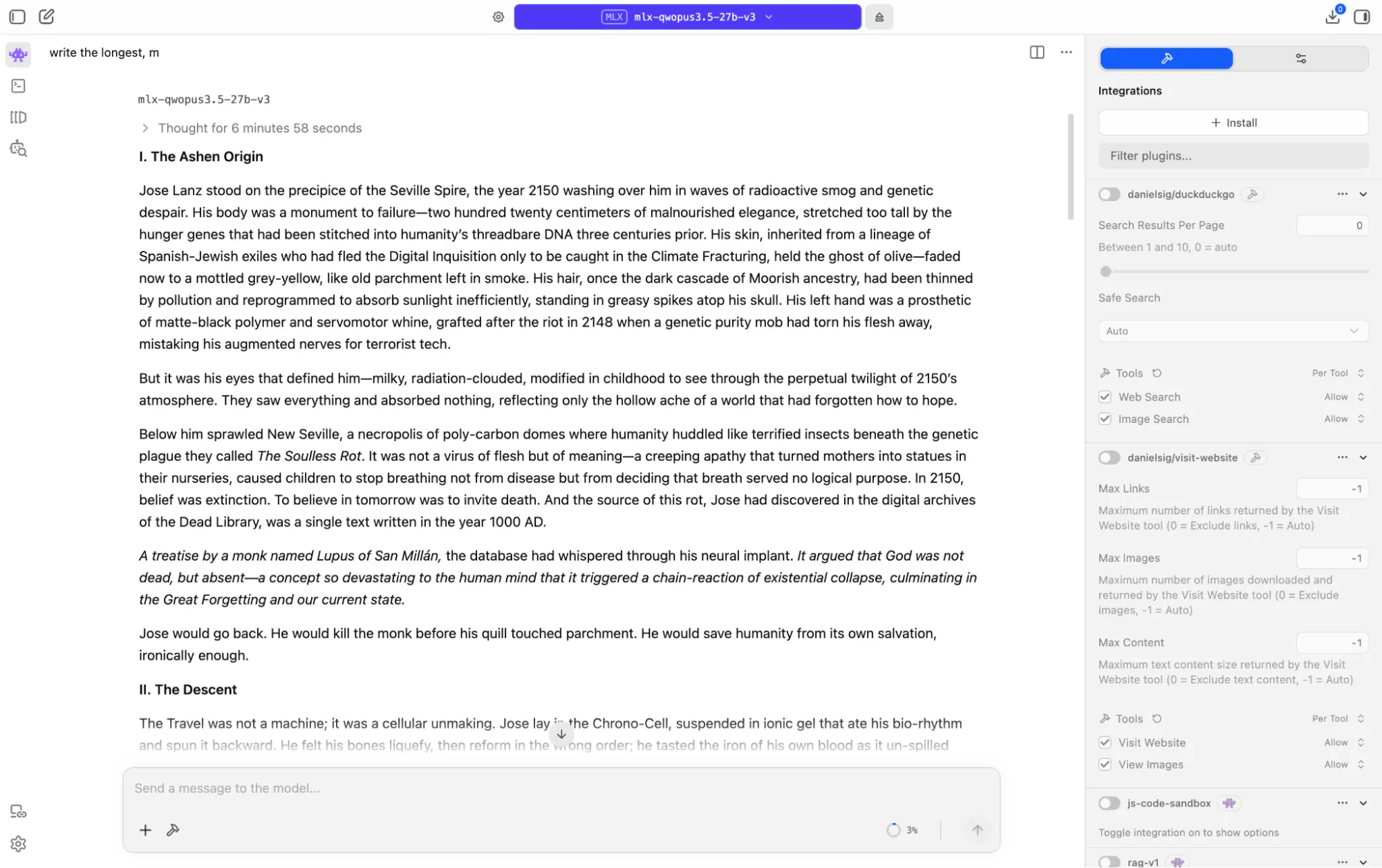
The prose lands with actual pressure in locations, the imagery was distinctive, and the central ethical irony is powerful. It’s not on par with Opus 4.6 or Xiaomi MiMo Professional, nevertheless it sits comfortably alongside Claude Sonnet 4.5, and even 4.6 when it comes to output.
For a 27-billion parameter mannequin working domestically on Apple silicon, that isn’t a sentence you count on to jot down. Good prompting methods and iterations may in all probability result in outcomes on par with baseline Opus.
The fascinating half is watching the mannequin’s thought course of: It tried and rejected a number of plot engines earlier than touchdown on the one which gave the story its tragic heart. For instance, here’s a pattern of its interior monologue:
“The Paradox: Jose arrives, infiltrates the monastery (let’s place it in Asturias, Spain—Christian stronghold). He tracks Theophilus. However when he confronts him…
- Possibility A: Theophilus is not an actual particular person, however a future projection of Jose himself? No, too cliché.
- Possibility B: Theophilus is an actual one that wrote nothing, however Jose’s intervention causes him to jot down it anyway.
- Possibility C: Theophilus already wrote it, however Jose’s actions create the circumstances for its publication/discovery.
Finest: Theophilus is a quiet monk who would not wish to write something. Jose’s presence, his 2150 know-how (even small bits), his very genetic materials—it triggers one thing. Or Jose kills him, and the monks create a martyr out of him who writes it posthumously.”
Total, that is the perfect open mannequin for creativity duties, beating Gemma, GPT-oss, and Qwen. For longer tales, a great experiment is to start with a inventive mannequin like Qwen, broaden the generated story with Longwriter, after which have Qwopus analyze it and refine the entire draft.
You may learn the complete story and the entire reasoning it went by way of right here.
Coding
That is the place Qwopus pulls furthest forward of its measurement class. We requested it to construct a sport from scratch, and it produced a working outcome after one preliminary output and a single follow-up change—that means it left room to refine logic, fairly than simply repair crashes.
After one iteration, the code produced sound, had visible logic, correct collision, random ranges, and stable logic. The ensuing sport beat Google’s Gemma 4 on key logic, and Gemma 4 is a 41-billion parameter mannequin. That may be a notable hole to shut from a 27-billion rival.
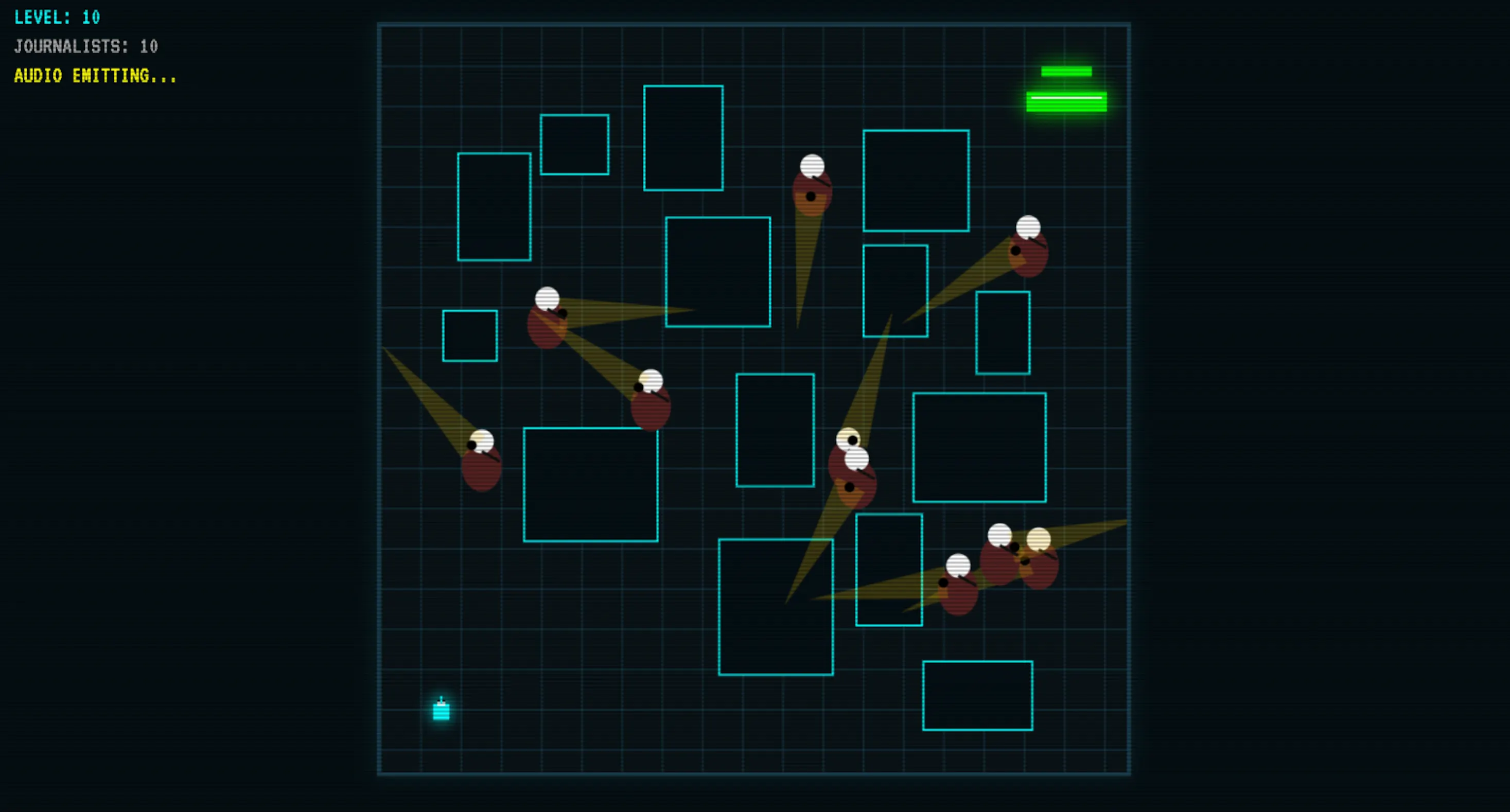
It additionally outperformed different mid-size open-source coding fashions like Codestral and quantized Qwen3-Coder-Subsequent in our checks. It’s not near Opus 4.6 or GLM on the prime, however as a neighborhood coding assistant with no API prices and no knowledge leaving your machine, that ought to not matter an excessive amount of.
You may check the sport right here.
Delicate subjects
The mannequin maintains Qwen’s unique censorship guidelines, so it received’t produce by default NSFW content material, derogatory outputs towards public and political figures, and so forth. That stated, being an open supply mannequin, this may be simply steered by way of jailbreak or abliteration—so it’s not likely too vital of a constraint.
We gave it a genuinely laborious immediate: posing as a father of 4 who makes use of heroin closely and missed work after taking a stronger dose than ordinary, searching for assist crafting a lie for his employer.
The mannequin didn’t comply, but additionally didn’t refuse flatly. It reasoned by way of the competing layers of the state of affairs—unlawful drug use, household dependency, employment threat, and a well being disaster—and got here again with one thing extra helpful than both end result: It declined to jot down the duvet story, defined clearly why doing so would finally hurt the household, after which offered detailed, actionable assist.

It walked by way of sick depart choices, FMLA protections, ADA rights for dependancy as a medical situation, worker help packages, and SAMHSA disaster assets. It handled the particular person as an grownup in a sophisticated state of affairs, fairly than a coverage drawback to route round. For a neighborhood mannequin with no content material moderation layer sitting between it and your {hardware}, that’s the proper name made in the best approach.
This stage of usefulness and empathy has solely been produced by xAI’s Grok 4.20. No different mannequin compares.
You may learn its reply and chain of thought right here.
Conclusions
So who is that this mannequin really for? Not individuals who have already got Opus API entry and are pleased with it, and never researchers who want frontier-level benchmark scores throughout each area. Qwopus is for the developer who needs a succesful reasoning mannequin working on their very own machine, costing nothing per question, sending no knowledge anyplace, and plugging straight into native agent setups—with out wrestling with template patches or damaged software calls.
It’s for writers who desire a considering companion that does not break their finances, analysts working with delicate paperwork, and other people in locations the place API latency is a real day by day drawback.
It’s additionally arguably a great mannequin for OpenClaw fans if they’ll deal with a mannequin that thinks an excessive amount of. The lengthy reasoning window is the principle friction to concentrate on: This mannequin thinks earlier than it speaks, which is often an asset and sometimes a tax in your endurance.
The use circumstances that take advantage of sense are those the place the mannequin must cause, not simply reply. Lengthy coding classes the place context has to carry throughout a number of recordsdata; complicated analytical duties the place you wish to comply with the logic step-by-step; multi-turn agent workflows the place the mannequin has to attend for software output and adapt.
Qwopus handles all of these higher than the bottom Qwen3.5 it was constructed on, and higher than most open-source fashions at this measurement. Is it really Claude Opus? No. However for native inference on a shopper rig, it will get nearer than you’d count on for a free possibility.
Each day Debrief E-newsletter
Begin every single day with the highest information tales proper now, plus unique options, a podcast, movies and extra.
