



has advanced considerably because the early days of Google Translate in 2007. Nevertheless, NMT techniques nonetheless hallucinate like every other mannequin — particularly with regards to low-resource domains or when translating between uncommon language pairs.
When Google Translate gives a consequence, you see solely the output textual content, not the likelihood distributions or uncertainty metrics for every phrase or sentence. Even if you happen to don’t want this data, information of the place the mannequin is assured and the place it isn’t may be actually invaluable for inside functions. For example, easy elements may be fed to a quick and low-cost mannequin, whereas extra sources may be allotted for troublesome ones.
However how can we assess and, most significantly, “calibrate” this uncertainty? The very first thing that involves thoughts is to judge the distribution of output chances for every token, for instance, by calculating its entropy. That is computationally easy, common throughout mannequin architectures, and, as may be seen beneath, truly correlates with instances the place the NMT mannequin is unsure.
Nevertheless, the restrictions of this strategy are apparent:
- First, the mannequin could also be selecting between a number of synonyms and, from the token choice perspective, be unsure.
- Second, and extra importantly, that is only a black-box technique that explains nothing in regards to the nature of the uncertainty. Maybe the mannequin actually hasn’t seen something related throughout coaching. Or maybe it merely hallucinated a non-existent phrase or a grammatical development.
Current approaches deal with this downside fairly properly, however all have their nuances:
- Semantic Entropy [1] clusters mannequin outputs by semantic which means, however requires producing 5–10 outputs for a single enter, which is computationally costly (and albeit, after I tried to breed this on my labelled dataset, the noticed semantic similarity of phrases in these clusters was questionable).
- Metrics like xCOMET [2] obtain SOTA-level QE on the token stage, however require fine-tuning 3.5 billion parameters of an XLM-R mannequin on costly quality-annotated knowledge and, apart from that, perform as a black field.
- Mannequin introspection [3] by way of saliency evaluation appears to be like attention-grabbing but in addition has interpretation points.
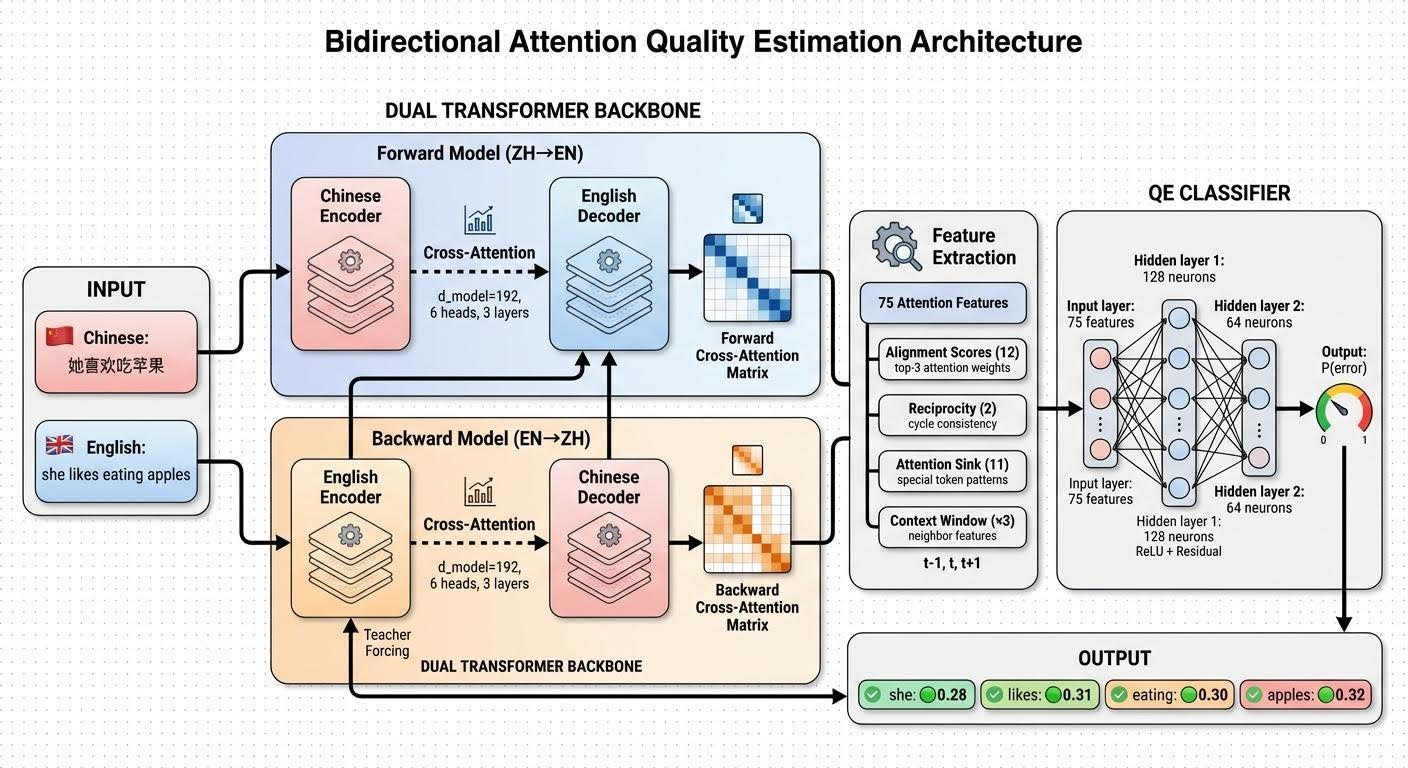
The strategy proposed beneath could make uncertainty computation environment friendly. Since most NMT setups have already got two fashions — a ahead mannequin (language1 → language2) and a backward mannequin (language2 → language1) — we will leverage them to compute interpretable uncertainty alerts.
After producing a translation with the ahead mannequin, we will “place” the inverted translation-source pair into the backward mannequin utilizing trainer forcing (as if it generated it itself), then extract the transposed cross-attention map and examine it with the corresponding map from the ahead mannequin. The outcomes beneath present that this strategy permits acquiring interpretable alerts on the token stage most often.
Moreover, there isn’t a must retrain a heavy NMT mannequin. It’s enough to coach a light-weight classifier on options from the matrix comparability whereas protecting the primary mannequin’s weights frozen.
What does proper and unsuitable appear to be
Let’s begin with a easy French → English translation instance the place all the pieces is obvious simply from the visualization.
“Elle aime manger des pommes → She likes to eat apples”
Now let’s examine this with a damaged NMT translation:
“La femme dont je t’ai parlé travaille à cette université” (right translation: “The woman I told you about works at this university”)
What the mannequin produced:
“The woman whose wife I told you about that university”
The place did this additional “wife” come from?

Bidirectional Cross-Test
Computation of bidirectional consideration. Please be aware that the backward mannequin makes use of trainer forcing. It receives the pre-generated English translation and checks whether or not it matches again to the unique French supply, whereas no new French sentence is generated. That is an alignment verification, not a round-trip translation.
def get_bidirectional_attention(dual_model, src_tensor, tgt_tensor):
    """Extract forward/backward cross-attention and reciprocal map."""
    dual_model.eval()
    with torch.no_grad():
        fwd_attn, bwd_attn = dual_model.get_cross_attention(src_tensor, tgt_tensor)

    # Align to full goal/supply lengths for element-wise comparability
    B, T = tgt_tensor.form
    S = src_tensor.form[1]
    fwd_aligned = torch.zeros(B, T, S, gadget=src_tensor.gadget)
    bwd_aligned = torch.zeros(B, T, S, gadget=src_tensor.gadget)
    if T > 1:
        fwd_aligned[:, 1:T, :] = fwd_attn
    if S > 1:
        bwd_aligned[:, :, 1:S] = bwd_attn.transpose(1, 2)

    reciprocal = fwd_aligned * bwd_aligned
    return fwd_aligned, bwd_aligned, reciprocal
All reproducible code is accessible through the challenge’s GitHub repository.
Initially of my work on the subject, I attempted utilizing direct round-trip translation. Nevertheless, as a result of poor efficiency of single-GPU-trained fashions and likewise due to the interpretation ambiguity, it was troublesome to match the supply and round-trip consequence on the token stage, as sentences might fully lose their which means. Furthermore, evaluating the eye matrices of the again and ahead fashions for 3 completely different sentences — the supply, the interpretation, and the reproduced supply from the round-trip — would have been pricey.
When Patterns Are Much less Apparent: Chinese language → English
For language pairs with related construction (like French↔English), the “1-to-1 token pattern” is intuitive. However what about typologically distant languages?
Chinese language → English entails:
- Versatile phrase order. Chinese language is SVO like English, however permits topicalization and pro-drop.
- No areas between phrases. Tokenizers should phase earlier than subword splitting.
- Logographic writing system. Characters map to morphemes, not phonemes.
The eye maps grow to be tougher to interpret simply by trying on the image, nonetheless the discovered options nonetheless handle to seize alignment high quality.
Let’s have a look at this instance of a semantic inversion error:
这家公司的产品质量越来越差客户都很不满意 (right translation: This firm’s product high quality is getting worse, prospects are very dissatisfied)
The mannequin output:
The standard of merchandise of the corporate is more and more happy with the shopper.
The phrase “不满意” means “dissatisfied”, however what the mannequin had produced is precisely reverse. Not even mentioning that the entire translation result’s nonsense.

Regardless of the sample being considerably much less visually noticeable, a trainable QE classifier continues to be in a position to seize it. That is exactly why we extract 75 consideration alignment–primarily based options of assorted sorts, as defined in additional element beneath.
Experimental Setup
The NMT core is deliberately saved undertrained for the setup. A near-perfect translator produces few errors to detect. Nonetheless, to construct a top quality estimation system, we’d like translations that typically (and even usually) fail, and embrace omissions, hallucinations, grammatical errors, and mistranslations.
Whereas a completely rubbish mannequin would make no sense, just because there can be no reference for the classifier on what is true, the mannequin used on this setup (~0.25–0.4 BLEU over a validation a part of the dataset) ensures a gradual provide of numerous error varieties, thereby creating an honest coaching sign for the QE.
The structure makes use of easy scaled dot-product consideration as a substitute of extra superior choices (linear consideration, GQA, and many others.). This retains the eye weights interpretable: every weight represents the likelihood mass assigned to a supply place, with out approximations or kernel tips that may even be good to think about — however but out of the scope of this experiment. Discovering methods to enhance the tactic for extra optimized consideration construction is an effective ahead level to go.
Knowledge and Annotation
| ZH→EN | FR→EN | |
|---|---|---|
| Typological distance | Excessive | Low |
| Anticipated error varieties | Alignment & phrase order errors | Lexical & tense errors |
| Coaching pairs | 100k sentences | 100k sentences |
| QE annotation set | 15k translations | 15k translations |
Token-level binary high quality labels have been annotated through “LLM-as-a-judge” strategy utilizing Gemini 2.5 Flash. The annotation immediate had clear and strict guidelines:
- BAD: mistranslations, unsuitable tense/kind, hallucinated content material, incorrect syntax, UNK tokens.
- OK: right which means, legitimate synonyms, pure paraphrasing.
Every translation was tokenized, and the judging mannequin created labels for each token. It additionally offered a reference translation and a minimal post-edit. In complete, this gave approx. 150,000 labeled tokens with 15–20% “BAD” fee.
Coaching Pipeline
Step 1: Practice bidirectional NMTs. Ahead (src→tgt) and backward (tgt→src) fashions have been skilled collectively on parallel knowledge. Each share the identical structure however separate parameters.
class DualTransformerNMT(nn.Module):
    """Bidirectional translator used for QE feature extraction."""
    def __init__(self, src_vocab_size, tgt_vocab_size, d_model,
                 n_heads, n_layers, d_ff, max_length):
        tremendous().__init__()
        self.zh2en = TransformerNMT(src_vocab_size, tgt_vocab_size,
                                    d_model, n_heads, n_layers, d_ff, max_length)
        self.en2zh = TransformerNMT(tgt_vocab_size, src_vocab_size,
                                    d_model, n_heads, n_layers, d_ff, max_length)

class QEClassifier(nn.Module):
    """Token-level BAD probability head."""
    def __init__(self, input_dim=75, hidden_dim=128, dropout=0.2):
        tremendous().__init__()
        self.input_projection = nn.Linear(input_dim, hidden_dim)
        self.hidden1 = nn.Linear(hidden_dim, hidden_dim)
        self.hidden2 = nn.Linear(hidden_dim, hidden_dim // 2)
        self.output = nn.Linear(hidden_dim // 2, 1)
Step 2: Generate translations. The ahead mannequin translated the QE annotation set. These translations (with their pure errors) turned the coaching knowledge for high quality estimation.
Step 3: Extract consideration options. For every translated sentence, 75-dimensional function vectors have been extracted per token place utilizing the tactic described beneath.
def extract_all_features(dual_model, src_tensor, tgt_tensor, attention_extractor):
    """Extract per-token QE features used in training/inference."""
    # Bidirectional cross-attention
    fwd_attn, bwd_attn = dual_model.get_cross_attention(src_tensor, tgt_tensor)

    # 75 consideration options (25 base x context window [-1,0,+1])
    attn_features = attention_extractor.extract(
        fwd_attn, bwd_attn, src_tensor, tgt_tensor
    )[0]  # [T, 75]

    # Elective entropy function (top-k normalized output entropy)
    entropy = compute_output_entropy(dual_model.zh2en, src_tensor, tgt_tensor)[0]

    # Last mixed vector utilized in ablation: [T, 76]
    options = torch.cat([attn_features, entropy.unsqueeze(-1)], dim=-1)
    return options
Step 4: Practice QE classifier. A small MLP classifier (128 → 64 → 1) was skilled on the extracted options with frozen translator weights.
# Freeze translator weights, prepare QE head solely
dual_model.freeze_translation_models()

n_bad = max(int(y_train.sum()), 1)
n_ok = max(int(len(y_train) - y_train.sum()), 1)
pos_weight = torch.tensor([n_ok / n_bad], gadget=gadget, dtype=torch.float32)

classifier = QEClassifier(input_dim=input_dim, hidden_dim=128, dropout=0.2).to(gadget)
optimizer = torch.optim.Adam(classifier.parameters(), lr=1e-3)
criterion = nn.BCEWithLogitsLoss(pos_weight=pos_weight)

for batch_x, batch_y in train_loader:
    optimizer.zero_grad()
    logits = classifier(batch_x.unsqueeze(1)).squeeze(1)
    loss = criterion(logits, batch_y)
    loss.backward()
    optimizer.step()
Alignment function varieties
1. Focus (12 options) — The place is the mannequin trying?

def extract_focus_features(fwd_attn, bwd_attn, tgt_pos, src_content_mask):
    """
    Extract top-k alignment scores and their backward counterparts.

    Args:
        fwd_attn: [S] ahead consideration from goal place to all sources
        bwd_attn: [S, T] backward consideration matrix
        tgt_pos: present goal place index
        src_content_mask: [S] boolean masks for content material (non-special) tokens

    Returns:
        options: [12] focus function vector
    """
    # Masks to solely think about content material supply tokens
    fwd_scores = fwd_attn * src_content_mask

    # Get top-3 attended supply positions
    top_k = 3
    top_fwd_scores, top_src_indices = torch.topk(fwd_scores, top_k)

    options = torch.zeros(12)
    options[0:3] = top_fwd_scores  # Ahead top-1, top-2, top-3

    # For every high supply, verify backward alignment power
    for i, src_idx in enumerate(top_src_indices):
        bwd_from_src = bwd_attn[src_idx, :]  # [T] - how supply appears to be like again
        top_bwd_scores, _ = torch.topk(bwd_from_src, 3)
        options[3 + i*3 : 3 + (i+1)*3] = top_bwd_scores

    return options
Hallucinated tokens usually (but not all the time) have subtle consideration. The mannequin fails to floor the reality between the supply and the goal and tries to “look” in every single place. A assured translation usually focuses sharply on 1–2 supply positions or a minimum of has a definite sample.
2. Reciprocity (2 options) — Does the alignment cycle again?

def extract_reciprocity_features(fwd_attn, bwd_attn, tgt_pos, src_content_mask):
    """
    Test if consideration alignment varieties a closed cycle.

    Returns:
        hard_reciprocal: 1.0 if precise match, 0.0 in any other case
        soft_reciprocal: dot product overlap (steady measure)
    """
    # Ahead: discover greatest supply place for this goal
    fwd_scores = fwd_attn * src_content_mask
    best_src = fwd_scores.argmax()

    # Backward: does that supply level again to us?
    bwd_from_best_src = bwd_attn[best_src, :]  # [T]
    best_tgt_from_src = bwd_from_best_src.argmax()

    # Arduous reciprocity: precise place match
    hard_reciprocal = 1.0 if (best_tgt_from_src == tgt_pos) else 0.0

    # Tender reciprocity: consideration distribution overlap
    # Excessive worth = ahead and backward "agree" on alignment
    fwd_normalized = fwd_scores / (fwd_scores.sum() + 1e-9)
    bwd_normalized = bwd_attn[:, tgt_pos] / (bwd_attn[:, tgt_pos].sum() + 1e-9)
    soft_reciprocal = (fwd_normalized * bwd_normalized).sum()

    return hard_reciprocal, soft_reciprocal
For instance, if “wife” (from the instance above) attends to place 3 in French, however place 3 doesn’t attend again to “wife,” the alignment is spurious.
3. Sink (11 options)

When unsure, transformers usually dump consideration onto “safe” particular tokens (SOS, EOS, PAD):
def extract_sink_features(fwd_attn, bwd_attn, src_tensor, tgt_tensor,
                          SOS=1, EOS=2, PAD=0):
    """
    Extract consideration sink options - consideration mass on particular tokens.
    """
    # Determine particular token positions in supply
    src_is_sos = (src_tensor == SOS).float()
    src_is_eos = (src_tensor == EOS).float()
    src_is_pad = (src_tensor == PAD).float()

    # Measure consideration mass going to every particular token sort
    sink_sos = (fwd_attn * src_is_sos).sum()  # Consideration to SOS
    sink_eos = (fwd_attn * src_is_eos).sum()  # Consideration to EOS
    sink_pad = (fwd_attn * src_is_pad).sum()  # Consideration to PAD
    sink_total = sink_sos + sink_eos + sink_pad

    # Backward sink: verify if best-aligned supply additionally reveals uncertainty
    best_src = fwd_attn.argmax()
    bwd_from_best = bwd_attn[best_src, :]
    tgt_is_special = ((tgt_tensor == SOS) | (tgt_tensor == EOS) |
                      (tgt_tensor == PAD)).float()
    bwd_sink = (bwd_from_best * tgt_is_special).sum()

    # Asymmetry: disagreement in uncertainty ranges
    sink_asymmetry = abs(sink_total - bwd_sink)

    # Prolonged options: entropy-based measures
    content_mask = 1.0 - src_is_sos - src_is_eos - src_is_pad
    fwd_content = fwd_attn * content_mask
    fwd_content_norm = fwd_content / (fwd_content.sum() + 1e-9)

    max_content = fwd_content.max()  # Peak consideration to content material
    focus = max_content / (fwd_content.sum() + 1e-9)  # How peaked?

    return {
        'sink_total': sink_total,
        'sink_sos': sink_sos,
        'sink_eos': sink_eos,
        'sink_pad': sink_pad,
        'bwd_sink': bwd_sink,
        'sink_asymmetry': sink_asymmetry,
        'max_content': max_content,
        'focus': focus,
        # ... plus entropy options
    }
Why Context Issues
Translation errors create a cascade, the place a dropped phrase impacts neighbors. By together with options from positions t-1 and t+1, we enable the classifier to detect these ripple patterns. That is clearly not the overwhelming sign (particularly when the true semantic “neighbor” could possibly be situated distantly within the sentence), however it’s already robust sufficient to convey the worth. Combining it with “topological” token-linking strategies might make these options much more significant.
Token-Degree Comparability: What Every Sign Sees
Now let’s take a look at a extra detailed breakdown – if attention-alignment could possibly be matched along with output distribution entropy scores. Are they carrying the identical data or might probably increase one another?
“Entropy” column beneath is the normalized top-k output entropy values (okay=20) of the ahead mannequin’s softmax distribution, leading to 0–1 scale. A price close to 0 means the mannequin is assured in a single token; a worth close to 1 means likelihood is unfold evenly throughout different candidates.
French: “wife” hallucination
Supply: La femme dont je t’ai parlé… → MT: “the woman whose wife i told you about…”

Chinese language: “satisfied” semantic inversion
Supply: 这家公司的产品质量越来越差客户都很不满意 → MT: “the quality of products of the company is increasingly satisfied with the customer”


Repetition Errors: How Consideration Catches Poor Mannequin Artifacts
Supply: Il est évident que cette approche ne fonctionne pas correctement (It’s apparent that this strategy doesn’t work correctly)
MT: “it’s obvious that this approach does not work properly operate properly”

What “Confident Translation” Seems to be Like
Supply: Le rapport mentionne uniquement trois incidents, pas quatre
MT: “the report mentions only three incidents, not four”

Scaling up
Now let’s discover how the tactic works at scale. For this, I did a fast ablation verify, which had the objective to look at the impression of attention-based options. May or not it’s that they carry nothing worthy of extra calculations, in contrast with a easy output entropy?
Methodology: the dataset was break up on the sentence stage into 70% coaching, 15% validation, and 15% check units. The perfect epoch was chosen utilizing validation ROC-AUC for threshold independence, and the classification threshold was tuned on validation F1(BAD). The ultimate metrics have been reported on the held-out check set solely.
Characteristic Contributions
| Options | ZH→EN ROC-AUC | ZH→EN PR-AUC | ZH→EN F1 (BAD) | FR→EN ROC-AUC | FR→EN PR-AUC | FR→EN F1 (BAD) |
|---|---|---|---|---|---|---|
| Entropy solely (1) | 0.663 | 0.380 | 0.441 | 0.797 | 0.456 | 0.470 |
| Consideration solely (75) | 0.730 | 0.486 | 0.488 | 0.796 | 0.441 | 0.457 |
| Mixed (76) | 0.750 | 0.506 | 0.505 | 0.849 | 0.546 | 0.530 |
Prolonged Metrics for Mixed options (entropy+consideration)
| Pair | Precision (BAD) | Recall (BAD) | Specificity (OK) | Balanced Acc. | MCC |
|---|---|---|---|---|---|
| ZH→EN | 0.405 | 0.672 | 0.689 | 0.680 | 0.315 |
| FR→EN | 0.462 | 0.623 | 0.877 | 0.750 | 0.443 |
When mixed, options work higher than every sign alone throughout each language pairs, seemingly as a result of they seize complementary error varieties.
Last ideas
May the identical strategy be used for duties past translation? Entropy captures “The model doesn’t know what to generate,” whereas consideration captures “The model isn’t grounded in the input.” For RAG techniques, this means combining perplexity-based detection along with consideration evaluation over retrieved paperwork. For summarization — constructing grounded hyperlinks between supply textual content tokens and people within the abstract.
Limitations
Computation value. Operating the backward mannequin primarily will increase inference time.
It’s a glassbox mannequin solely. You want entry to consideration weights and, subsequently, it received’t work on API-based fashions. Nevertheless, in case you have entry — you received’t have to change the core mannequin’s weights. You possibly can plug in any pretrained encoder-decoder, freeze it, and prepare solely the QE head.
Uncertainty doesn’t imply errors. It simply implies that the mannequin is uncertain. The mannequin typically flags right paraphrases as errors as a result of consideration patterns differ from these which the mannequin met throughout coaching — just like how a human translator may be uncertain if that they had by no means encountered something prefer it earlier than.
Strive It Your self
All code, fashions, and the annotated dataset are open supply:
# Clone the repository
git clone
cd nmt-quality-estimation
pip set up -r necessities.txt

# Run interactive demo (downloads fashions routinely)
python inference/demo.py --lang zh-en --interactive
# Or use programmatically:
from inference.demo import QEDemo

# Initialize (downloads fashions from HuggingFace routinely)
demo = QEDemo(lang_pair='zh-en')

# Translate with high quality estimation
consequence = demo.translate_with_qe("她喜欢吃苹果")

print(consequence['translation'])  # "she likes eating apples"
print(consequence['tokens'])       # ['she', 'likes', 'eating', 'apples']
print(consequence['probs'])        # (P(BAD) per token)
print(consequence['tags'])

# Highlighted output
print(demo.format_output(consequence))
# Translation: she likes consuming apples
# QE: she likes consuming apples
# BAD tokens: 0/4
Assets
References
[1] S. Farquhar, J. Kossen, L. Kuhn, Y. Gal, Detecting Hallucinations in Giant Language Fashions Utilizing Semantic Entropy (2024),
[2] COMET, GitHub repository,
[3] W. Xu, S. Agrawal, E. Briakou, M. J. Martindale, M. Carpuat, Understanding and Detecting Hallucinations in Neural Machine Translation through Mannequin Introspection (2023),
