



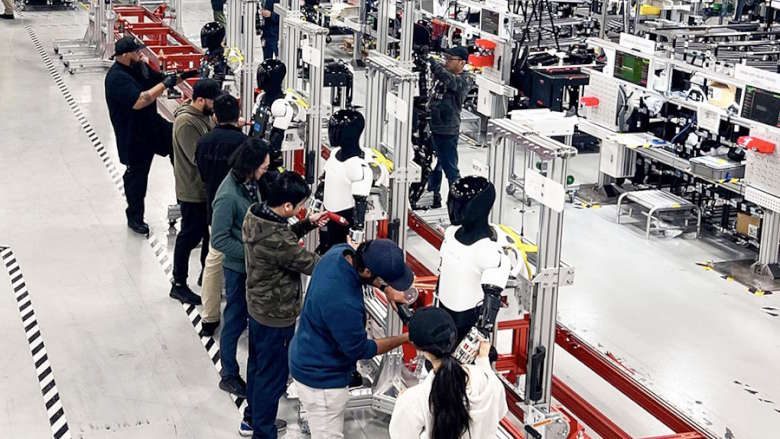
CAMBRIDGE, England—The humanoid robotic trade is getting into an early commercialization part, with adoption anticipated to scale first in industrial environments earlier than increasing into broader business and shopper markets.
Based on a brand new report by IDTechEx, the worldwide marketplace for humanoids will attain $30 billion by 2036, pushed by rising deployments in automotive manufacturing and logistics, alongside ongoing progress in element scaling and platform reliability.
“Humanoid robots are increasingly viewed less as futuristic prototypes and more as a practical route to bring artificial intelligence into human-designed environments,” says Shihao Fu, know-how analyst at IDTechEx. “Over the past 12 months, market exercise has shifted from commerce present demonstrations towards structured pilot deployments on manufacturing websites, supported by bigger and extra deliberate funding from each start-ups and established OEMs.
“With component supply chains gradually stabilizing and early cost reductions emerging, [companies] are now using real-world deployment data to define which humanoid use cases are commercially viable in the near term, and which remain longer-term opportunities,” explains Fu.
Based on Fu, automotive manufacturing would be the first business sector the place humanoid robots scale in significant volumes. Certainly, automakers corresponding to BMW, Hyundai, Mercedes-Benz and Tesla have already deployed bipedal machines of their factories.
“Compared with open-world environments, automotive plants offer controlled operating conditions, structured workflow and clearer ROI justification for repetitive labor-intensive tasks,” says Fu. “Early deployments are targeted on comparatively easy, however scalable duties corresponding to materials dealing with, inspection assist, intra-factory transport and fundamental meeting help.
“As the market transitions beyond proof-of-concept demonstrations, commercialization is increasingly being defined less by ‘general-purpose capability’ and more by reliability, safety validation, maintainability and predictable uptime,” Fu factors out.
In search of fast solutions on meeting and manufacturing matters?
Strive Ask ASM, our new sensible AI search device.
Ask ASM
A key motive why automotive manufacturing is rising as the primary scalable deployment market is that lots of the most lively buyers and strategic backers are automotive OEMs themselves. In contrast to conventional industrial automation patrons, they’ve each the capital base and long-term incentive to speed up humanoid improvement, significantly as they face rising labor prices, tightening workforce availability and rising stress to enhance manufacturing flexibility.
“OEM-backed investment also provides immediate access to controlled production environments, engineering validation resources and real operational datasets that are difficult for start-ups to obtain independently,” notes Fu. “In apply, this enables humanoid platforms to iterate sooner via reliability testing, security validation workflows and maintainability optimization.
“OEM involvement also increases the likelihood of scaled procurement once a platform meets minimum performance thresholds, reducing go-to-market uncertainty and accelerating supply chain readiness,” provides Fu.
Logistics and warehousing functions are anticipated to turn into the second large marketplace for humanoids. Nonetheless, progress on this section shall be affected by competitors from present automation applied sciences corresponding to autonomous cellular robots, automated guided autos, cobots and conventional six-axis robots.
“Despite this, humanoid robots are increasingly positioned as a flexible automation alternative where mixed and unpredictable tasks must be completed in facilities designed around human workers,” says Fu. “As hardware cost declines and task performance improves, humanoids may become commercially attractive for workflows such as pick-and-place, parcel handling and repetitive sorting operations, particularly in environments where deploying fixed automation would require high capital investment and major infrastructure redesign.”
However, humanoid robots nonetheless face main engineering and manufacturing constraints, corresponding to component-level bottlenecks.
“Battery energy density and thermal management remain major limitations, restricting operating time and increasing downtime,” warns Fu. “On the similar time, scaling high-precision elements, corresponding to screws, bearings and high-performance actuators, stays difficult, as provide chains will not be but optimized for high-volume humanoid manufacturing.
“Dexterous hands and tactile sensing also remain critical hurdles for expanding humanoid task capability beyond basic industrial operations,” claims Fu. “In many current deployments, humanoids remain best suited to tasks that do not require advanced manipulation, fine grip control or human-level perception of contact forces.”
