




In short
- Google publicly set a 2029 deadline to transition its methods to post-quantum cryptography.
- Bitcoin faces long-term cryptographic danger as quantum breakthroughs compress safety timelines.
- Crypto should coordinate a sluggish, decentralized migration to quantum-resistant requirements below exterior stress.
Google is finished treating quantum computing as a future drawback. On Tuesday, the corporate revealed a proper timeline for transitioning its whole infrastructure to post-quantum cryptography (PQC) by 2029—calling the transfer pressing and saying quantum frontiers “may be closer than they appear.”
“As a pioneer in both quantum and PQC, it’s our responsibility to lead by example and share an ambitious timeline,” the weblog reads. “Quantum computers will pose a significant threat to current cryptographic standards, and specifically to encryption and digital signature.”
The announcement, signed by Google VP of Safety Engineering Heather Adkins and Senior Cryptography Engineer Sophie Schmieg, describes the 2029 goal as a response to fast advances in quantum {hardware}, error correction, and factoring useful resource estimates.
In plain English: The machines that might theoretically crack at the moment’s encryption are getting actual, quicker than anticipated.
Google’s warning rests on two distinct threats. The primary is already taking place. So-called “harvest now, decrypt later” assaults enable dangerous actors to steal encrypted information at the moment and sit on it, assured they’re going to have the ability to unlock it as soon as quantum computer systems are highly effective sufficient. That menace is present-tense. The second is future-facing: digital signatures, the cryptographic basis of authentication throughout the web, will should be changed earlier than a cryptographically related quantum laptop—a CRQC—arrives.
To steer by instance, Google introduced that Android 17 will combine post-quantum digital signature safety utilizing ML-DSA, an algorithm just lately standardized by the U.S. Nationwide Institute of Requirements and Expertise (NIST). The corporate can be pushing PQC throughout Google Cloud and inside communications methods.
The 2029 deadline just isn’t arbitrary. IBM has its personal roadmap concentrating on fault-tolerant quantum methods by the identical yr. As each corporations race towards that threshold, 2025 marked a turning level within the subject—when error correction breakthroughs, new processor architectures, and a Caltech consequence trapping over 6,000 atomic qubits directly shifted the dialog from “if” to “when.”
What does it imply for Bitcoin?
Bitcoin runs on elliptic curve cryptography (or ECDSA signatures), the identical class of math that quantum computer systems—working what’s often known as Shor’s algorithm—may ultimately reverse-engineer. Which means: Given your public key, a sufficiently highly effective quantum machine may derive your personal key.
Regular computer systems would take centuries to crack one thing like this. Quantum computer systems might take that drawback and switch it into one thing solvable in sensible time.
The publicity is bigger than most individuals notice. In line with Mission Eleven, a cybersecurity and crypto-focused startup engaged on defending crypto from future quantum laptop assaults, over 6.8 million Bitcoin—over $470 billion value—sits in addresses which are weak to quantum assaults, together with cash from Bitcoin’s earliest days. A separate estimate from Ark Make investments and Unchained places roughly 35% of the overall Bitcoin provide in handle sorts theoretically weak to a future quantum assault.
Google’s researchers just lately discovered that cracking RSA encryption might require 20 instances fewer quantum sources than beforehand estimated—a discovering that compressed the safety timeline for every little thing that depends on related mathematical buildings, Bitcoin included. Earlier estimates put the qubit depend wanted to crack Bitcoin at round 20 million. Researchers at Iceberg Quantum now counsel the quantity may fall to roughly 100,000.
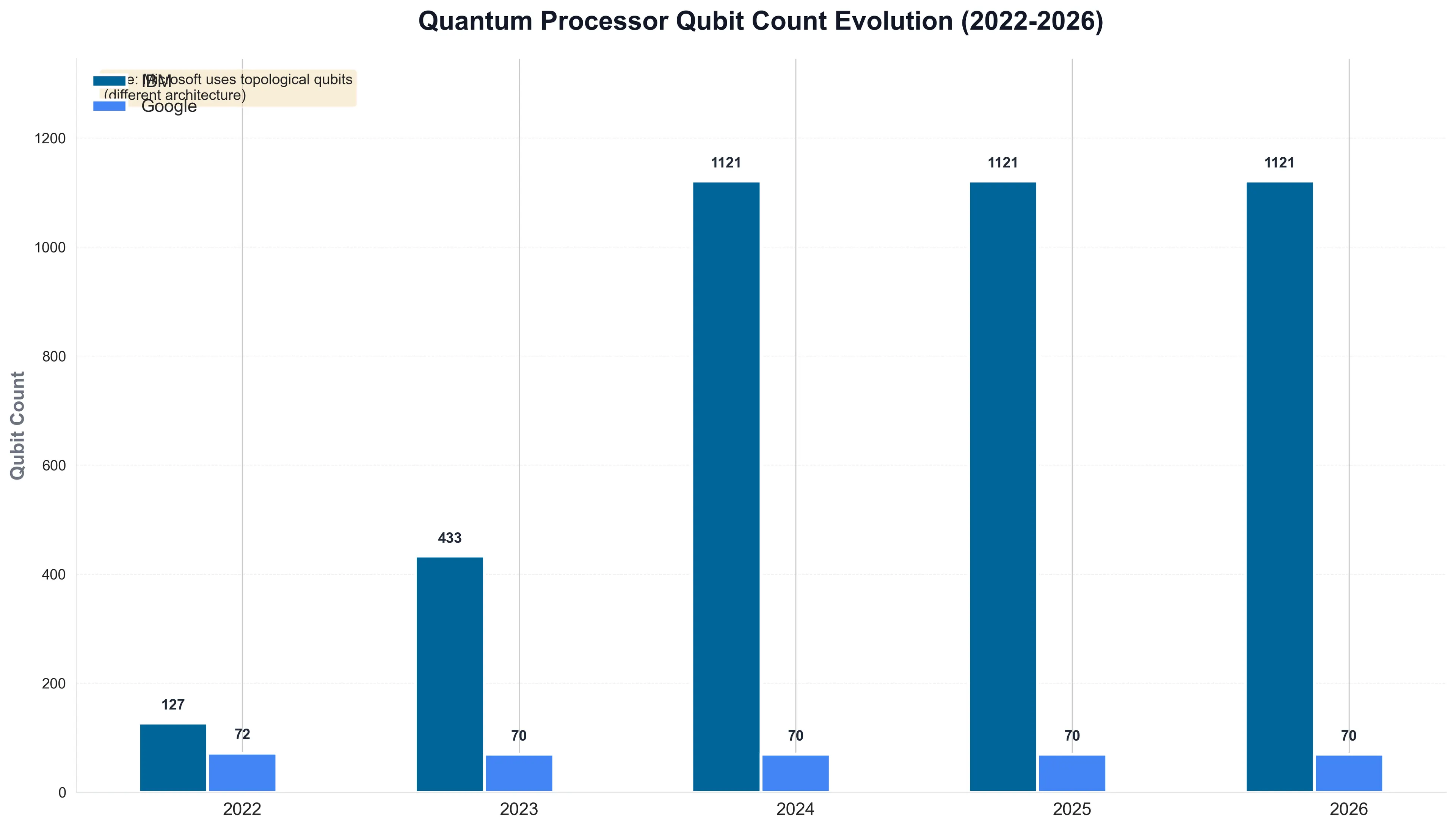
Quantum computer systems have achieved nearly a 10x progress in energy within the final 5 years.
So, ought to all of us panic and promote our cash? Not likely—however we should always concentrate.
To begin with, Google isn’t saying quantum computer systems will break cryptography by 2029. It’s merely saying it plans to be prepared earlier than they do.
Additionally, Bitcoin builders aren’t asleep on the wheel. BIP 360, a proposal introducing a quantum-resistant handle format known as Pay-to-Merkle-Root, was just lately merged into Bitcoin’s formal enchancment repository. It does not activate something—nevertheless it begins the clock on a severe overhaul.
Jameson Lopp, co-founder of Bitcoin custody agency Casa, believes that even when quantum computer systems stay years away from posing an actual menace, upgrading Bitcoin’s protocol and migrating billions in consumer funds may take 5 to 10 years by itself.
“Right now, we’re several orders of magnitude away from having a cryptographically relevant quantum computer, at least as far as we know,” Loop informed Decrypt earlier this yr. “If innovation in quantum computing continues at a similar, fairly linear rate, it’s going to take many years—probably over a decade, maybe even several decades—before we get to that point.”
Bitcoin’s decentralized governance means no single staff can flip a change. Miners, pockets builders, exchanges, and hundreds of thousands of particular person customers would all want to maneuver concurrently.
Google can set a 2029 deadline as a result of it controls its personal infrastructure. Bitcoin can’t. And that asymmetry is strictly what makes Google’s announcement matter for crypto—not as a demise sentence, however as a tough deadline the community did not set for itself and might’t afford to disregard.
Every day Debrief Publication
Begin on daily basis with the highest information tales proper now, plus unique options, a podcast, movies and extra.
