



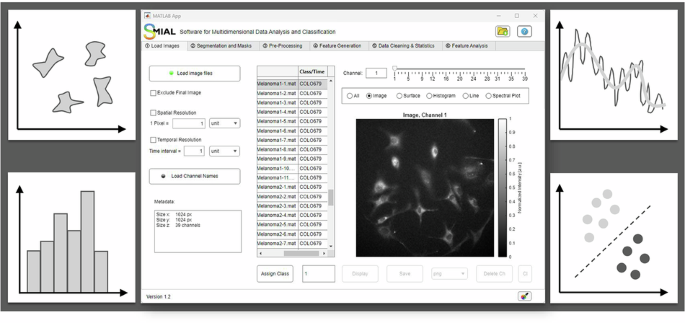
Du, X. et al. Hyperspectral retinal imaging in Alzheimer’s illness and age-related macular degeneration: a evaluate. Acta Neuropathol. Commun. 12, 157 (2024).
Chandrasekaran, S. N., Ceulemans, H., Boyd, J. D. & Carpenter, A. E. Picture-based profiling for drug discovery: due for a machine-learning improve?. Nat. Rev. Drug Discov. 20, 145–159 (2021).
Campbell, J. M. et al. Label-free evaluation of key organic autofluorophores: materials traits and alternatives for medical functions. Adv. Mater. e2403761. (2024).
Knab, A., Giardina, C., Gray, S. T., Goldys, E. M. & Campbell, J. M. Illuminating immunity: a scientific evaluate of immune cell autofluorescence. J. Biophotonics 18, e202400576 (2025).
Handley, S., Anwer, A. G., Knab, A. Bhargava, A. & Goldys, E. M. AutoMitoNetwork: Software program for analyzing mitochondrial networks in autofluorescence photographs to allow label-free cell classification. Cytometry 1552–4930. (2024).
Extra, S. S., Seaside, J. M., McClelland, C., Mokhtarzadeh, A. & Vince, R. In vivo evaluation of retinal biomarkers by hyperspectral imaging: early detection of Alzheimer’s illness. ACS Chem. Neurosci. 10, 4492–4501 (2019).
Campbell, J. M. et al. Rising medical functions in oncology for non-invasive multi- and hyperspectral imaging of cell and tissue autofluorescence. J. Biophotonics e202300105. (2023).
Campbell, J. M. et al. Medical functions of non-invasive multi and hyperspectral imaging of cell and tissue autofluorescence past oncology. J. Biophotonics 16, e202200264 (2023).
Zahra, A. et al. Present advances in imaging spectroscopy and its state-of-the-art functions. Skilled Syst. Appl. 238, 122172 (2024).
Vidal, M. & Amigo, J. M. Pre-processing of hyperspectral photographs. Important steps earlier than picture evaluation. Chemom. Intell. Lab. Syst. 117, 138–148 (2012).
Carpenter, A. E. et al. CellProfiler: picture evaluation software program for figuring out and quantifying cell phenotypes. Genome Biol. 7, R100 (2006).
Bray, M. A. et al. Cell Portray, a high-content image-based assay for morphological profiling utilizing multiplexed fluorescent dyes. Nat. Protoc. 11, 1757–1774 (2016).
Campbell, J. M. et al. Pancreatic islet characterisation by the hyperspectral Evaluation of autofluorescence: a non-invasive, label-free measure of viability. Proc. SPIE 11655, Label-free Biomedical Imaging and Sensing (LBIS) 2021, 1165506 (2021). https://doi.org/10.1117/12.2578220.
Campbell, J. M. et al. Non-destructive, label free identification of cell cycle section in most cancers cells by multispectral microscopy of autofluorescence. BMC Most cancers 19, 1242 (2019).
Campbell, J. M. et al. Multispectral autofluorescence traits of reproductive getting older in young and old mouse oocytes. Biogerontology 23, 237–249 (2022).
Wiggins, L. et al. The CellPhe toolkit for cell phenotyping utilizing time-lapse imaging and sample recognition. Nat. Commun. 14, 1854 (2023).
Pudjihartono, N., Fadason, T., Kempa-Liehr, A. W. & O’Sullivan, J. M. A evaluate of function choice strategies for machine learning-based illness danger prediction. Entrance. Bioinform. 2, 927312 (2022).
Smith, Okay. et al. Phenotypic picture evaluation software program instruments for exploring and understanding large picture knowledge from cell-based assays. Cell Syst. 6, 636–653 (2018).
Abramoff, M., Magalhães, P. & Ram, S. J. Picture Processing with ImageJ. Biophotonics Int. 11, 36–42 (2003).
Pau, G., Fuchs, F., Sklyar, O., Boutros, M. & Huber, W. EBImage—an R package deal for picture processing with functions to mobile phenotypes. Bioinformatics 26, 979–981 (2010).
Lehnert, L. W. et al. Hyperspectral Information Evaluation in R: The hsdar Package deal. J. Stat. Softw. 89, 1–23. (2019).
Stirling, D. R., Carpenter, A. E. & Cimini, B. A. CellProfiler Analyst 3.0: accessible knowledge exploration and machine studying for picture evaluation. Bioinformatics 37, 3992–3994 (2021).
Laksameethanasan, D., Tan, R., Toh, G. W. & Bathroom, L.-H. CellXpress: a quick and user-friendly software program platform for profiling mobile phenotypes. BMC Bioinform. 14, (2013).
Elliott, Okay., Berry, J. C., Kim, H. & Bart, R. S. A comparability of ImageJ and machine studying primarily based picture evaluation strategies to measure cassava bacterial blight illness severity. Plant Strategies 18, 86 (2022).
Gómez-de-Mariscal, E. et al. DeepImageJ: a user-friendly atmosphere to run deep studying fashions in ImageJ. Nat. Strategies 18, 1192–1195 (2021).
Piccinini, F. et al. Superior Cell Classifier: user-friendly machine-learning-based software program for locating phenotypes in high-content imaging knowledge. Cell Syst. 4, 651–655.e5 (2017).
Lyngdoh, R. B. et al. AVHYAS: A Free and Open Supply QGIS Plugin for Superior Hyperspectral Picture Evaluation. 2021 Worldwide Convention on Rising Strategies in Computational Intelligence (ICETCI), 71–76 (Hyderabad, India, 2021). https://doi.org/10.1109/ICETCI51973.2021.9574057.
Horgan, C. C. & Bergholt, M. S. spectrai: A deep studying framework for spectral knowledge. J. Spectral Imaging. 11, a7 (2022).
Knab, A. et al. In the direction of label-free non-invasive autofluorescence multispectral imaging for melanoma prognosis. J. Biophotonics e202300402. https://doi.org/10.1002/jbio.202300402.
Rasti, B., Ulfarsson, M. & Ghamisi, P. Computerized hyperspectral picture restoration utilizing sparse and low-rank modeling. IEEE Geosci. Distant Sens. Lett. 14, 2335–2339 (2017).
Mahbub, S. B., Plöschner, M., Gosnell, M. E., Anwer, A. G. & Goldys, E. M. Statistically sturdy label-free quantitative identification of native fluorophores in a organic pattern. Sci. Rep. 7, 15792 (2017).
Berg, S. et al. ilastik: interactive machine studying for (bio)picture evaluation. Nat. Strategies 16, 1–7 (2019).
Varga, L., Makowski, J. & Zell, A. Measuring the ripeness of fruit with hyperspectral imaging and deep studying. Preprint at (2021).
Grahn, H. & Geladi, P. Strategies and Functions of Hyperspectral Picture Evaluation (J. Wiley, 2007).
Wang, J., Xu, J., Zhao, C., Peng, Y. & Wang, H. An ensemble function choice methodology for high-dimensional knowledge primarily based on type aggregation. Syst. Sci. Management Eng. 7, 32–39 (2019).
Bhargava, A. et al. VascuViz: a multimodality and multiscale imaging and visualization pipeline for vascular programs biology. Nat. Strategies 19, 242–254 (2022).
Erickson, N. et al. AutoGluon-Tabular: sturdy and correct AutoML for structured knowledge. Preprint at (2020).
Ghamisi, P., Plaza, J., Chen, Y., Li, J. & Plaza, A. J. Superior spectral classifiers for hyperspectral photographs: a evaluate. IEEE Geosci. Distant Sens. Magazine. 5, 8–32 (2017).
Ying, X. An outline of overfitting and its options. J. Phys. Conf. Ser. 1168, 022022 (2019).
Ahsan, M. M., Luna, S. A. & Siddique, Z. Machine-learning-based illness prognosis: a complete evaluate. Healthcare 10, 541 (2022).
Alieva, M., Wezenaar, A., Wehrens, E. & Rios, A. Bridging live-cell imaging and next-generation most cancers therapy. Nat. Rev. Most cancers 23, (2023).
Aung, L., Li, R., Prabhakar, B., Maker, A. & Li, P. Mitochondrial protein 18 (MTP18) performs a pro-apoptotic function in chemotherapy-induced gastric most cancers cell apoptosis. Oncotarget 8, (2017).
Ponsioen, B. et al. Quantifying single-cell ERK dynamics in colorectal most cancers organoids reveals EGFR as an amplifier of oncogenic MAPK pathway signalling. Nat. Cell Biol. 23, 1–14 (2021).
Li, L. et al. β-nicotinamide mononucleotide rescues the standard of aged oocyte and improves subsequent embryo improvement in pigs. PLoS ONE 18, e0291640 (2023).
Jo, Y.-J. et al. Particulate matter publicity throughout oocyte maturation: cell cycle arrest, ROS technology, and early apoptosis in mice. Entrance. Cell Dev. Biol. 8, 602097 (2020).
Kim, H. et al. Longitudinal study-based dementia prediction for public well being. Int. J. Environ. Res. Public Well being 14, (2017).
Murugan, A., Nair, S. A. H., Preethi, A. A. P. & Kumar, Okay. P. S. Analysis of pores and skin most cancers utilizing machine studying strategies. Microprocess. Microsyst. 81, 103727 (2021).
Campbell, J. M. et al. Single cell, label free characterisation of human mesenchymal stromal cell stemness and future development potential by autofluorescence multispectral imaging. Stem Cell Rev. Rep. 20, 2283–2292 (2024).
Wu, H. H. L. et al. Non-invasive evaluation of urinary exfoliated proximal tubule cell multispectral autofluorescence might differentiate between causes of kidney transplant dysfunction. Kidney360 (2025).
Bemando, C., Miranda, E. & Aryuni, M. Machine-learning-based prediction fashions of coronary coronary heart illness utilizing naïve Bayes and random forest algorithms. In Proc. 2021 Worldwide Convention on Software program Engineering & Laptop Programs and 4th Worldwide Convention on Computational Science and Info Administration (ICSECS-ICOCSIM) 232–237. (2021).
Sharma, S. & Khanna, P. Laptop-aided prognosis of malignant mammograms utilizing Zernike moments and SVM. J. Digit. Imaging 28, 77–90 (2015).
Guerraty, M., Bhargava, A., Senarathna, J., Mendelson, A. A. & Pathak, A. P. Advances in translational imaging of the microcirculation. Microcirculation 28, e12683 (2021).
Senarathna, J. et al. In vivo phenotyping of the microvasculature in necrotizing enterocolitis with multicontrast optical imaging. Microcirculation 29, e12768 (2022).
Bhargava, A., Popel, A. S. & Pathak, A. P. Vascular phenotyping of the invasive entrance in breast most cancers utilizing a 3D angiogenesis atlas. Microvasc. Res. 149, 104555 (2023).
Ren, Y. et al. Multimodality imaging reveals angiogenic evolution in vivo throughout calvarial bone defect therapeutic. Angiogenesis 27, 105–119 (2024).
Stamatelos, S. Okay., Bhargava, A., Kim, E., Popel, A. S. & Pathak, A. P. Tumor ensemble-based modeling and visualization of emergent angiogenic heterogeneity in breast most cancers. Sci. Rep. 9, 5276 (2019).
Senarathna, J. et al. HemoSYS: a toolkit for Picture-based Programs Biology of Tumor Hemodynamics. Sci. Rep. 10, 2372 (2020).
Held, M. et al. CellCognition: time-resolved phenotype annotation in high-throughput stay cell imaging. Nat. strategies 7, 747–754 (2010).
Kankaanpää, P. et al. BioImageXD: An open, general-purpose and high-throughput image-processing platform. Nat. strategies 9, 683–689 (2012).
Natekar, P., Wang, Z., Arora, M., Hakozaki, H. & Schöneberg, J. Self-supervised deep studying uncovers the semantic panorama of drug-induced latent mitochondrial phenotypes. Preprint at bioRxiv (2023).
Stringer, C. et al. Cellpose: a generalist algorithm for mobile segmentation. Nat. Strategies 18, 100–106 (2021).
Gnutti, A., Guerrini, F., Adami, N., Migliorati, P. & Leonardi, R. A wavelet filter comparability on a number of datasets for sign compression and denoising. Multidimens. Syst. Sign Course of. 32, 791–820 (2021).
Rasti, B., Sveinsson, J. R., Ulfarsson, M. O. & Benediktsson, J. A. Hyperspectral picture denoising utilizing first order spectral roughness penalty in wavelet area. IEEE J. Sel. High. Appl. Earth Obs. Distant Sens. 7, 2458–2467 (2013).
Rasti, B., Ulfarsson, M. O. & Ghamisi, P. Computerized hyperspectral picture restoration utilizing sparse and low-rank modeling. IEEE Geosci. Distant Sens. Lett. 14, 2335–2339 (2017).
Radovic, M., Ghalwash, M., Filipovic, N. & Obradovic, Z. Minimal redundancy most relevance function choice strategy for temporal gene expression knowledge. BMC Bioinform. 18, (2017).
Franke, T. M., Ho, T. & Christie, C. A. The Chi-Sq. Check: typically used and extra typically misinterpreted. Am. J. Eval. 33, 448–458 (2012).
Mukhopadhyay, N. & Pratim Sengupta, P. Gini Inequality Index: Strategies and Functions 1st edn (CRC Press, 2021).
He, X., Cai, D. & Niyogi, P. Laplacian rating for function choice. Convention: Advances in Neural Info Processing Programs 18 (Neural Info Processing Programs, NIPS 2005, Vancouver, British Columbia, Canada, 2005).
Robnik-Sikonja, M. & Kononenko, I. An adaptation of Reduction for attribute estimation in regression. ICML ’97: Proceedings of the Fourteenth Worldwide Convention on Machine Studying 296–304 (Morgan Kaufmann Publishers Inc., 1997).
Freitas, D., Lopes, L. G. & Morgado-Dias, F. Particle Swarm Optimisation: A Historic Overview As much as the Present Developments. Entropy 22, 362 (2020).
Costa, S. I. R., Santos, S. A. & Strapasson, J. E. Fisher info distance: a geometrical studying. Discret. Appl. Math. 197, 59–69 (2015).
Koutroumbas, Okay.& Theodoridis, S. Sample Recognition 4th edn (Elsevier Science & Know-how, 2008).
Mittal, N. & Kumar, A. 20—Evaluation of supervised function choice in bioinformatics. in Blockchain Functions for Healthcare Informatics (ed. Tanwar, S.) 431–446 (Tutorial Press, 2022).
Sharma, A. & Paliwal, Okay. Rotational linear discriminant evaluation approach for dimensionality discount. In Proc. IEEE Transactions on Information and Information Engineering Vol. 20, 1336–1347 (IEEE, 2008).
Jolliffe, I. T. & Cadima, J. Principal part evaluation: a evaluate and up to date developments. Philos. Trans. R. Soc. A Math. Phys. Eng. Sci. 374, 20150202 (2016).
Ngiam, J., Chen, Z., Bhaskar, S., Koh, P. & Ng, A. Sparse filtering. NIPS’11: Proceedings of the twenty fifth Worldwide Convention on Neural Info Processing Programs 1125–1133 (Curran Associates Inc., 2011).
Bishop, C. M. Sample Recognition and Machine Studying eighth edn (Info Science and Statistics) (Springer, 2006).
Bonaccorso, G. Machine Studying Algorithms: Widespread Algorithms for Information Science and Machine Studying 1–514 (Packt Publishing Restricted, 2018).
Lopez-Bernal, D., Balderas, D., Ponce, P. & Molina, A. Schooling 4.0: instructing the fundamentals of KNN, LDA and easy perceptron algorithms for binary classification issues. Future Web 13, 193 (2021).
Dobson, A. J. & Barnett, A. G. An introduction to Generalized Linear Fashions 4th edn (Generalized Linear Fashions) (CRC Press, Taylor and Francis Group, 2018).
Hastie, T., Tibshirani, R. & Friedman, J. H. The Parts of Statistical Studying: Information Mining, Inference, and Prediction (Springer, 2009).
Tharwat, A. Linear vs. quadratic discriminant evaluation classifier: a tutorial. Int. J. Appl. Sample Recognit. 3, 145–180 (2016).
Pal, M. Random forest classifier for distant sensing classification. Int. J. Distant Sens. 26, 217–222 (2005).
Ghosh, S. & Dubey, S. Okay. Comparative Evaluation of Okay-Means and Fuzzy C-Means Algorithms. Int. J. Adv. Comput. Sci. Appl. 4, 35–39 (2013).
Datta, D., Mallick, P. Okay., Shafi, J., Choi, J. & Ijaz, M. F. Computational intelligence for statement and monitoring: a case research of imbalanced hyperspectral picture knowledge classification. Comput. Intell. Neurosci. 2022, 8735201 (2022).
Lever, J., Krzywinski, M. & Altman, N. Factors of significance: mannequin choice and overfitting. Nat. Strategies 13, 703–705 (2016).
Rafało, M. Cross validation strategies: Evaluation primarily based on diagnostics of thyroid most cancers metastasis. ICT Specific 8, 183–188 (2022).
Wong, T.-T. Efficiency analysis of classification algorithms by k-fold and leave-one-out cross validation. Sample Recognit. 48, 2839–2846 (2015).
Grandini, M., Bagli, E. & Visani, G. Metrics for multi-class classification: an summary. Preprint at arXiv (2020).
