



Cohort choice and information sources
Our UCSF echocardiogram dataset comprised research acquired on grownup sufferers at UCSF between 2012 and 2020. These uncooked imaging information are linked with structured diagnoses and measurement information, together with quantitative and qualitative measures adjudicated by degree 3 echocardiographers on the UCSF echo lab. Measurement of RV parameters was commonplace follow within the UCSF echo lab in the course of the research interval; RV dimension and performance labels had been current for almost all of research. Pixel information had been extracted from the Digital Imaging and Communications in Medication format, and the echo imaging area (cone) was recognized by producing a masks of pixels with depth adjustments over time. We then utilized erosion and dilation operations to take away smaller transferring parts comparable to electrocardiogram waveforms. Movies had been then cropped to the smallest sq. that contained the complete echo imaging cone and resized to 224 × 224 pixels. All analyses excluded the next research sorts: transesophageal, intracardiac, and stress checks of any variety. This research was reviewed and acquired approval from the Institutional Evaluation Boards of UCSF and the College of Montreal which waived the necessity to receive knowledgeable consent within the setting of this minimal-risk retrospective report analysis.
To coach the video-based view classifier, 6,549 echocardiograms from 1,437 sufferers had been manually labeled. The 20 most typical views had been labeled, with the rest labeled as “other.” To simulate real-world information circulate the place all clinically obtained movies would bear view classification, “other” was included as a educated class for the DNN. Views within the “other” class included view from transesophageal echo, shade examine, break up display, amongst others. By coaching the DNN view classifier to categorise 21 distinct echo views, extra views than beforehand printed image-based view classifiers, this served to scale back enter variance into the DNN; this permits for discrimination, for instance, between commonplace depth PLAX views, PLAX zoomed on the left atrium, or PLAX zoomed on the aortic valve16. This view classifier DNN achieved a imply AUC of 0.972 throughout the 21 courses (Prolonged Information Fig. 1). We educated an identical video-based DNN to categorise the presence or absence of shade doppler inside the echo video which achieved an AUC of 0.991 (Prolonged Information Fig. 1).
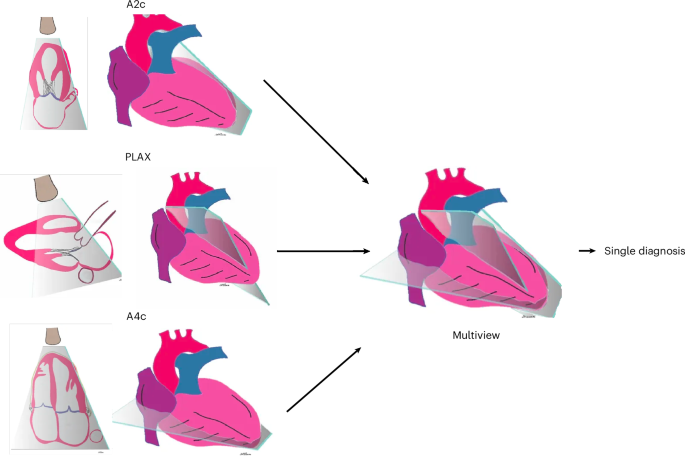
These view/doppler-classifier DNNs mechanically recognized enter echo movies comprising the predefined view and doppler mixture for every process. We then utilized these view/doppler DNN classifiers to all UCSF echos to establish the precise echo movies wanted for coaching and validation for every of the three demonstration duties. For the ventricular abnormality and diastolic dysfunction multiview DNNs, the three enter echo views used had been non-doppler A4c, A2c, and PLAX views; and for valve regurgitation, the enter echo views had been color-doppler A4c, A5c, and PLAX views. To make sure a good comparability between single-view and multiview fashions, we first excluded all research that had been lacking any required views. Each mannequin sorts had been educated and evaluated on movies from the identical research, the one distinction being whether or not a mannequin acquired a single view or three views as enter.
For the ventricular abnormality dataset, we included all sufferers in our dataset with measures of ventricular operate, comprising 36,023 echo research from 11,334 sufferers. Of those, 2,907 sufferers had been recognized as having a ventricular abnormality, outlined as having any irregular measure of EF, LV dimension, RV dimension, or RV operate. Ventricular abnormality was outlined as constructive if there was any abnormality in LV/RV dimension or operate. LV dimension abnormality was outlined as larger than delicate dilation, which was LV finish diastolic quantity index of >86 ml m−2 for males or >70 ml m−2 for girls. LV purposeful abnormality was outlined as LVEF < 50%, measured by Simpson’s biplane strategy19. RV dimension abnormality was outlined as reasonably elevated or larger, and irregular RV operate was outlined as reasonably decreased or larger19.
For diastolic dysfunction, we included all sufferers with measures of diastolic dysfunction, comprising 11,341 echo research from 6,649 sufferers. Diastolic dysfunction was outlined as any diastolic dysfunction (grades 1–4) as decided by ASE tips20,21. Of those, we recognized 4,774 sufferers displaying any diastolic dysfunction measure above grade 0. Grades 1–2 included any annotation of irregular or impaired rest, or elevated filling stress. Grade 3 included all pseudonormal diastolic operate, and grade 4 included restrictive diastolic operate.
For valve regurgitation, we included all sufferers with measures of valve regurgitation, comprising 27,652 echo research from 18,533 sufferers. Any substantial valve regurgitation was outlined as reasonable or larger regurgitation in any of the mitral, tricuspid, or aortic valves in keeping with ASE tips22. Of those, we recognized 969 sufferers with mitral valve regurgitation, 329 sufferers with aortic valve regurgitation, and 1,299 sufferers with tricuspid valve regurgitation.
Our exterior validation dataset consisted of all echos acquired on the MHI in 2022 on sufferers over the age of 18 years. These research had been equally linked to the medical echo stories from which we obtained qualitative and quantitative reference labels. The MHI echo lab makes use of linear measurements (in contrast with volumetric measurements at UCSF), which resulted in our needing to make use of linear measurements to outline sure “abnormal” findings at MHI, as described beneath. For LV operate, we labelled research with an EF < 50% to be irregular. Research with a basal RV dimension measurement >4.4 cm had been labelled irregular. Research with a basal LV dimension measurement of 6.3 cm for males or 5.6 cm for girls had been outlined to be irregular. For RV operate, abnormality was outlined as greater than reasonably decreased operate (qualitative). Diastolic operate grade labels had been out there in MHI and adopted ASE tips20,21. Measurement of RV parameters was commonplace follow within the MHI echo lab in the course of the research interval. MHI echos had been processed utilizing equivalent preprocessing as described above. Preprocessing and look at classification efficiency in MHI had been assessed by randomly reviewing 350 MHI clips labelled by the UCSF-trained view classifier. The view classifier carried out nicely throughout our goal views with precision (PPV) of 100% for A4c, 83.3% for PLAX, 88.5% for A2c, and 81.8% for A5c, with a world accuracy of 79.14%. We deployed our educated multiview DNNs on all MHI echos that had pertinent diagnostic labels and the three predefined views for every process. We then ran inference utilizing the three multiview DNNs on all MHI research containing the suitable views.
DNN architectures
For view classification, doppler detection, and all single-view fashions, we selected as our video-based DNN spine the 3D convolutional neural community X3D-Medium (X3D-M), from the household of X3D architectures15. We examined different video-based DNN backbones, together with R2-1D and the transformers ViViT, MoviNet, and STAM, and located X3D probably the most performant spine general. X3D-M had the extra good thing about being comparatively light-weight in comparison with these different fashions, with 3.8 million parameters in comparison with R2-1D’s 33.3 million. This computational effectivity enabled quicker coaching, bigger batch sizes, and, ultimately, enlargement of the structure to include multiview video enter.
For our multiview evaluation, we developed a bespoke structure to combine a number of views with an enhanced mid-fusion technique. First, the DNN passes every view, consisting of a 64 × 224 × 224 × 3 video, by means of 5 convolutional blocks consisting of 3D convolutions, batch normalization, and a rectified linear unit non-linearity, producing temporally and spatially decreased embeddings of form (B, C, T, H, W) representing batch, channel, time, peak, and width. These first 5 blocks are unchanged from the unique X3D-M structure15. The ensuing embeddings are stacked alongside a brand new view dimension, V, to provide a tensor of form (B, C, V, T, H, W). This tensor is then flattened throughout the time, peak, and width dimensions, leading to a tensor of form (B, C, V, THW). A sixth convolutional block (following the identical convolution, batch normalization, rectified linear unit format) performs a 2D convolution throughout the view and mixed spatiotemporal dimensions to fuse data throughout the views. The tensor is then reshaped to (B, CT, V, H, W) and handed to the ultimate convolutional block. This last block expands the variety of channels by an element of 128 because it performs a 3D convolution throughout view, peak, and width. This step is essential for deep integration of spatiotemporal data throughout views. The ensuing tensor is then reshaped to (B, CV, T, H, W), and we carry out common pooling on time, peak and width dimensions earlier than passing the ultimate tensor by means of a completely linked layer and a choice head. The ultimate multiview DNN has 230 million parameters.
DNN coaching
All DNNs had been developed and educated in Python (model 3.8.8) utilizing the Pytorch library35 (model 1.8.8). Coaching of single-view DNNs took roughly 3 h; coaching of multiview DNNs took roughly 30–50 h on twin NVIDIA Quadro RTX 8000. For binary classification, we used a sigmoid determination head and the binary cross entropy loss, and for multiclass classification, we used a softmax determination head and the cross entropy loss operate. For every of the three demonstration echo duties individually, the info had been divided into coaching/growth/take a look at datasets particular to that process in a 70/15/15 ratio, break up by affected person. The event dataset was used throughout coaching for studying fee decay scheduling and number of the ultimate fashions. The take a look at dataset was held out from any mannequin coaching or growth and used to calculate analysis metrics as soon as the ultimate DNNs for every process had been educated.
Enter movies to the DNN consisted of the primary 64 frames of the video. Movies shorter than 64 frames had been padded with empty frames. Echo video body charges had been 33 ± 17 frames per second. We didn’t normalize body charges within the last coaching course of, as this was tried and didn’t enhance efficiency. The view classifier DNN was educated for 1,000 epochs beginning with a studying fee of 0.01 and lowering studying fee utilizing an element of 0.5 with a persistence of fifty and a loss threshold of 0.01. A separate doppler detection algorithm was educated on the identical information with the identical parameters. After coaching, the checkpoint reaching the bottom loss on the validation set was chosen as the ultimate DNN.
To coach the single- and multiview DNNs, we used an ordinary hyperparameter sweep paradigm to permit all fashions to attain their optimum efficiency and allow comparability. We carried out separate hyperparameter sweeps over equivalent ranges of studying fee, threshold, and persistence for studying fee decay for every process and look at mixture. For every sweep, we sampled studying fee from a log-uniform distribution between 1 × 10⁻⁶ and 5 × 10⁻². For studying fee decay, we used the ReduceLRonPlateau scheduler monitoring validation loss with a 5% threshold. The scheduler persistence was randomly sampled from (3, 5, 7, 10) and issue from (0.3, 0.5, 0.7). All fashions had been educated for a complete of fifty epochs with out early stopping over 40 sweep trials with mounted random seeds for reproducibility. All fashions had been educated on a single mounted information break up for every process dataset. Each the enter information dimension and mannequin parameter sizes are considerably bigger for the multiview DNNs leading to elevated coaching time for multiview fashions. We used the stochastic gradient descent optimizer (momentum = 0.9; weight decay = 0.0001) for all coaching runs. Coaching information had been augmented gently utilizing random resized crop between 0.95 and 1.0, shade jitter between 0.8 and 1.2, and random rotation between −5 and 5 levels. After coaching, the checkpoint reaching the best AUC on the event set was chosen as the ultimate DNN.
All DNNs had been evaluated utilizing a mix of AUC and sensitivity/specificity at an optimum threshold outlined as the brink at which the geometric imply of sensitivity and specificity was maximal. Multiclass DNNs had been evaluated utilizing the imply AUC per class.
Explainability evaluation
To look at the options from the enter video that contributed to the DNN predictions, we used a customized adaptation of the guided class-discriminative gradient class activation mapping algorithm (guided grad-CAM) to look at single-view mannequin efficiency23. This tailored the 2D implementation to develop the dimensionality to accommodate 3D video information. This supplies an approximation of what echo video pixels the multiview DNN mannequin could also be specializing in, with the caveat that these are single-view approximations. Consultant movies had been chosen for top diagnostic high quality and assured disease-positive predictions (>0.95), and the tailored guided grad-CAM strategy was used to generate warmth maps similar to the pixels that the majority strongly contributed to that DNN’s prediction. Along with the guided grad-CAM, we additionally generated commonplace grad-CAM maps to offer a course, class-discriminative localization of related areas, whereas guided grad-CAM highlights fine-grained pixel-level options.
Statistical evaluation
All steady values are offered as imply ± 95% CI. For binary classification DNNs, the output of the ultimate sigmoid operate was a rating ranging [0–1]. We report efficiency metrics utilizing a default threshold for every DNN that was chosen to maximise the F1 rating on the event dataset for every process36. For the sensitivity/specificity-optimized sensitivity evaluation, DNN efficiency metrics are reported at thresholds within the take a look at dataset that repair sensitivity or specificity at 0.800. Statistical analyses had been carried out in Python utilizing pandas 2.3.0, numpy 1.26.4, scikit-learn 1.6.1, statsmodels 0.14.5, and MLstatkit 0.1.7.
The multiclass view classification DNN output consists of 21 steady values ranging [0–1] with the anticipated view similar to the utmost of the 21 values. For all take a look at datasets, we current the AUC, sensitivity, specificity, and F1 rating. CIs had been derived by sampling the take a look at set with alternative for 1,000 iterations to acquire fifth and ninety fifth percentile values.
Variations in AUCs had been examined utilizing DeLong’s take a look at37; in settings of a number of comparisons, Bonferroni correction was carried out by adjusting the P values whereas retaining the brink for significance at <0.05 (ref. 38). DeLong’s take a look at was applied utilizing the MLstatkit package deal (model 0.1.7) in Python, and Bonferroni correction was applied utilizing the statsmodels package deal (model 0.14.5) in Python. Statistical significance was outlined as P < 0.05.
For stratified analyses, we computed efficiency metrics for every DNN individually on strata of the take a look at units relating to age, gender, and illness subtypes. We outlined illness substrata as these research assembly beforehand described standards for every abnormality in comparison with research with out standards for abnormalities inside every of the three echo duties individually.
Reporting abstract
Additional data on analysis design is accessible within the Nature Portfolio Reporting Abstract linked to this text.
