



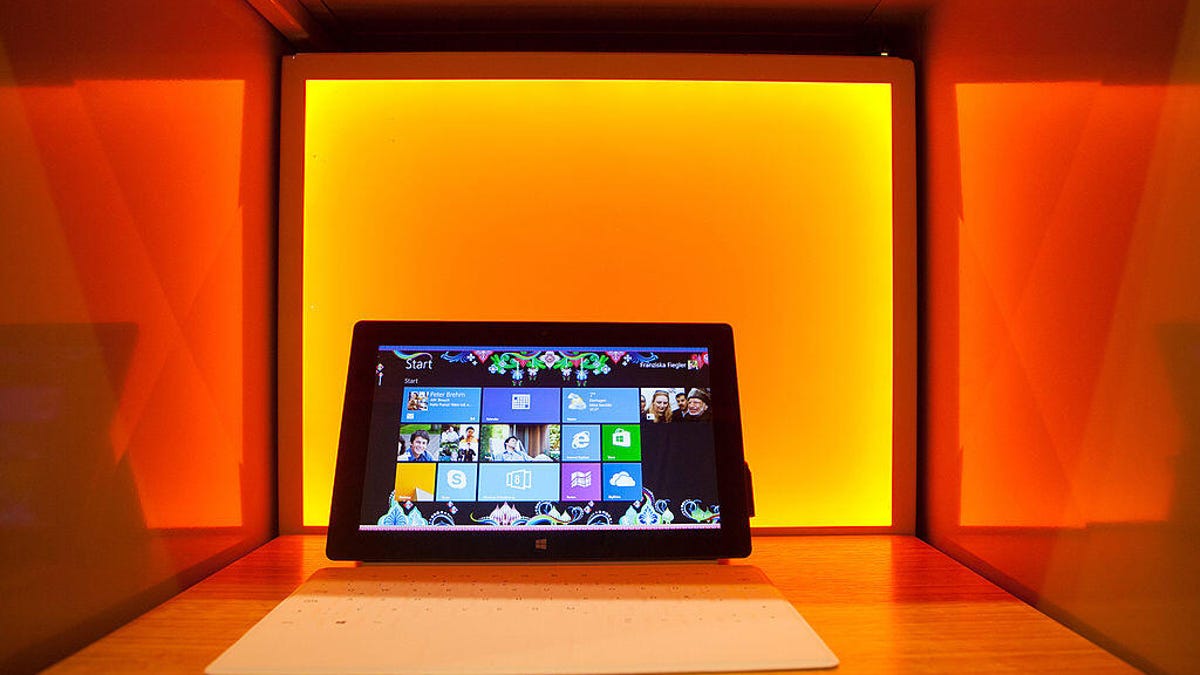
The Microsoft Floor RT from 2012.
Bloomberg / Getty Photographs
Comply with ZDNET: Add us as a most popular supply on Google.
ZDNET’s key takeaways
- The MacBook Neo is not the primary “cheap premium” laptop computer.
- Microsoft’s Floor RT was an identical product that launched in 2012, however it failed.
- Regardless of being years late, the MacBook Neo nails the execution.
The $599 MacBook Neo’s disruption of the patron laptop computer trade has been profitable not simply in its product design, but in addition in its execution. The branding is efficient, the timing is sweet, and Apple is talking to a demographic that truly exists.
However the Neo is just not the primary gadget of its sort. Microsoft tried the identical factor greater than a decade in the past with the Floor RT, a $599 ultraportable hybrid pill/laptop computer with a premium (for the time) construct, good battery, and {hardware} designed for on a regular basis duties. Nevertheless it by no means caught on.
Additionally: After utilizing MacBook Neo, it is clear Home windows must rethink its PC technique (and quick)
In a latest Substack publish, Microsoft’s former head of Home windows and architect behind the Floor RT, Steven Sinofsky shared some reward of the MacBook Neo, whereas drawing some “melancholy” conclusions about his — and Microsoft’s — failure to succeed with a product that’s pretty thought-about a predecessor of the Neo — almost 15 years in the past.
There are numerous components at play right here, however despite the fact that the Floor RT was a well-designed product with an modern perspective, Microsoft misplaced $900 million {dollars} on it as a result of they did not promote. It was too early — the ecosystem wasn’t there, and the approach to life branding fell flat.
All of it begins with the muse
Within the client electronics market, efficiency is necessary, however so is branding. You are not simply promoting a product, you are promoting a way of life. Clearly, Apple understands this intimately. The Neo involves market with many years of established branding supporting it. Its place in Apple’s laptop computer catalog is obvious and straightforward to know, even to the typical client.
Conversely, when Microsoft launched the Floor RT in 2012, it went to market with a variety of “firsts.” It was an all-new product line: Microsoft’s first in-house laptop computer PC, and it launched with an all-new working system: Home windows RT, a stripped-down model of Home windows 8 that ran on ARM structure.
Revisit: My 60 days with the Floor RT
For all that alone, the Floor RT was an enormous danger for Microsoft, however it’s a must to respect it. Microsoft believed it had created one thing modern (and it had), however the client market is not assured to simply accept an modern product solely due to that truth alone — particularly if there’s not a longtime model story to assist it.
The Floor was too new, too unknown, and despite the fact that its {hardware} and design have been spectacular, customers weren’t able to throw down for Home windows RT’s “walled garden”, which solely ran choose apps from the Home windows Retailer. The Neo involves market alongside a totally mature ecosystem with many years of app improvement. It’s Apple’s Nepo Child — all of the exhausting work has been finished, it simply wants to indicate up.
Proto-Neo
Senior Contributing Editor Ed Bott went hands-on with the Floor RT again in October 2012 and praised its {hardware} and design, however acknowledged there was rather a lot lacking. In addition to being locked to Web Explorer with no assist for Chrome or Firefox, even Microsoft’s personal ecosystem of apps was restricted on the Floor RT.
The Floor launched with an Nvidia Tegra 3 SoC and 2GB of RAM, which on the time, was roughly equal to the Neo’s 8GB: not rather a lot, however actually sufficient for on a regular basis use. Native storage was additionally lean, with both 32GB or 64GB of eMMC (soldered) on the gadget.
On the plus aspect, Bott stated its battery life was nice, lasting for a number of days with intermittent use, and the general {hardware} was attractive, together with the well-engineered kickstand. It ran quietly and environment friendly, with no followers and no warmth. Sound acquainted?
However the issue was the ecosystem. It merely wasn’t developed sufficient to face by itself — the variety of apps within the Home windows Retailer is a fraction of these accessible to Apple and Android customers. Not solely might customers run the apps they wished, however the ones accessible have been additionally not optimum.
Hindsight is 20/20. You possibly can wager that Apple realized from Microsoft’s rollout of the Floor RT nearly 15 years in the past and waited to launch the Neo till the celebs aligned — even when meaning a number of years late.
Audience
I do not know who wants to listen to this, however in the event you do not just like the MacBook Neo, it in all probability is not for you. There’s a goal demographic for this gadget, and it is not the MacBook Professional consumer. It does not matter if there are objectively “better” bang-for-buck PCs or Chromebooks in the marketplace (there are). What issues is Apple’s calculated execution that hits all the fitting notes: branding, product ecosystem, and goal demographic.
Neo nails the cool issue. And that is what strikes merchandise.
Additionally: MacBook Neo assessment: My largest concern with Apple’s near-perfect finances laptop computer
Now, Apple could have realized from the previous, however the future remains to be unwritten. If these units find yourself piling up as low-cost, disposable merchandise that do not final various years, it will be disappointing. I am not predicting doom and gloom, however I’ve expressed my issues concerning the Neo’s longevity, particularly since if these items are going to be thrown round lecture rooms and public areas by children.
In that sense, its scenario is the other of Microsoft’s Floor RT: the ecosystem is there — the {hardware} simply must final. Here is hoping that is not the case, and it is well worth the wait.
