



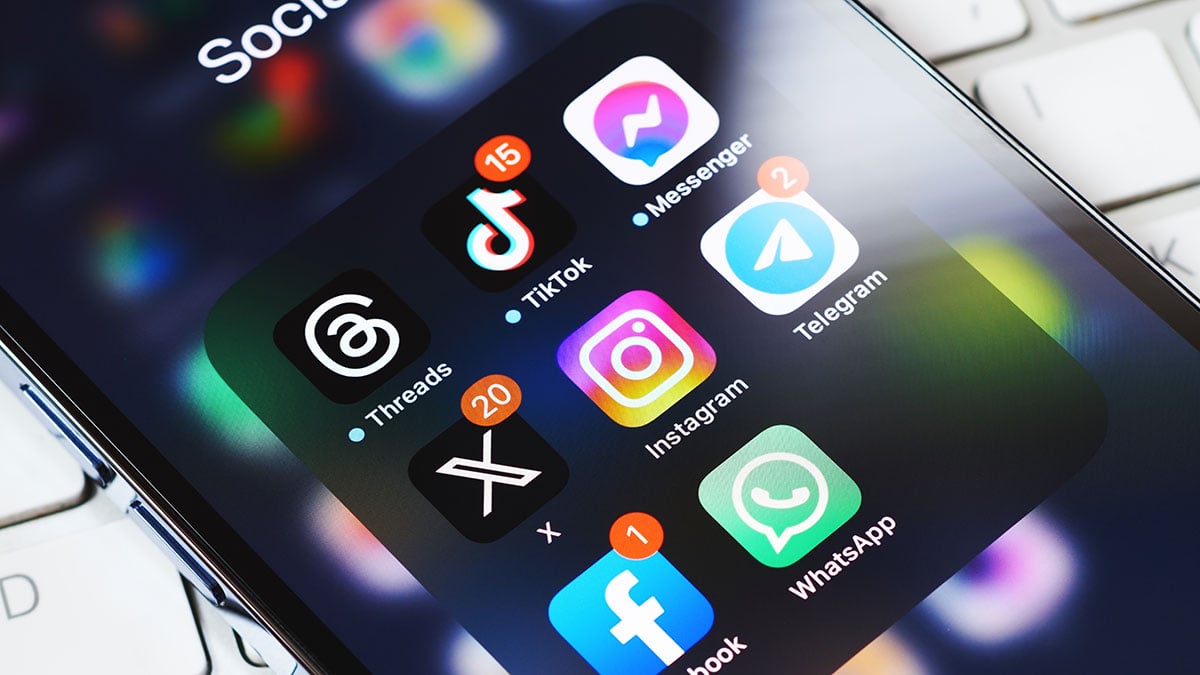
The misuse of social media, the moral challenges of synthetic intelligence, and the pressing want for governance within the digital sphere had been the important thing themes mentioned on the London Tech Expo within the London Docklands at the moment.
Audio system together with Baroness Martha Lane Fox, documentary maker Louis Theroux and mathematician Professor Hannah Fry warned that anonymity, algorithmic amplification, and unmoderated engagement have reshaped human behaviour in ways in which reward spectacle over empathy and extremity over nuance, with penalties for each people and society.
Lane Fox, entrepreneur and co-founder of Lastminute.com, known as for extra deliberate oversight of digital platforms.
“For too long, we have assumed the market would self-correct,” she stated. She urged stronger privateness protections, strong age-assurance mechanisms for younger customers, and higher variety in know-how management.
“Underrepresentation of women and minority groups has real consequences for product design, algorithmic fairness, and the distribution of digital power,” she added, framing the dialogue round accountability, ethics, and inclusion.
Lane Fox argued that leaving innovation totally to industrial platforms has uncovered society to systemic dangers. From amplified disinformation to the monetisation of human consideration, she stated, the present trajectory prioritises engagement over societal well-being.
“We have the opportunity to build a digital ecosystem that protects users, promotes inclusion, and ensures accountability,” she warned. “It will not happen automatically; it will require deliberate choices by regulators, industry, and society.”

Louis Theroux illustrated the human penalties of social media’s attain. “You can fart in your front room, and millions of people are watching,” he stated, referring to platforms corresponding to X (previously Twitter). “There’s no barrier to entry, and that’s a disaster.”
He emphasised the size of amplification: “You stand in your kitchen at the door and end up with tens of thousands or even millions of followers. Of course a lot of them are bots. But they’re out there waiting on your every word.”
For Theroux, the digital world has collapsed the space between non-public life and public publicity, leaving strange customers susceptible to magnification and misinterpretation.
Professor Hannah Fry, the mathematician and writer, defined how the structure of social media amplifies human impulses.
“It’s not that people are innately extreme. It’s that the system rewards extremity. Amplification becomes a vector for vulnerability,” she stated. Fry described the permanence of content material on-line, recounting how kids can unintentionally broadcast non-public photographs to tens of millions. “We are designing systems that collapse privacy and reward impulsivity. A single click can put something online forever,” she stated.
Theroux additionally explored the gendered and social dynamics of on-line engagement – one thing he explores in depth in his Netflix sequence Louis Theroux: Contained in the Manosphere the place he interviews anti-feminist influencers.
“What you come to realise is actually, in many respects, the most there is a projection of weakness rather than strength. It’s a compensation for a world that seems intimidating, for which many men feel lost. It’s a strategy for survival.”
Male-dominated content material typically emphasises aggression and bravado, whereas feminine creators could give attention to social or reflective interactions, he stated. Algorithms, nevertheless, reward extremes in each circumstances, producing distorted mirrors of human behaviour.
Fry, who just lately recorded her personal BBC documentary, AI Confidential With Hannah Fry, described encounters with builders creating avatars of deceased family members, designed to permit ongoing interplay.
“There’s a real human need here, but it is intertwined with exploitation. We need to be thoughtful about what is being monetised and scaled,” she stated.
She emphasised that whereas AI can present consolation and help, it can not change human judgment, creativity, or moral reasoning. “AI can simplify tasks, but it cannot generate the insights that define human progress. Our challenge is to use these tools wisely, not to be dominated by them.”
Fry additionally addressed the monetary incentives behind excessive content material. “Engagement dictates how much money they make,” she stated, referring to evenly curated, constantly streamed content material optimised to maximise visibility. “In a sense, it’s like turbo-charging those impulses to perform your worst qualities.” The algorithms reward spectacle and provocation, not authenticity.
Regardless of these warnings, Fry provided a cautiously optimistic perspective. AI and social media can facilitate connection, creativity, and societal enchancment—however provided that deployed thoughtfully. “Ultimately, we can design systems that improve well-being and societal outcomes. But it will take vigilance, not passivity,” she stated.
