



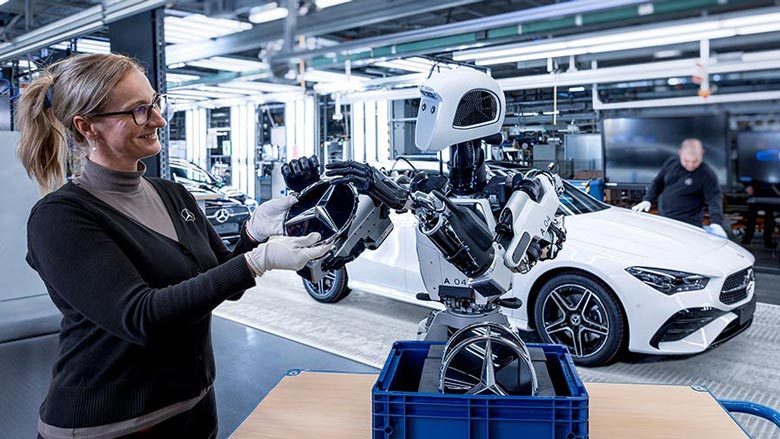
As superior sensors, synthetic intelligence and different know-how transforms industrial robotics, some observers predict that people will play much less of a hands-on position in manufacturing. Others argue that individuals will change into extra vital than ever.
Human-centered manufacturing is the main focus of Trade 5.0, which is the following step past Trade 4.0 initiatives. The purpose is to reinforce the position of people in factories and enhance how they work together with robots on meeting strains.
The time period originated in Europe a number of years in the past to explain an atmosphere the place folks keep full management whereas fostering a harmonious collaboration with machines. Robots deal with labor-intensive or high-risk duties, however people concentrate on complicated or value-added manufacturing duties.
People stay within the loop for decision-making and judgment. Automation helps flexibility, studying and system resilience somewhat than inflexible optimization.
“Manufacturing is often described in terms of machines, automation and technology,” says Todd Deaville, vp of superior manufacturing innovation at Magna Worldwide Inc. “However, a very powerful change taking place on in the present day’s manufacturing unit ground isn’t mechanical—it’s human.
Trade 5.0 emphasizes human-centricity, sustainability and system resilience. Photograph courtesy Common Robots
“Automation doesn’t replace people—it changes how people add value,” claims Deaville. “As machines take on more repetitive, dangerous or physically demanding tasks, human work shifts toward interpretation, troubleshooting, problem solving and continuous improvement. The work becomes less about motion and more about judgment.”
“Industry 5.0 represents a value-driven evolution beyond Industry 4.0 rather than a replacement,” provides Shihao Fu, a know-how analyst at IDTechEx. “Whereas Trade 4.0 focuses on effectivity, automation and digital connectivity, Trade 5.0 emphasizes human-centricity, sustainability and system resilience.
On the lookout for fast solutions on meeting and manufacturing matters?
Strive Ask ASM, our new good AI search device.
Ask ASM
“In this context, technology is no longer designed solely to maximize throughput or reduce costs,” explains Fu. “Instead, Industry 5.0 asks how machines, robots and artificial intelligence can augment human capabilities, support collaboration, and enable manufacturing systems to remain robust and adaptable under uncertainty. Humans are no longer treated as system variables, but as the central element around which technology is designed.”
Based on Fu, the important thing distinction between Trade 5.0 and Trade 4.0 lies within the real-world challenges they’re designed to handle.
“Industry 4.0 emerged in a period of relative global stability, with supply chains optimized for efficiency and predictability,” explains Fu. “Its focus was on making manufacturing quicker, cheaper and extra secure by system-level automation and digitalization.
“Industry 5.0 arises because these assumptions no longer hold,” says Fu. “Market volatility, geopolitical uncertainty, supply chain disruptions and labor shortages have exposed a key limitation of Industry 4.0 systems: they are highly efficient, but often fragile.”

Trade 5.0 shifts automation from remoted, cage-based methods to environments the place people and robots work safely collectively. Illustration courtesy Siemens
“Industry 5.0 shifts automation from isolated, cage-based systems to environments where humans and robots work safely and naturally together, with automation designed to assist and amplify human workers, not replace them,” provides Vincent Duchaine, chief know-how officer at Robotiq, a Canadian firm that makes a speciality of collaborative robotic know-how.
“While Industry 4.0 focused on connecting machines and data, Industry 5.0 is about intelligent interaction,” Duchaine factors out. “It’s about utilizing AI to simplify integration, coordination and real-world decision-making throughout robots, machines and peripherals.
“Industry 5.0, or what could be referred to more accurately as ‘smart automation,’ means systems are intuitive, quick to deploy and operable by teams working on the shop floor, not by robot experts,” says Duchaine. “This lowers integration value and complexity, which is very vital for small- and mid-sized producers.
“Industry 5.0 is about making automation truly work,” notes Duchaine. “It’s more than just connecting machines. [The goal is to simplify] how humans and robots interact, using AI to make automation easier to deploy, simpler to use and more accessible to manufacturers that don’t have deep automation expertise.”
“Industry 5.0 represents a recalibration in how technology is applied across manufacturing operations,” provides Loic Barancourt, CEO, of Digital Matter, an organization that makes a speciality of Trade of Issues {hardware}. “Success is outlined much less by the quantity of automation or knowledge collected, and extra by the outcomes know-how allows—
supporting folks, strengthening resilience and serving to operations carry out reliably beneath real-world situations.
“Engineers and operators remain responsible for the decisions that matter most, from when to intervene to how risk and resources are managed,” explains Barancourt. “Trade 5.0 positions know-how as a sensible enabler of these judgments, offering constant and reliable perception that helps folks act with confidence as situations evolve.
“Industry 4.0 emphasized automation, connectivity and the large-scale data collection inside the factory, with a strong focus on efficiency and optimization,” says Barancourt. “Whereas many organizations are nonetheless within the technique of implementing these methods, expertise has proven that effectivity alone doesn’t assure resilience or higher outcomes.
“Industry 5.0 builds on that foundation, but reframes the objective,” claims Barancourt. “Instead of simply asking ‘how much can be automated or measured?’ manufacturers are asking whether technology genuinely supports people, holds up over time and contributes to long-term operational stability. In practice, this means applying existing technologies more deliberately across the full operating system.”
Human Collaboration
Over the last 15 years, producers in a wide range of industries have adopted key ideas of Trade 4.0 by investing in augmented actuality, cloud computing, collaborative robots, knowledge analytics, digital twins, 5G communication networks and different know-how.
“This period has witnessed multiple global events which have challenged industries in various ways, including economic volatility and supply chain disruptions,” says Umang Garg, managing director and world follow chief for automation and manufacturing Nagarro, a digital engineering and consulting agency that works with a wide range of Fortune 500 corporations. “Industry 5.0 has brought back the need for human effort and put workers at the center of manufacturing operations.”
With Trade 5.0, automation turns into human-centric, adaptive and collaborative. “In Industry 4.0, automation primarily aims to reduce human variability by standardizing processes for efficiency and stability,” explains Fu. “Trade 5.0 shifts the emphasis from automating duties to automating collaboration and coordination between people, machines and software program.
“Automation systems are increasingly designed to interact with humans, understand intent and context, and continuously adapt,” says Fu. “In Industry 5.0, humans are the core of the manufacturing system. Their value lies not in repetitive manual work, but in decision-making, judgment, creativity and handling complex or unexpected situations.”

The purpose of Trade 5.0 is to simplify how people and robots work together, utilizing AI to make automation simpler to deploy, less complicated to make use of and extra accessible to producers. Photograph courtesy Robotiq
In contrast with Trade 4.0, the place people primarily act as supervisors, Trade 5.0 elevates human experience and contextual understanding. The target is to permit folks to concentrate on high-value cognitive duties whereas being supported by clever machines that deal with routine, hazardous or precision-intensive work.
Certainly, a human-centric strategy is among the key differentiators of Trade 5.0. Inside this context, folks play a number of key roles, together with:
- Supervision. “Humans act as supervisors of the automation, overseeing the process and outcome,” says Garg.
- Collaboration. “Humans work with cobots to ensure task completion,” Garg factors out. “These tasks may be across different parts of the industrial value chain. For example, a cobot may be used to lift a heavy object while the human is responsible for performing the necessary steps on that object.”
- Personalization. “Industry 5.0 is likely to enable large-scale personalization of products,” predicts Garg. “This might encompass robots performing production steps in small batches, while humans focus on product customization and managing the final outcome.”
- Innovation. “While robotic automation drives efficiency in performing repetitive tasks with high accuracy, the role of humans is to create process innovation and product innovation,” says Garg.
Function of Robots
Specialists consider that autonomous cell robots (AMRs), six-axis collaborative robots and humanoid robots will all play interconnected roles within the new world of Trade 5.0.
“Robots will evolve from isolated task executors into collaborative partners and capability amplifiers,” says Fu. “Collaborative robots and extra superior, human-like robotic methods are designed to work safely alongside people in shared environments.
“They take on repetitive, physically demanding or high-risk tasks, while adapting to human pace and intent,” notes Fu. “This collaboration enhances flexibility and resilience, allowing production systems to respond more effectively to variability and disruption.”
“The distinction lies in a fundamental shift of industrial philosophy moving from a technology-driven mindset to a purpose-driven one,” notes Arungalai Anbarasu, a member of the group govt board at Körber AG. “Trade 4.0 was centered on attaining aggressive benefits by growing connectivity, knowledge transparency and maximized throughput.
“Industry 5.0 takes those digital tools, but applies a completely different intent, pivoting toward the three critical pillars of human-centricity, resilience and sustainability,” says Anbarasu. “This marks a transition from merely constructing good factories and course of options to designing future-ready ecosystems.

Automation methods are more and more designed to work together with people, perceive intent and constantly adapt. Photograph courtesy Nationwide Institute of Requirements and Know-how
“While the 4.0 era succeeded in connecting machines to each other, Industry 5.0 focuses on the collaboration between those machines and human operators,” explains Anbarasu. “I view this as shifting the focus from the sheer acceleration of output toward creating systems that are disruption-ready, environmentally conscious, and fundamentally designed to harmonize with human capabilities, such as creativity, rather than replace them.”
Anbarasu believes that it’s not nearly what know-how can do, however how know-how can serve the long-term resilience of a producing operation and the co-existence of the folks inside it.
Automation is present process a basic shift from being a device of alternative to a device of augmentation. Within the Trade 5.0 period, automation will probably be designed to function a strategic companion to the workforce.
“Automation is no longer just about doing things faster without human interaction,” claims Anbarasu. “It is about building more adaptable and flexible systems that enhance worker safety and support complex decision making. It becomes a lever for personalization and a way to build resilience into the very fabric of the assembly process.”
Based on Anbarasu, probably the most aggressive manufacturing methods within the close to future will probably be people who seamlessly mix machine reliability with the distinctive adaptability of the human thoughts. “Robots are evolving from isolated machines behind safety fences into collaborative partners,” she factors out. “On this new period, robotic methods tackle essential ache factors like skilled-labor shortages, whereas bettering yield and security.
“This transformation is visible in our deployment of collaborative robots that work alongside operators and AMRs that handle complex logistics,” says Anbarasu. “By integrating perception and sensing technologies, we enable robots to understand their environment and assist humans more intuitively. Their role is to handle dull and dangerous tasks. This allows the human workforce to focus on the creative side of manufacturing.”
As extra robots are deployed in factories and do extra complicated work alongside folks, they want a standard option to talk not simply the place they’re, however what they’re making an attempt to do and the way they’ll reply to their environment.
“As robots move beyond isolated, preprogrammed tasks and work more closely with humans, they must be able to communicate information beyond basic state and status,” says Andrew Singletary, Ph.D., CEO of 3Laws Robotics, an organization that has labored with producers akin to Ford, Raytheon and Yamaha to develop safetycritical autonomy software program. “Speaking intent, akin to whether or not a robotic plans to decelerate, change course or pause, builds predictability. That predictability is essential not just for protected robot-robot coordination, however for creating environments the place people really feel assured working aspect by aspect with machines.
“Robotics is changing fast,” explains Singletary. “New forms of robots, with completely different sensor modalities and compute architectures, are being deployed throughout more and more complicated manufacturing environments and different shared areas.
“For these systems to work safely and effectively, they must operate together rather than in silos,” warns Singletary. “Interoperability provides a common framework that enables safer interactions, smoother coordination between machines and gives people confidence that robotic systems will behave predictably, even in dynamic or unplanned situations.”
ASSEMBLY ONLINE
For extra data on human-robot collaboration, go to www.assemblymag.com to learn these articles.
