



**Effective Persistent Memory and State Management Patterns for Production AI Agents**
Building an AI agent is one thing; keeping it reliable, predictable, and maintainable over a six‑month production deployment is another. Because large language models (LLMs) are stateless by design, teams often try to “solve” memory by dumping the entire conversation history into the context window. That approach works for demos, but it quickly falls apart in production: latency spikes, relevant facts get buried, token costs balloon, and the model loses the ability to reliably use what’s in context.
The alternative is to treat memory and state as first‑class architectural decisions—not afterthoughts. This means explicitly separating short‑term execution state from long‑term knowledge and enforcing boundaries for privacy, compliance, and cost control.
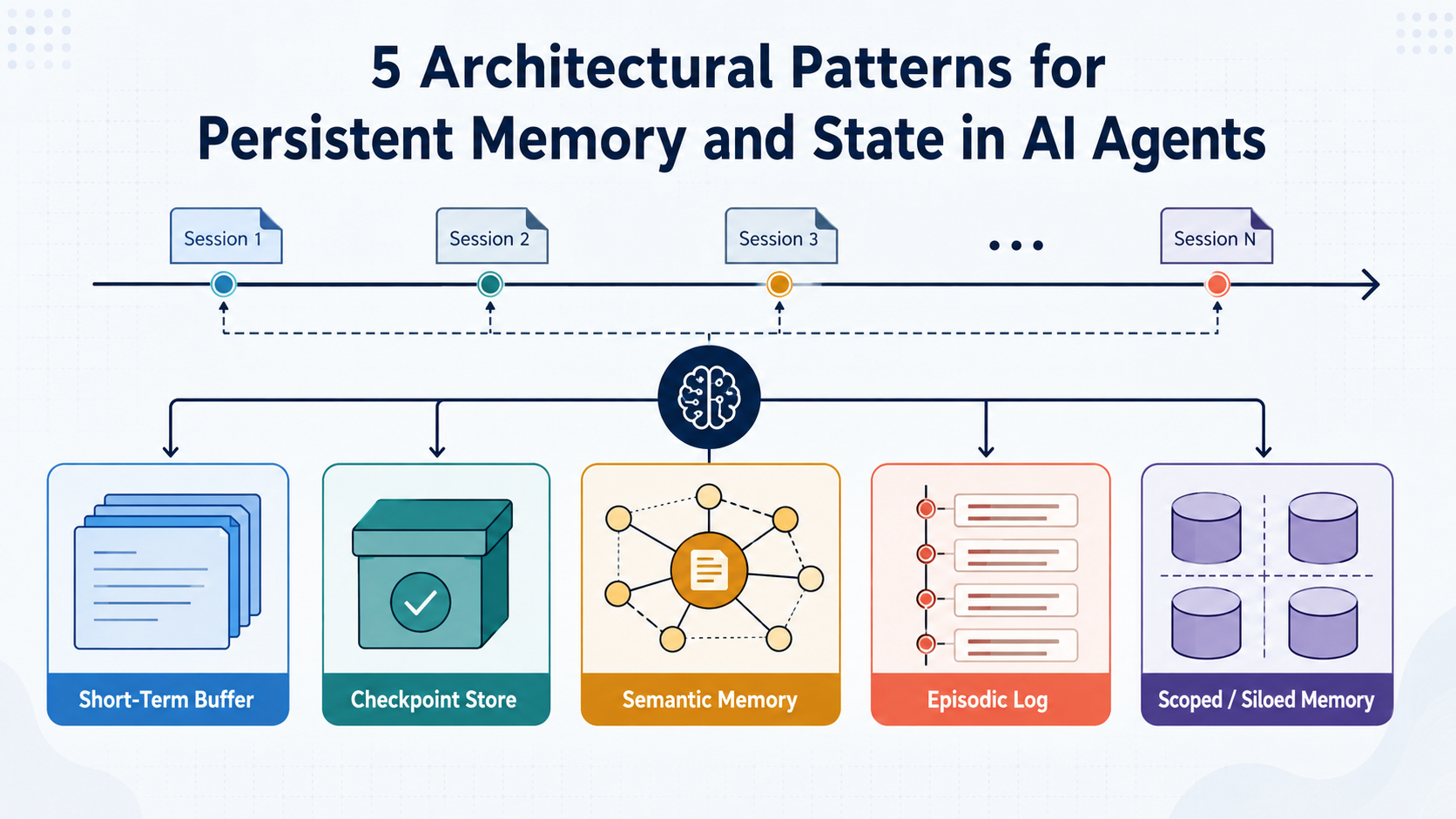
Below are five practical patterns that help production AI agents stay accurate, learn from experience, and remain operationable over time.
—
### 1. The In‑Context Working Buffer (Short‑Term Execution)
**What it is**
A short‑term, session‑level “working memory” that holds the active reasoning chain, recent tool calls, and intermediate prompts. It acts as a sliding scratchpad that is summarized and pruned as the task progresses.
**How it works**
Instead of appending every message turn to the context, the agent maintains a lightweight scratchpad. As the buffer approaches its token limit, an older steps are summarized into a compact background context while raw tool outputs are dropped. At task completion, the buffer is flushed: important insights are persisted, and the rest is discarded.
**When to use it**
Essential for any multi‑step agent that needs to reason across turns without unbounded context growth.
—
### 2. Execution Checkpointing (Fault Tolerance & Pausing)
**What it is**
A durable snapshot of the agent’s workflow state (variables, step progress, tool outputs) saved to a database so that execution can resume after interruptions without redoing completed work.
**How it works**
In graph‑oriented agent frameworks, each step writes its state to a store such as PostgreSQL or SQLite. If a timeout, rate limit, or human approval pauses execution, the agent reloads the last checkpoint and continues.
**Important caveats**
Resuming does not guarantee exactly‑once behavior: side‑effecting actions (e.g., sending emails or writing records) may repeat. Make nodes idempotent when possible, and avoid checkpointing non‑serializable resources such as open file handles.
**When to use it**
Critical for long‑running tasks, human‑in‑the‑loop approvals, regulated workflows, and environments prone to network or service disruptions.
—
### 3. Semantic Memory (Cross‑Session Knowledge)
**What it is**
Persistent facts about users, preferences, and domain knowledge that survive across independent sessions.
**How it works**
Facts are extracted asynchronously and stored externally, typically in a vector database with metadata filtering or a knowledge graph for relational queries. Before a task, relevant facts are retrieved and injected into the prompt. Because facts can become stale or contradictory over time, mechanisms like recency weighting, TTLs, or explicit supersession logic are necessary.
**Security and integrity notes**
Credentials and secrets should never be stored as retrievable semantic memory. Use a secrets manager instead. Untrusted content should be ingested with provenance tags and access controls to prevent poisoned knowledge from distorting future behavior.
**When to use it**
Personal assistants, coding copilots, and enterprise agents that must remember user preferences, API choices, or architectural guidelines across months or years.
—
### 4. Episodic Event Logs (Historical Reflection)
**What it is**
A chronological record of what the agent did: goal, plan, tool calls, and outcomes.
**How it works**
After each workflow completes, an “episode” is logged. Before similar tasks, the agent consults this log to avoid repeating mistakes. Unlike semantic memory, episodic memory influences behavior as advisory context rather than hard constraints.
**Caveats**
Retrieved episodes can mislead if the environment has changed or if a rare failure is overgeneralized. Treat logs as learning signals, not rigid rules.
**When to use it**
Useful for autonomous coding agents, data pipelines, and planning systems that should learn from past executions without human supervision.
—
### 5. Multi‑Scope Segregation (Enterprise Privacy)
**What it is**
Strict isolation of memories between users, sessions, and organizations.
**How it works**
Every memory write is tagged with identity scopes such as `user_id`, `session_id`, and `org_id`. Retrieval filters strictly enforce these tags, ideally at the storage layer through tenant‑level namespaces or row‑level security.
**Compliance implications**
Segregation is a prerequisite for data privacy compliance. Deletion is equally important: erasing a user’s data must also remove derived embeddings, summaries, and learned facts.
**When to use it**
Any SaaS product or multi‑tenant system where data boundaries must be guaranteed.
—
### Frequently Asked Questions (FAQ)
**Q: What is the difference between state and memory?**
State is the agent’s current snapshot of task progress; memory is the mechanism that carries information across sessions or turns. State is volatile and short‑lived; memory can be persistent.
**Q: Why not just use a large context window for everything?**
Because context windows are not databases. They suffer from latency, token cost, relevance decay, and model context degradation, making them unreliable for long‑term knowledge.
**Q: How often should I checkpoint a long‑running agent?**
Checkpoint after each logically complete step, especially before side‑effecting actions or network calls. The exact frequency depends on tolerance for rework and the cost of duplication.
**Q: Can episodic memory cause the agent to “overfit” to past failures?**
Yes. If failures are logged without context or filtering, the agent may avoid beneficial actions. Use episodic memory as guidance, not constraints, and apply probabilistic or recency weighting.
**Q: How do I handle memory deletion for compliance?**
Implement a data‑erasure pipeline that removes not only raw user data but also derived semantic embeddings, summaries, and learned associations stored in vector databases or knowledge graphs.
—
### Conclusion
The context window is not a database, and hoping it can function as one is a recipe for fragile, expensive, and unreliable agents. By separating concerns—short‑term working buffers, durable checkpoints, cross‑session semantic memory, episodic learning, and strict scope segregation—you build agents that learn, stay within policy, and hold up in production.
At scale, memory management also requires ongoing care: TTLs, consolidation jobs, pruning strategies, and continuous validation of retrieval quality. Invest in memory as a core architectural component, and your AI agents will become more trustworthy, efficient, and adaptable over the long term.
