



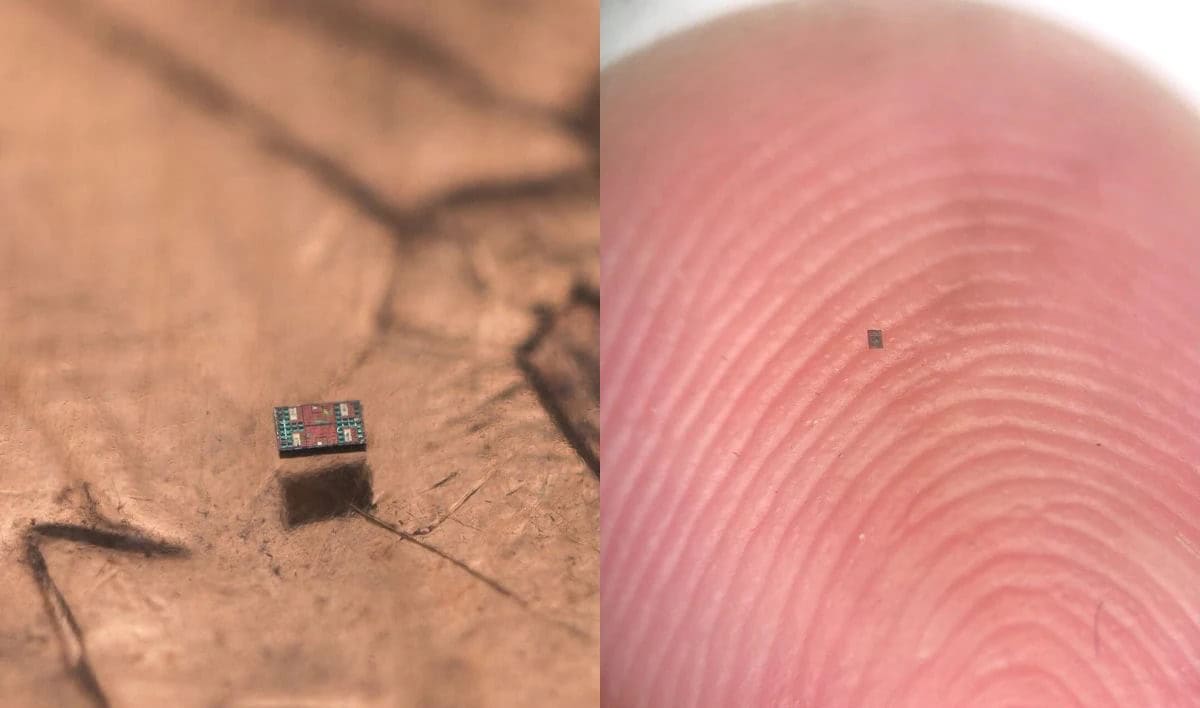
For nearly half a century, the dream of microscopic robotics has felt tantalizingly close, yet perpetually out of reach. We have grown up on a diet of science fiction like Fantastic Voyage, imagining tiny machines shrinking down to navigate the human bloodstream, repairing cells and hunting down viruses. But in the real world, shrinking a robot isn’t just about making things smaller; it’s about fighting physics.
Now, a collaboration between researchers at the University of Pennsylvania and the University of Michigan has finally broken through the barrier that has stalled the field for all this time. They have created the world’s smallest fully programmable, autonomous robots. These are extremely tiny swimming machines equipped with onboard sensing, memory, and computation.
Measuring just 200 by 300 by 50 micrometers — smaller than a grain of salt and roughly the size of a single-celled paramecium — these bots can sense their environment, make decisions, and move independently. They operate without tethers or magnetic fields, powering themselves with light and communicating through a clever series of wiggles.
“We’ve made autonomous robots 10,000 times smaller,” says Marc Miskin, Assistant Professor in Electrical and Systems Engineering at Penn Engineering and the paper’s senior author. “That opens up an entirely new scale for programmable robots.”
Swimming Through Tar
To understand why this is such a massive leap, you have to understand how weird the world gets when you shrink down to the microscale. In our human-sized world, inertia dominates. But at the scale of a cell, surface area rules. Forces like drag and viscosity become overwhelming.
“If you’re small enough, pushing on water is like pushing through tar,” says Miskin.
This explains why the field has been “stuck on this problem for 40 years.” You can’t simply shrink a mechanical arm or a propeller. “Very tiny legs and arms are easy to break,” says Miskin. “They’re also very hard to build.”

So, the team abandoned the idea of mechanical limbs entirely. Instead, they turned to a propulsion system that exploits the strange physics of the micro-world: electrokinetics.
The robots utilize four onboard actuators that generate a localized electrical field. This field tugs on the charged ions in the surrounding fluid, which then drag the water molecules along with them. “It’s as if the robot is in a moving river,” says Miskin, “but the robot is also causing the river to move.”
Because this system requires no moving parts, the robots are practically indestructible. “You can repeatedly transfer these robots from one sample to another using a micropipette without damaging them,” says Miskin.
The World’s Smallest Computer

While the propulsion system is a marvel of physics, the robot’s “brain” is a masterpiece of efficiency. A robot isn’t truly autonomous if it relies on an external operator to tell it every move. It needs to make decisions by itself.
This presented a massive engineering headache. The robots are powered by microscopic solar cells, or photovoltaics, that cover their backs. These tiny panels generate a meager 75 nanowatts of power.
“The key challenge for the electronics,” says David Blaauw, a professor at the University of Michigan whose lab developed the computer, “is that the solar panels are tiny and produce only 75 nanowatts of power. That is over 100,000 times less power than what a smart watch consumes.”
To work within this starvation-level energy budget, Blaauw’s team had to design circuits that run on extremely low voltages, drastically reducing power consumption. They also had to reinvent how the robot processes data. The team developed a custom instruction set — essentially the machine language the robot speaks — to pack complex behaviors into a tiny memory bank of just a few hundred bits.
“We had to totally rethink the computer program instructions,” says Blaauw, “condensing what conventionally would require many instructions for propulsion control into a single, special instruction to shrink the program’s length to fit in the robot’s tiny memory space.”

The result is a fully lithographic, silicon-based robot that can be manufactured en masse. The researchers can fit over 100 robots on a single chip, and with yields exceeding 50 percent, they are producing swarms of them at once.
The Waggle Dance
One of the most charming features of these high-tech specks is how they talk to us. Since the robots are too small to carry Wi-Fi antennas, the researchers took a cue from nature.
The robots are capable of sensing temperature with a precision of about 0.2 degrees Celsius. When a robot needs to report that data back to the researchers, it doesn’t send a radio signal. It dances. Well, sort of.
“To report out their temperature measurements, we designed a special computer instruction that encodes a value, such as the measured temperature, in the wiggles of a little dance the robot performs,” Blaauw told the Wall Street Journal.

The robot modulates its motion, wiggling left and right in a pattern known as Manchester encoding. An observer looking through a microscope can record this movement and decode the message. “We then look at this dance through a microscope with a camera and decode from the wiggles what the robots are saying to us,” says Blaauw. “It’s very similar to how honey bees communicate with each other.”
This optical communication works both ways. Researchers program the robots by flashing lights at them, transmitting a high-speed Morse code that the robots’ optical receivers pick up and store in memory. To prevent random flickering lights in the room from accidentally reprogramming the bots, the team included a “passcode” system; the robot only accepts new orders if it sees a specific sequence of light flashes first.
A Penny for Your Robot

Because these robots are built using standard semiconductor manufacturing techniques — the same processes used to make computer chips — they are incredibly cheap to produce.
“This opens up a host of possibilities,” says Blaauw, “with each robot potentially performing a different role in a larger, joint task.”
In mass production, the researchers estimate the cost could drop to “under $0.01 per machine”. At that price point, robots become disposable. You could inject thousands of them to monitor cellular health or use swarms of them to build materials from the bottom up.
The current study demonstrates robots that can climb heat gradients, sensing where it is warm and autonomously navigating toward the source. This behavior, called thermotaxis, suggests future applications where robots could hunt for specific biological signals or delivering drugs with pinpoint accuracy.
Miskin points out that “some kinds of light can pass through human tissue,” which could allow external light sources to power robots swimming beneath the skin. For deeper excursions where light truly cannot reach, the team is already looking at alternatives. The researchers note that “ultrasound could also work” as a future power source, replacing the solar panels with acoustic receivers that harvest energy from sound waves.
While they can’t yet communicate with each other directly, the research team views this as just the beginning.
“This is really just the first chapter,” says Miskin. “We’ve shown that you can put a brain, a sensor and a motor into something almost too small to see, and have it survive and work for months. Once you have that foundation, you can layer on all kinds of intelligence and functionality. It opens the door to a whole new future for robotics at the microscale.”
The swimming bots were published in the journal Science Robotics.
