



Replicating the dexterity of the human hand is far harder than it seems.
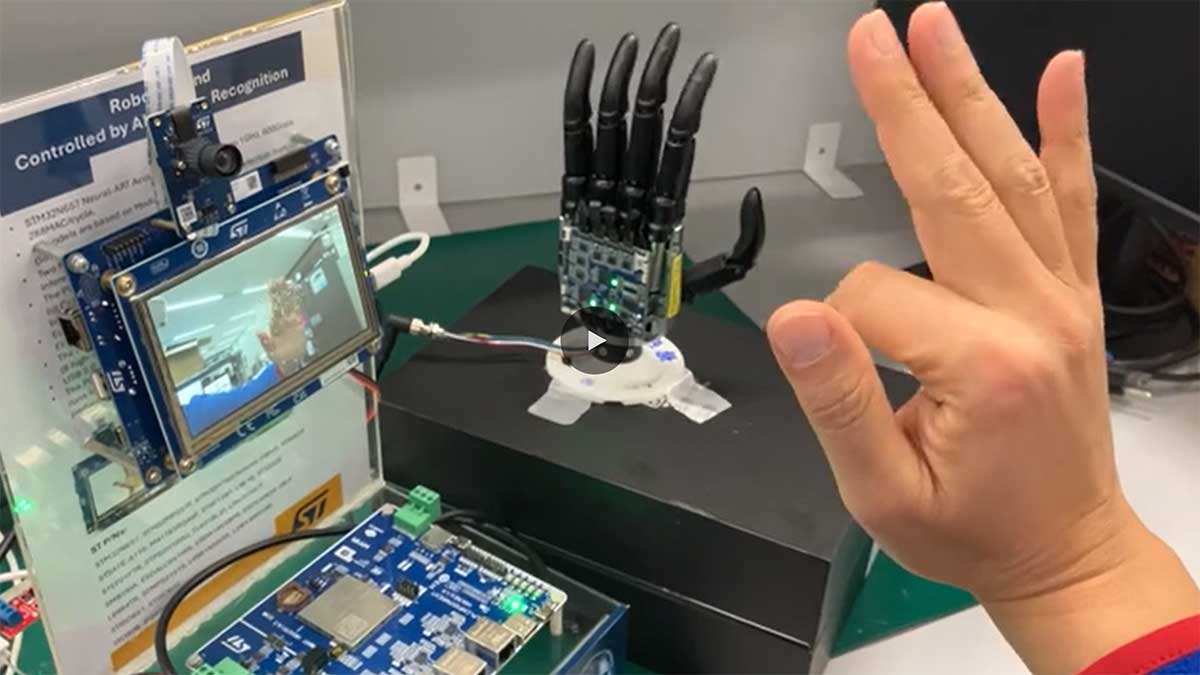
During a presentation at Hardware Pioneers this week, Dr. Stephen Ihmels played a video showing a human hand moving in front of a camera. As the fingers bent and twitched, a robotic hand positioned beside it replicated the motions almost immediately.
The demo appeared effortless. The engineering required to achieve it was anything but.
For the system to function, the robot needed to sense its surroundings, analyze visual input, execute AI models, interpret the output, and convert those insights into accurate motor actions—all in real time. Every component, from sensors and processors to communication links, power regulation, and control mechanisms, had to operate in seamless coordination.
“Physical AI isn’t just about computation,” explained Ihmels, who serves as Head of Segment Marketing and System Architect for Industrial Automation and Robotics at STMicroelectronics. “It’s about sensors, processing, control, actuation, and power delivery all working together as an integrated system.”
As Ihmels emphasized, the real hurdle today isn’t simply connecting devices to the internet—it’s making them smart, secure, dependable, and energy-efficient enough to operate reliably in real-world environments.
At Hardware Pioneers Max, held this week at London’s ExCeL Centre, discussions kept circling back to one central question: what’s currently holding IoT back?
Responses varied, but four key challenges came up repeatedly.
1. Tackling rising system complexity
Ihmels noted that the growth of physical AI is shifting the focus from mere connectivity to the integration of diverse technologies into a unified, functional system.
“We’re moving AI out of the Cloud and into the physical world,” he said. “That means we have to consider the entire technology stack.”
Today’s connected systems increasingly combine sensors, AI accelerators, wireless modules, motor drivers, power electronics, cameras, lidar units, and edge processors. Ihmels referred to this as a “system of systems.”
The robotic hand demo illustrated this complexity perfectly: visual data had to be captured, processed, and interpreted before motor commands could be generated and executed without delay. Any lag, bottleneck, or failure in the chain would degrade performance.
This escalating complexity is pushing companies to shift their focus from individual parts to how entire architectures function together.
As Ihmels put it, success will hinge not only on the intelligence embedded in a system but also on meeting “the application demands related to safety, reliability, and efficiency.”
2. Running AI without draining batteries
The push to embed AI into connected devices is also introducing a major new hurdle for developers: managing power consumption.
Many IoT devices are designed to run for months or even years on battery power, yet AI tasks can rapidly deplete energy reserves if not optimized carefully.
Sam Presley, Technical Product Manager at Nordic Semiconductor, believes the solution increasingly lies in performing AI processing directly on the device rather than shuttling data back and forth to the Cloud.
“We can execute machine learning inference on-chip using far less power than running the same models on a CPU,” he said. “Our customers typically see around a 10x improvement in both power efficiency and processing speed.”
Presley showcased a camera-based system that could detect whether a person was present in an image—all processed locally on the device.
“You don’t want to stream all that data to the Cloud,” Presley added. “It’s expensive in terms of cloud computing resources, and it raises serious security concerns.”
3. Maintaining reliability as devices gain autonomy
As IoT devices evolve from passive monitors to active participants in the physical world, reliability becomes critical.
A sensor reporting a wrong temperature reading is concerning—but an autonomous robot making a faulty decision can have far more severe consequences.
This was a key point raised by Harrison Parker, Regional Sales Manager at QNX, who argued that many developers overlook the importance of the underlying operating system.
“In Linux, if a single issue occurs in the kernel, the entire system can crash,” he said.
QNX, an alternative OS designed for mission-critical robotics, uses a microkernel architecture that isolates different functions. If one component fails, the rest of the system keeps running.
Parker used a surgical robot to illustrate the difference:
“If my display fails during keyhole surgery, the robot arm continues operating safely because it runs in its own protected space within QNX,” he explained. “But on Linux, if the screen dies, the robot arm dies too.”
This distinction grows more crucial as autonomous systems expand beyond factories into warehouses, hospitals, public areas, and eventually homes.
Parker noted that developers are finally recognizing the issue.
“For the first time this year, in our industry surveys, respondents said software is now the bottleneck,” he said. “Hardware used to be seen as the limiting factor—now people realize the software must keep pace.”
4. Security as a long-term commitment
Cybersecurity has always been a priority for IoT, but evolving regulations are raising the bar.
Manufacturers are increasingly expected not only to secure devices at launch but to maintain that security throughout the device’s entire operational lifespan.
“Security is a top priority across all our product lines,” said Presley. “Regulations in Europe, the U.S., and globally are driving this.”
The challenge is especially tough because many IoT deployments remain in service for years—or even decades.
“With new regulatory requirements, you’ll need to support over-the-air firmware updates to patch any future security vulnerabilities,” Presley added.
For more insights, check out additional editorial content on our sister site, Electronic Specifier! Or join the conversation by commenting below or visiting our LinkedIn page.
