



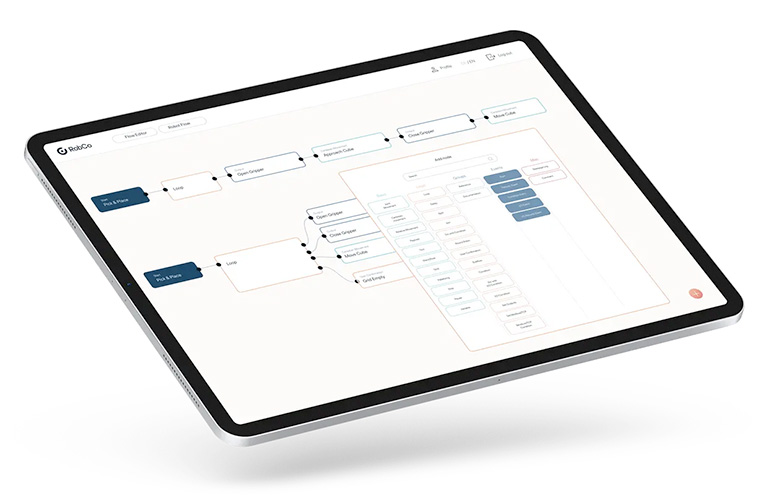
RobCo Studio software program simplifies robotic workcell configuration and operations. | Credit score: RobCo

Roman Hölzl, cofounder and CEO of RobCo. | Credit score: LinkedIn
Munich-based modular robotics firm RobCo not too long ago opened its U.S. headquarters in San Francisco and commissioned Sapio Analysis to survey 400 U.S. industrial decision-makers throughout manufacturing, building, engineering, and healthcare.
The Automation Readiness Index survey examines how warehouses and factories are paying for automation and present roadblocks for the subsequent wave of robots.
The corporate additionally not too long ago closed a Collection C funding of $100 million to advance its bodily AI roadmap, broaden enterprise deployments, and deepen its presence within the U.S. market.
“With $100 million of extra funding, we are going to change into the dominant AI robotics firm for manufacturing within the U.S. and Europe,” acknowledged Roman Hölzl, founder and CEO of RobCo. “This may permit us to execute on our objective of automating the unusual, so people can do the extraordinary.”
The largest takeaways from the Automation Readiness Index
The Robotic Report (Mike Oitzman): What do you assume was probably the most stunning knowledge level within the current analysis report about automation utilization within the business?
Roman Hölzl: It needs to be the sheer absolute quantity representing the scarcity of labor. The numbers present greater than 1.6 million unfilled jobs within the subsequent couple of years. And so the query is, how can we remedy that? Absolutely the variety of greater than 1,000,000 jobs within the manufacturing sector between the U.S. and Europe that can stay unfilled, and that storm is barely going to extend, was astonishing. The best way we have a look at it at RobCo is: there needs to be a really clear, ROI pushed answer, when it comes to the business viability, however then additionally the technical feasibility.
We predict at RobCo right this moment, we’ve got an answer that already works, that hits the necessities when it comes to precision, know-how, time cycle, time software program integration at a really enticing ROI as a result of we value at roughly the price of a single employee, single shift per 30 days.
TRR: What takeaways ought to robotic builders take from this report in regards to the business?
Roman Hölzl: Builders must sharpen the worth proposition [for their solutions]. The information that we revealed reveals that there needs to be a transparent driver for each robotic answer suppliers and robotic purchasers. In our thoughts, the worth proposition is centered round whether or not we truly improve productiveness with the options we deploy. And that may be a very clear benchmark: Can our prospects tackle extra orders, can they enhance the output, and enhance their productiveness ranges? That is an important takeaway, and it’s key to coping with the storm that’s brewing up within the business round the price of labor.
What can end-users study?
TRR: What do you assume an finish consumer would possibly take away from the information within the report, and what recommendation would you give to them?
Roman Hölzl: Finish customers ought to perceive the challenges which have historically been related to robotics, reminiscent of lengthy implementation timelines, excessive six to seven-figure CapEx funding prices, and options that may be in the end solely usable by skilled robotics customers.
These phrases can truly be overcome now, and it begins with a beautiful enterprise mannequin. What we do at RobCo is supply what we name Robots-as-a-Service (RaaS), a enterprise mannequin priced at roughly the equal of a human employee per 30 days per shift. That is wherever from a pair thousand U.S. {dollars} a month to 10,000 U.S. {dollars} a month. Along with deploying that enterprise mannequin, within the order of weeks, as an alternative of quarters. That’s the large unlock, particularly for mid-cap producers within the U.S. and Europe.
TRR: What do you assume are the developments to search for in 2026, taking into consideration the macroeconomic components from 2025?
Roman Hölzl: I believe that the macro developments for 2026 will probably be an extension of what we’ve seen in 2025. Primary is that lots of the Western nations are reshoring their manufacturing capacities. That is paired with large strain on prices, as a result of we’ve simply gotten used to very enticing costs by means of Chinese language suppliers. All the areas wish to manufacture domestically. That’s a really clear governmental strategic pillar as effectively, and that will probably be a key focus level in 2026.
The query is, how can we do it? The reply can’t be a full year-long seven-figure capex funding course of to get there. It’ll should be a quick, attractively priced, and quite simple to make use of answer that works for each mid-caps and the enterprise.
Hölzl on who can profit probably the most from RaaS
TRR: The place do you assume RaaS works greatest?
Roman Hölzl: So, we predict robot-as-a-service goes to be the predominant enterprise mannequin for robotics sooner or later, and particularly should you have a look at options being way more software-centric and AI-centric. To your level, the adoption right this moment is the most important in industries which are shifting quick, which have a really, very clear automation problem right this moment, and never the monetary means, or on the flip facet, they’re very refined when it comes to monetary setup, and don’t wish to burden their steadiness sheet with an funding into an automation answer.
The businesses would quite maintain it working as an operational expenditure, bettering margins, bettering the steadiness sheet dimension, and albeit, setting themselves up for the long run. And so to my thoughts, that’s going to be for each buyer on the market. However right this moment we see the most important uptick both in bigger corporations which are very refined financially, or conversely, with smaller prospects that don’t have, frankly, the financial institution accounts and the money statements to make sense of CapEx, robotics investments within the seven figures.
Prioritize organizational simplicity, Hölzl stated
TRR: In my expertise, having run a $50M SaaS enterprise line for a Fortune 500 software program firm, I don’t assume that you would be able to run a enterprise each as a SaaS and as a CapEx group. You must decide a lane and follow it. In that group, we had each SaaS and enterprise gross sales and help groups. They didn’t combine.
I’ve heard many younger RaaS-based startups say that they’ll promote regardless of the buyer desires, nevertheless the client desires to purchase it. However this isn’t good for a small group, when it comes to the gross sales crew design, compensation plans, help group, your contracts division, all of it. Should you try and promote each CapEx and OpEx, it’s a headache throughout. As a startup CEO constructing a RaaS-based enterprise, give me your inside view on that remark.
Roman Hölzl: We consider in simplicity inside a corporation to streamline the fee mannequin, stock design, and the order-to-cash course of. Nevertheless, we predict there are two totally different, distinct enterprise fashions. The primary mannequin drives recurring income as a service mannequin, and the second is a CapEx mannequin.
All finish buyer direct deployments on-line must be ordered as a service mannequin with deep software program integration. If we co-sell with a 3rd social gathering, an OEM associate who straight serves their prospects, that’ll doubtless be a reselling CapEx movement even sooner or later. However then that’s a special a part of the enterprise, totally different crew, totally different incentives, totally different numbers, , totally different setup. And so then it’ll nonetheless work, whilst an organization with solely, , a pair 100 FTEs versus a a lot bigger one.

