



# When Machines Scale Discovery: How Artificial Intelligence Tackled One of Mathematics’ Hardest Unsolved Problems
## A Problem That Stumped the World’s Best Minds
Among the most celebrated challenges in modern mathematics sits a deceptively simple question about the behavior of moving fluids. Known formally as the Navier-Stokes existence and smoothness problem, it asks whether the equations that describe fluid motion always produce smooth, predictable solutions — or whether under certain conditions those solutions can suddenly break down into chaotic singularities. First formulated in the 19th century, it remains unresolved to this day and carries a million-dollar prize from the Clay Mathematics Institute as one of its seven Millennium Prize Problems.
Recently, a large-scale artificial intelligence experiment claimed to have constructed a finite-time singularity within the three-dimensional Navier-Stokes equations using a smooth external force — one of the accepted approaches allowed under the formal problem statement. The result was verified through a formal proof system called Lean after an additional period of intensive review. Whether this fully resolves the broader conjecture remains a matter of ongoing evaluation by the mathematical community, but the method behind it raises profound questions about the future of human-machine collaboration in research.
## The Human Foundation Behind the Machine
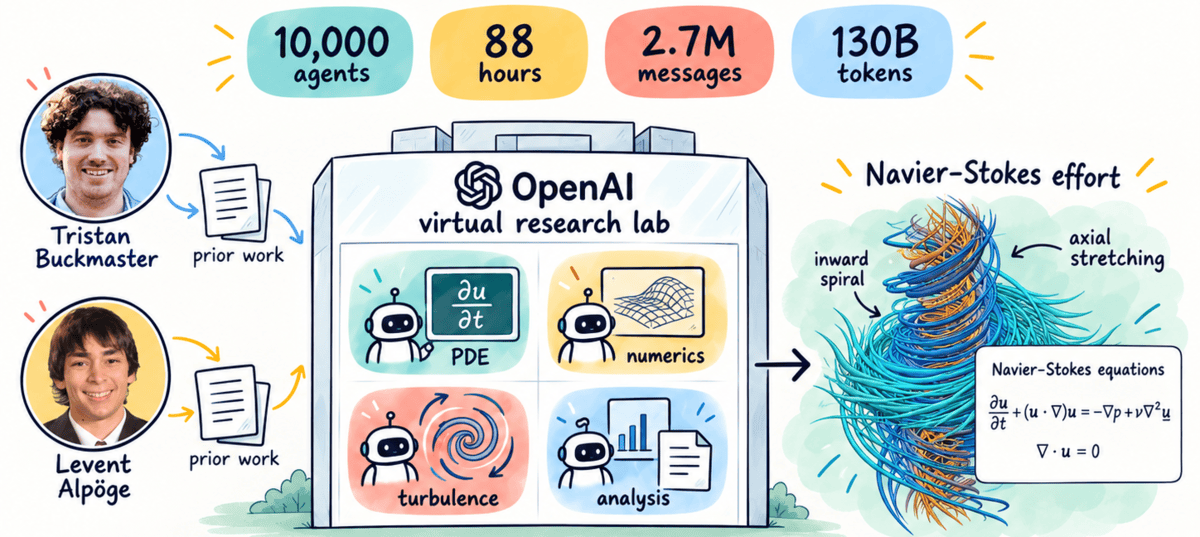
Long before the large-scale AI experiment began, two mathematicians were already making remarkable headway in the same domain. Tristan Buckmaster, affiliated with New York University, and Levent Alpöge, working at Anthropic, had been building on years of accumulated mathematical insight to attack closely related problems in fluid dynamics.
Their research trajectory included constructing explicit scenarios where fluid-like equations develop singularities in finite time — a critical stepping stone toward understanding the deeper Navier-Stokes question. Throughout their work, they used AI-powered coding tools such as Claude and OpenAI Codex to accelerate calculations and explore complex derivations. Every result they produced was formally verified using the Lean proof assistant, ensuring rigorous correctness.
Their Euler-related findings didn’t directly answer the Navier-Stokes problem, but they opened important new pathways and demonstrated that finite-time blowup phenomena could be constructed under controlled conditions. These results provided a crucial conceptual foundation that would later prove invaluable.
## The Experiment That Redefined Scale
The AI-driven effort that followed was unlike anything attempted before in mathematical research. Rather than relying on a single model or a small team, the project mobilized an enormous swarm of concurrent AI agents — approximately 10,000 working simultaneously. Over the course of roughly 88 hours, these agents exchanged approximately 2.7 million messages and generated more than 130 billion output tokens as they explored the problem space.
The architecture was designed to mimic a distributed research laboratory. Groups of agents were assigned different mathematical strategies and could communicate findings internally, execute code, and draw upon a cached body of existing knowledge. The early phase saw nearly 100 agents dedicated to tackling the closely related Euler equations for about 50 hours. When those efforts produced promising intermediate results, the project’s scope was redirected toward Navier-Stokes with significantly expanded resources.
What made this approach powerful was a process of selective reinforcement. Dead-end strategies were identified and discarded, while productive lines of inquiry were amplified and shared across agent groups. Useful intermediate breakthroughs were consolidated and fed back into subsequent prompts, allowing the collective effort to build momentum rapidly. This cross-pollination of ideas between parallel research threads compressed what might have taken a human team months or years into a matter of days.
## Questions of Origin and Attribution
The announcement did not go unchallenged. Concerns surfaced almost immediately about the relationship between the AI experiment and the prior unpublished work of Buckmaster and Alpöge. Buckmaster raised the question of whether the AI system had been trained on or exposed to the drafts and session data from his and Alpöge’s research, particularly given that he had used OpenAI’s Codex tool extensively during his own investigations.
OpenAI conducted an internal review and concluded that Buckmaster’s Codex prompts from the preceding two months could not have influenced the system in any capacity, including through its training process. The company further stated that its researchers and agents had not accessed the unpublished work of Buckmaster and Alpöge prior to its public release. Based on available evidence, there was no indication that the AI had directly copied or been fed private research from either mathematician.
However, the incident highlighted a deeper tension that academic institutions were never designed to handle: the question of credit when AI tools participate actively in research, when a separate AI system then generates a proof, and when humans must still interpret and publish the results. Buckmaster was reportedly offered the opportunity to lead a paper presenting the Navier-Stokes result while explicitly acknowledging the AI’s role, but complications surrounding institutional affiliations created friction. The episode underscores an urgent need for new norms and frameworks around authorship in an era where multiple forms of intelligence contribute to discovery.
## What Does This Mean for the Future of Research?
The result itself is significant, but perhaps the more transformative aspect is what it reveals about methodology. The experiment demonstrated that artificial intelligence can function not merely as a helpful assistant but as a massively parallel research workforce capable of exploring thousands of potential solution paths simultaneously.
The mathematical community has acknowledged that the Navier-Stokes problem has apparently been settled, though the evaluation process for determining formal credit and validation will take considerable time. Beyond the specific result, the experiment points toward a future in which difficult problems across mathematics, science, and engineering could be tackled at unprecedented speed through coordinated AI systems.
What remains unsettled is the philosophical question of authorship in discovery. The AI agents were working atop centuries of accumulated human knowledge, recent breakthroughs by active researchers, and deliberate decisions made by human engineers about where to allocate computational resources. The agents themselves did not invent fluid dynamics or conceive of the problem independently — but they did navigate an enormous space of possibilities and converge on a result that human mathematicians had not yet reached.
## Frequently Asked Questions
**What is the Navier-Stokes existence and smoothness problem?**
It is one of the seven Millennium Prize Problems posed by the Clay Mathematics Institute. It asks whether solutions to the Navier-Stokes equations — which model the motion of viscous fluids — always remain smooth and well-behaved for all time, or whether singularities (points where the mathematics breaks down) can develop in finite time.
**Why does this problem matter?**
Navier-Stokes equations are fundamental to physics and engineering, governing everything from airplane aerodynamics to ocean currents and blood flow. Proving whether smooth solutions always exist would deepen our theoretical understanding of fluid mechanics and potentially unlock new insights into turbulent flow.
**What does “finite-time singularity” mean in this context?**
A finite-time singularity refers to a point in time where a mathematical solution ceases to be smooth — quantities like velocity or pressure may become infinite or undefined. Constructing such a singularity for the Navier-Stokes equations under specific conditions is one of the acceptable routes to resolving the Millennium Prize Problem.
**How were the AI agents organized?**
The agents were structured into groups that could communicate with each other, execute computational code, and access a repository of existing mathematical knowledge. Different groups explored different approaches, and promising results were shared across teams to build collective momentum.
**Did the AI work entirely alone?**
No. The experiment was guided by human decisions about problem selection, resource allocation, and interpretation of intermediate results. The AI agents operated within a framework designed by human researchers, and the final result required human-led verification through a formal proof system.
**Is the result now considered a full solution?**
The Clay Mathematics Institute has acknowledged that the Navier-Stokes problem has apparently been settled based on the result, but formal evaluation and validation are ongoing. The mathematical community will need to carefully examine the proof before a definitive resolution is declared.
**What are the implications for other unsolved problems?**
If the approach of deploying thousands of AI agents to explore a problem space in parallel proves generalizable, it could dramatically accelerate progress across many fields of mathematics, science, and engineering. The same methodology could potentially be applied to other Millennium Prize Problems or entirely different research domains.
**What happened to the question of credit?**
Disputes arose over attribution, particularly regarding the relationship between the AI experiment and prior unpublished work by human mathematicians. OpenAI stated that its system was not trained on private research from other scientists, but the incident has prompted broader discussions about how credit and authorship should be assigned in AI-assisted research.
## Conclusion
The recent experiment represents a watershed moment in the history of mathematical research. Whether or not the Navier-Stokes result ultimately withstands full scrutiny, the method itself — coordinating thousands of AI agents to explore, combine, and refine mathematical ideas at machine speed — demonstrates a fundamental shift in what is possible. We are moving toward a paradigm where human intuition sets the direction and artificial systems provide unprecedented scale of exploration.
Yet this shift also demands careful reflection. The role of discovery, the assignment of credit, and the relationship between human and machine contributions all require new frameworks that our current academic institutions were not built to address. The Navier-Stokes experiment is not just a mathematical achievement — it is a signal that research itself is becoming scalable in ways we are only beginning to understand.
Thank you for reading
