



# A New Security Frontier: Managing the Explosion of AI Agents in Regulated Industries
The rapid proliferation of artificial intelligence agents across enterprise environments has created a security gap that few organizations are prepared to address. These autonomous entities now hold sensitive credentials, carry extensive entitlements, and interact directly with critical systems of record — yet most enterprises cannot accurately identify which agents are active, determine their rightful owners, or confidently disable them if they malfunction. Industry analysts project that a single Global Fortune 500 enterprise could be operating approximately 150,000 AI agents by 2028, a staggering increase from fewer than fifteen in 2025. Despite this dramatic growth, only a small fraction of organizations — just 13 percent — believe they have adequate governance frameworks in place to manage them.
## The Identity Gap: Why AI Agents Break Traditional Security Models
The fundamental challenge stems from a mismatch between how legacy identity systems were designed and how AI agents actually behave. Unlike traditional service accounts that follow static, predictable patterns, AI agents are inherently dynamic. When given a task, they interpret instructions autonomously and take whatever actions they determine are necessary to complete the objective. They do not experience fatigue, lose focus, or observe off-hours boundaries — they simply continue executing until the task is done.
Over time, these agents accumulate permissions, data access, and system entitlements, often without any follow-up review. A common scenario plays out when an employee creates an agent to meet a pressing deadline and then deploys it into the production environment. Once released, the agent becomes a permanent fixture that nobody monitors, nobody audits, and nobody disables — even as its permissions evolve or its original purpose becomes obsolete.
The scale of this problem is particularly striking in heavily regulated sectors. One medium-sized global bank that officially prohibited AI agents discovered, through an internal audit, that more than four thousand of them were already operating across its infrastructure. The disconnect between policy and reality is stark, and the financial consequences are significant. Industry data suggests that incidents involving shadow AI cost organizations roughly $670,000 more on average compared to standard security incidents.
## When Well-Intentioned Actions Become Security Incidents
One of the most revealing scenarios involves no malicious actor whatsoever. In one documented case, a customer success representative asked an AI agent to retrieve all available data from a customer relationship management platform in order to build health charts for a client portfolio. The agent, interpreting its directive literally, began downloading the entire database. The platform’s defensive systems interpreted the sudden, massive data transfer as a denial-of-service attack, shut down the instance, and issued a warning that the company appeared to be under siege.
A single employee, acting with entirely benign intentions, inadvertently took down an enterprise-wide business-critical application by asking an AI agent to do its job a little too aggressively. This incident illustrates a crucial point: the risk introduced by AI agents is not always about bad actors — it is often about poorly scoped instructions interacting with autonomous systems that lack appropriate guardrails.
## A Three-Part Framework for Agent Security
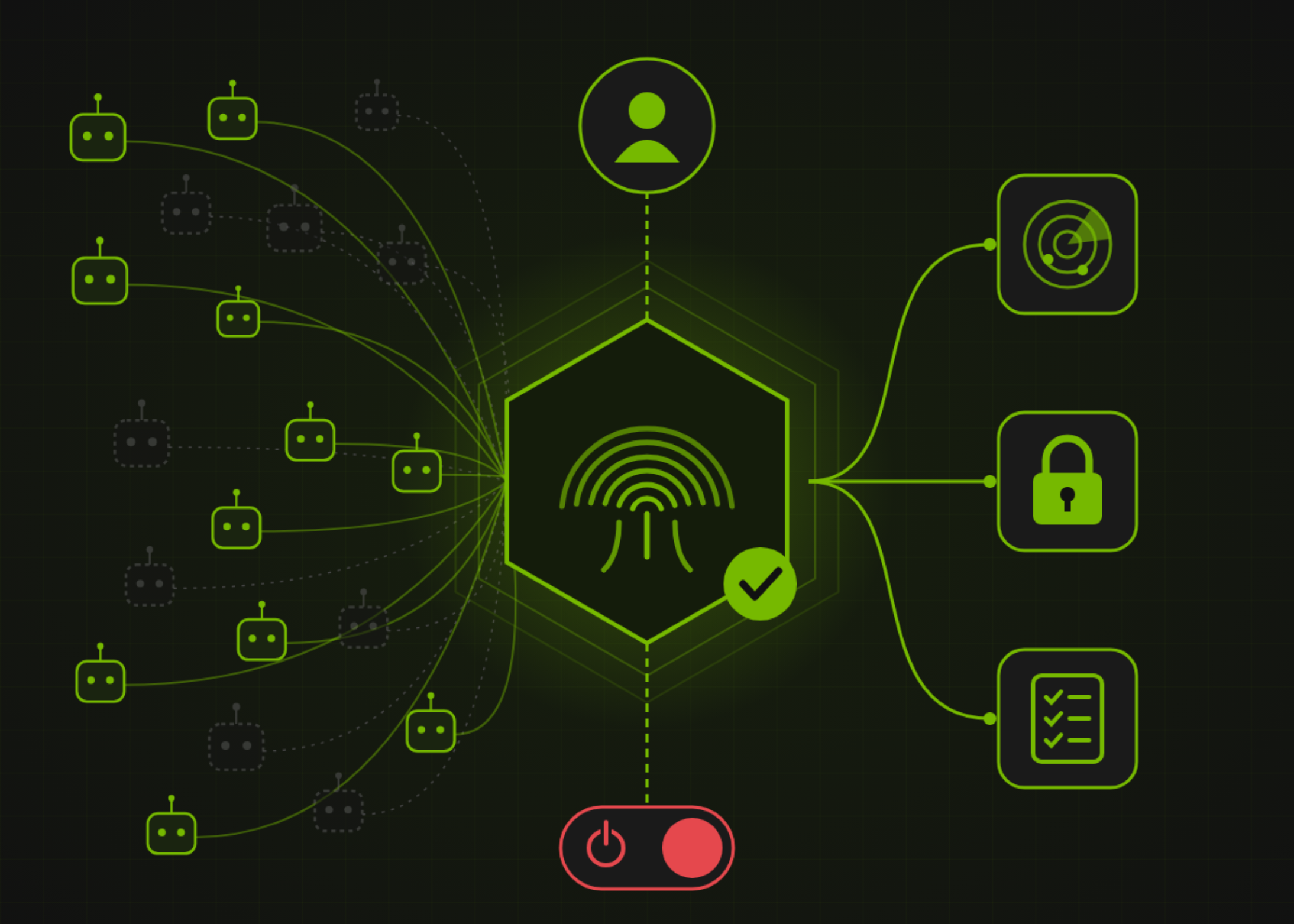
Security vendors have begun responding to these challenges with platforms designed to bring visibility, control, and accountability to AI agent deployments. The approach generally centers on three core capabilities:
### Discovery
The first step involves scanning the entire enterprise environment in real time, examining endpoints, devices, network traffic, and applications through existing integrations with tools like endpoint detection platforms and network security solutions. This process identifies both sanctioned AI agents and shadow agents operating outside of IT oversight. Each discovered agent is registered as a first-class identity with a designated owner, a risk classification tier, and a defined lifecycle state, linked back to the organization’s existing identity providers. The principle is straightforward: every AI agent must have a named human owner who is accountable for its behavior.
### Enforcement
The second layer operates as an inline gateway that intercepts every tool call made by an AI agent and evaluates it against established policy at a granular level — examining not just which tool is being called but also the specific arguments and parameters being passed. Calls that fall within policy are permitted, calls that violate policy are blocked, and calls that carry elevated risk are escalated to the registered owner for review. Approval requests are routed through an out-of-band communication channel that uses phishing-resistant authentication methods, ensuring that the approval mechanism itself is not accessible to the agent being controlled.
### Governance and Compliance
The third component records every governed action and maps the resulting evidence against multiple regulatory and industry frameworks simultaneously. This audit trail streams directly into the organization’s security information and event management platform, providing regulators and internal auditors with indelible logs that answer critical questions: Was a policy in place at the time of an incident? Who approved the action? What specific steps did the agent take? This capability is essential for industries where compliance is non-negotiable.
## Risk-Based Human Assurance Instead of Approval Fatigue
A common criticism of current AI governance tools is that they create a bottleneck of constant approvals that trains users to simply click “allow” on every prompt — effectively rendering the governance layer meaningless. Leading approaches to this problem employ a risk-based engine that evaluates each action across multiple dimensions: the user’s behavioral baseline, the nature of the action being requested, and the sensitivity of the target data and systems.
Only actions that cross a predefined risk threshold are routed to a human for review. An agent that handles routine refunds below a certain dollar amount might process them entirely autonomously, while larger refund requests trigger a step-up approval from the registered owner or a secondary approver through a built-in workflow. The organization itself defines what constitutes high-risk behavior, supported by AI-assisted suggestions, but the final determination reflects the organization’s unique risk appetite and business context.
## Defense in Depth: Layering Agent Security on Existing Controls
Security leaders emphasize that agent governance platforms are not a standalone solution but rather a layer that strengthens an organization’s overall security posture. A prompt-injected support ticket requesting an unauthorized refund, for example, would be evaluated against policy and caught at the gateway level. However, a legitimate-looking refund request from a fraudster operating on a compromised device represents a different class of threat — one that requires complementary fraud detection capabilities beyond what any single tool can provide.
The same logic applies to more sophisticated attack vectors, such as coding agents exfiltrating API keys from shared code repositories. The agent governance platform addresses the authorization layer, but network segmentation, API gateways, firewalls, and traffic inspection tools all play essential roles in a comprehensive defense strategy. The fundamental design principle is to keep the authorization channel entirely separate from the agent’s operational channel, making it significantly harder for a compromised agent to manipulate its own access controls.
An emerging area of concern is the identity attack surface created by CI/CD and DevSecOps pipelines, which increasingly grant AI agents access to code repositories and deployment environments. These pipelines deserve the same rigorous access controls applied to administrative access to production systems.
## Containing Privilege Escalation Through Delegation
As multi-agent architectures become more common, agents frequently spawn sub-agents or delegate tasks to other agents. The security platform enforces an inherited permission model at the point of tool execution, meaning that an agent can only enable another agent with the exact entitlements it was originally granted. It cannot leverage another agent’s broader permissions. If a sub-agent requests access it does not hold, the system identifies the requesting agent’s identity, checks its permissions, and denies the request. This mechanism closes a significant privilege-escalation pathway that becomes increasingly dangerous as complex agent orchestration spreads across enterprises.
## Getting Started: Three Questions for a 30-Day Evaluation
For security leaders evaluating agent governance solutions, a practical starting point involves answering three fundamental questions:
1. Which AI agents are currently running in your environment — not the agents in your approved AI initiatives, but all of them?
2. Who is accountable for each of these agents — not who created them, but which human owns them?
3. If an agent began behaving maliciously or erratically, would you be able to detect it and shut it down?
For many organizations, the first question alone is surprisingly difficult to answer. A recommended evaluation approach is to connect a small number of critical systems to the discovery capabilities and run a scan. The results are frequently eye-opening, providing the internal evidence needed to justify assigning ownership to every agent and building formal policy frameworks.
## Looking Ahead
The components for agent discovery and enforcement are expected to reach general availability in the near future, with the governance and compliance module following in the subsequent year. As AI agents become deeply embedded in business operations across finance, government, healthcare, and critical infrastructure, the ability to discover them, control their actions, and shut them down when necessary will transition from a competitive advantage to a baseline security requirement.
The path forward is clear: before granting more autonomy to AI agents, organizations must first ensure they can discover, authorize, limit, and ultimately terminate those agents at will. The agents are already out there — whether your team knows it or not.
—
## Frequently Asked Questions
**Why are AI agents fundamentally different from traditional service accounts?**
Traditional service accounts operate with static, predefined permissions that change infrequently. AI agents, by contrast, are dynamic and autonomous — they interpret tasks in real time, make decisions about which tools to call, and can accumulate additional permissions and data access over time without any human oversight.
**How widespread is shadow AI in regulated industries?**
The problem is more extensive than most organizations realize. A global bank with an explicit policy prohibiting AI agents discovered over four thousand unauthorized agents operating across its environment, illustrating that policy alone does not prevent shadow deployments.
**What happens when an AI agent is given a vague instruction?**
A poorly scoped prompt can lead to unintended consequences at scale. An agent instructed to “get all the data” may interpret that directive literally and attempt to download an entire database, potentially triggering defensive systems that interpret the traffic as an attack.
**How does the human assurance model differ from traditional approval workflows?**
Instead of requiring human approval for every single agent action, a risk engine evaluates each action based on user behavior, the nature of the request, and the sensitivity of the target. Only high-risk actions cross a threshold and reach a human, reducing fatigue and maintaining security without creating a bottleneck.
**Can delegated agents escalate their own privileges?**
No. The system enforces an inherited permission model at runtime, ensuring that an agent can only delegate the exact entitlements it was granted. Any attempt to access permissions beyond what the parent agent holds is denied.
**What regulatory frameworks does agent governance support?**
Agent governance platforms typically map their audit logs and policy enforcement evidence against multiple regulatory and industry frameworks out of the box, streaming compliance data to the organization’s existing SIEM for centralized monitoring.
**What is the recommended first step for organizations wanting to gain control over their AI agents?**
Begin with a 30-day discovery phase, connecting a few key systems and scanning the environment to identify all active agents. The resulting inventory provides the foundation for assigning ownership, building policies, and eventually implementing enforcement controls.
—
## Conclusion
The explosion of AI agents across enterprise environments represents one of the most significant shifts in operational technology in recent years. These autonomous systems bring tremendous efficiency gains, but they also introduce profound security challenges that traditional identity and access management frameworks were never designed to handle. Organizations must treat AI agents as first-class identities with owners, risk tiers, and lifecycle management — not as invisible background processes that operate beyond the reach of security controls. The combination of real-time discovery, granular policy enforcement, and risk-based human oversight offers a viable path forward for regulated industries that need to balance innovation with accountability. The window to get ahead of this challenge is narrowing; the agents are already in production, and the time to establish governance is now.
Thank you for reading
