



# How to Think Critically About AI Hype Without Missing What Actually Matters
—
Every week, a new AI tool, framework, or paradigm promises to reshape entire industries. Teams sprint to adopt them, roadmaps get rewritten overnight, and budgets shift toward whatever trend is generating the loudest buzz. But beneath the surface, many of these initiatives fail to deliver measurable outcomes — or solve problems that were never real to begin with.
This guide is for professionals who want to stay sharp when the noise gets overwhelming. It walks through three core practices that help you separate signal from hype, and finishes with a toolkit of practical questions you can use the next time a vendor or headline makes a bold AI promise.
—
## Part One: Map the Landscape Before You Judge the Claims
### The AI Industry Has a Structure — Learn It
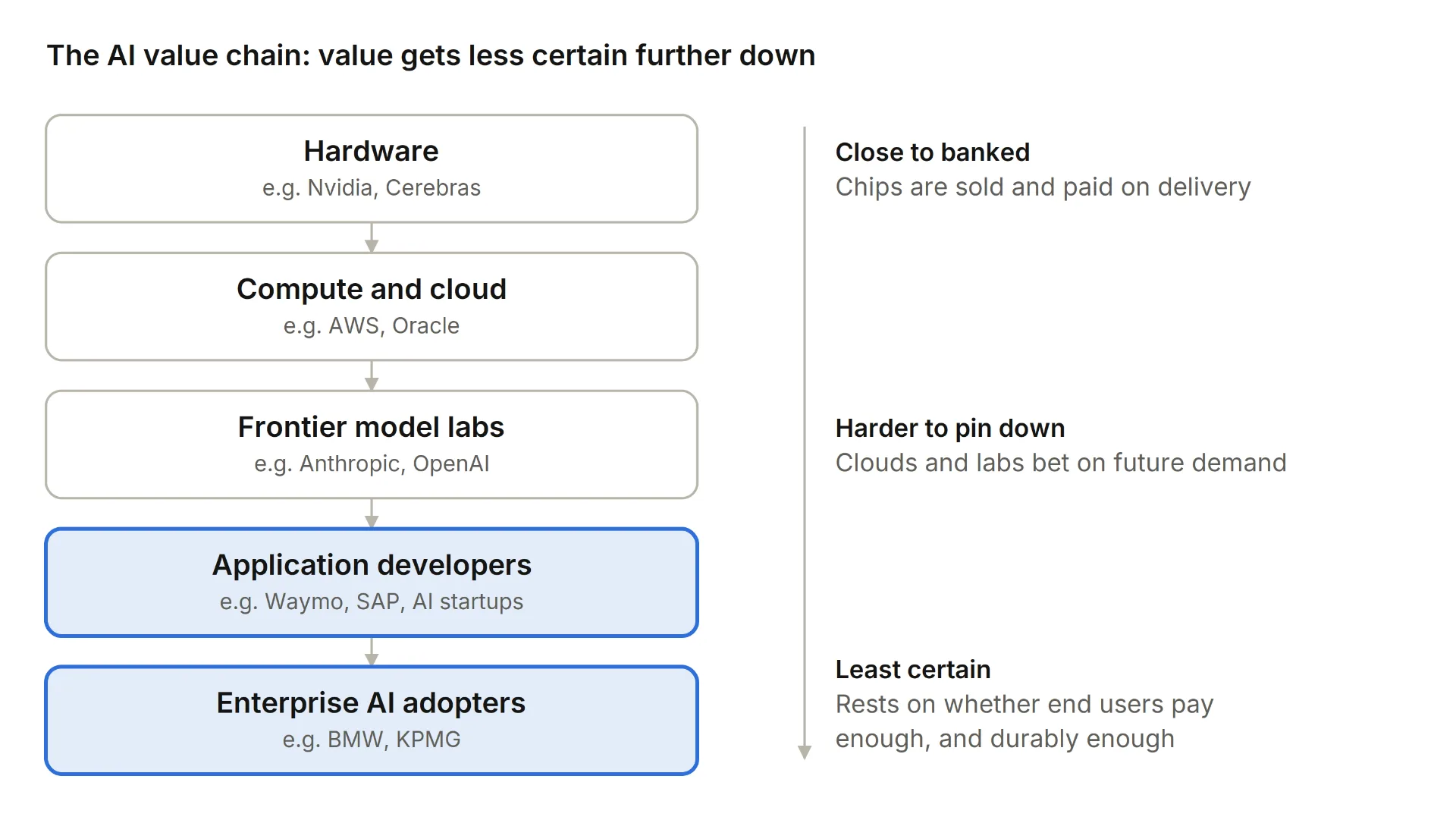
To evaluate what anyone tells you about AI, you first need to understand where that person sits in the broader ecosystem. The AI world can be broken down into several interconnected layers:
– **Hardware and silicon** — the physical chips that power computation
– **Cloud infrastructure** — the platforms that make compute accessible on demand
– **Model development** — the organizations building foundational and specialized AI models
– **Tools and platforms** — middleware that wraps models into developer-friendly interfaces
– **Applications and deployment** — the end products that actual users interact with
Value creation is not evenly distributed across these layers. The earliest layers capture revenue the moment a sale is made, but the layers closest to the end user carry far more uncertainty. Real business value only materializes when an AI system actually improves outcomes for people who use it daily — and that is the hardest part of the chain.
### Why End Users Are at a Disadvantage
If your role involves adopting or building AI-powered products, you are almost certainly at the receiving end of this value chain. And that position comes with three structural weaknesses:
1. **You are being sold to relentlessly.** AI companies invest heavily in marketing because the products they sell often have uncertain real-world performance. The more unpredictable the outcome, the louder the pitch tends to be. This creates what many practitioners call the “accessibility illusion” — the impression that AI is cheap, plug-and-play, and guaranteed to transform operations, when in reality it requires significant effort to integrate and tune.
2. **You will discover limitations late.** Vendors intimately understand the boundaries of their own products, but buyers typically encounter those boundaries only after deployment — in the messy gap between a polished demonstration and a system that consistently delivers value to real users.
3. **The reward timeline is skewed.** Vendors earn revenue when a deal closes. You earn value only when the system works reliably and you can prove its impact. Bridging the gap from raw model access to measurable business results demands technical skill, strategic thinking, and organizational maturity.
The reality is stark. According to recent industry surveys, the vast majority of organizations using generative AI have not yet demonstrated a clear effect on their bottom line. Failure rates for AI projects are high, and many companies still lack reliable methods for measuring whether their AI investments are paying off.
Developing your own informed judgment is the single most effective defense against hype-driven decisions.
—
## Part Two: Build a Knowledge Base That Holds Up Under Pressure
### Strip Away the Emotional Layer
Most AI content mixes factual information with deliberately injected emotion — excitement, urgency, anxiety about falling behind. These emotional triggers exploit common blind spots:
– **Demos overshadow real workflows.** A demonstration showcases the best-case scenario of a single run. Production systems must handle the same task thousands of times, including all the edge cases that never make it into a demo.
– **Benchmarks don’t reflect your world.** Public benchmarks evaluate models on curated datasets. Your internal data is messier, more specific, and shaped by your organization’s unique processes.
– **Case studies tell one side of the story.** Vendors highlight wins. Projects that failed or were quietly abandoned rarely make it into their marketing materials.
Without a solid understanding of how AI actually works — including its inherent limitations — you are mentally building a structure where every claim supports the next, like a house of cards. One well-placed question can bring the whole thing down.
### Invest in Two Foundations
A durable knowledge base rests on two pillars:
**1. Grasp the underlying principles.** AI systems are built on concepts from linear algebra, probability theory, and calculus. Understanding these — even at a conceptual level — reveals why today’s language models behave the way they do. For example, language models generate text by estimating probabilities, and that probabilistic nature is why they confidently produce incorrect information. You don’t need to become a mathematician, but you should be willing to learn from trusted experts or invest the time to study the fundamentals yourself.
**2. Develop systems thinking.** AI doesn’t operate in isolation. Its value in your organization depends on how it connects with existing processes, data infrastructure, decision-making workflows, and human expertise. Resources like foundational texts on systems thinking and strategic frameworks for AI adoption can help you see the bigger picture. When your mental model of how things fit together is strong, inflated claims become immediately suspect — a promise of “zero errors” suddenly sounds like a question: zero by what measure, on what data, and under what conditions?
—
## Part Three: Consume AI Content With Intention
### Follow the Incentives
Behind every source of AI content is a person or organization with their own interests. To maintain your independence, reverse the typical content creation process:
1. **Start with the action.** What is the source trying to get you to do? Book a demo? Download a white paper? Purchase a platform?
2. **Identify the story.** What narrative and emotions are used to pull you toward that action? Customer testimonials, urgency-driven language, and fear of obsolescence are common tactics.
3. **Examine the facts.** What data points are being presented, and were they selectively chosen to support the narrative?
Data can be perfectly accurate while still being used to steer you toward a particular conclusion. The trick is to use the numbers and set aside the spin.
### Watch Your Language Cues
How something is written often reveals more than what it says. Pay attention to these warning signs:
– **Generic, overly polished writing.** Genuinely original thinking about AI is difficult and usually shows — it is raw, specific, and often imperfect. Content that reads like it was generated by a machine probably was.
– **Anthropomorphic language.** Describing AI tools as “digital team members” or “employees” encourages you to think in terms of headcount replacements rather than measurable outcomes, making return-on-investment calculations feel obvious before they can be properly evaluated.
– **Alarmist headlines.** Claims about AI destroying jobs or threatening civilization are rarely pure journalism — they are often backed by marketing strategies that use fear to generate attention. When you trace these claims back to first principles, they typically don’t hold up as stated.
– **Jargon as camouflage.** Complex terminology can repackage ordinary capabilities as something revolutionary. Many use cases labeled as “agentic” or “autonomous” today are better served by simpler, proven approaches.
### A Practical Filter for New Ideas
When a new AI concept or product captures your attention, run it through this process:
1. **Triage.** Ask two questions: Is this genuinely new, or a repackaging of something older? Is it strategically relevant to what you are actually trying to accomplish?
2. **Go deep only if both answers are yes.** Read primary sources, test the technology yourself with real data, and form your own opinion.
3. **Park it otherwise.** Wait for independent third-party evaluations and trusted expert commentary before revisiting.
4. **Revisit with evidence.** If data supports the idea, invest time deeper; if not, move on.
—
## FAQ
**Q: I’m not a data scientist or engineer. Can I still apply these practices?**
Absolutely. These practices are about critical thinking and asking better questions — skills that do not require a technical background. Understanding the structure of the AI ecosystem and recognizing common marketing tactics is valuable regardless of your role.
**Q: What if a vendor’s claims turn out to be partially true?**
That is common. Most AI tools are not useless, but their value is often overstated or narrowly scoped. The goal is not to reject every claim, but to understand what a tool can and cannot do in your specific context before committing resources.
**Q: How do I distinguish genuine innovation from rebranding?**
Genuine innovation addresses a problem that was previously unsolvable or significantly improves on existing solutions. Rebranding takes an existing capability — like chatbots, rule-based automation, or simple API integrations — and wraps it in new terminology. Look past the marketing language and examine what the tool actually does and how it differs from what you already have.
**Q: Is it okay to be skeptical about AI without being “against AI”?**
Yes — in fact, it is essential. Healthy skepticism means demanding evidence and clarity, not dismissing AI outright. The strongest positions in any organization belong to people who can evaluate AI claims rigorously and advocate for the ones that genuinely create value.
**Q: How much time should I invest in building this kind of knowledge?**
You do not need to become an expert. Even a modest investment — reading foundational materials, following a few trusted independent voices, and regularly applying a critical lens to the content you consume — will dramatically improve your ability to make sound AI decisions.
—
## Conclusion: Staying Grounded in a Noisy Field
You do not need to prove whether the AI industry is in a bubble or a revolution. What you need is a reliable decision-making framework that works regardless of the outcome. When the next bold AI claim reaches you, slow down and break it apart:
– Who is making this claim, and what do they gain if I believe it?
– What evidence supports it, and what evidence is missing?
– How does this fit into the actual needs and constraints of my organization?
– What would a failed version of this look like, and am I prepared for it?
Over time, these questions become second nature. You will find yourself cutting through hype faster, focusing energy on initiatives that deliver real results, and earning the trust of colleagues who depend on your judgment.
The goal is not to be right about the future of AI. The goal is to make better decisions today — and that is a skill worth building now.
Thank you for reading
