



## Tencent’s Hy3: A Compact 295B MoE Model Designed for Agentic, Long‑Context Work
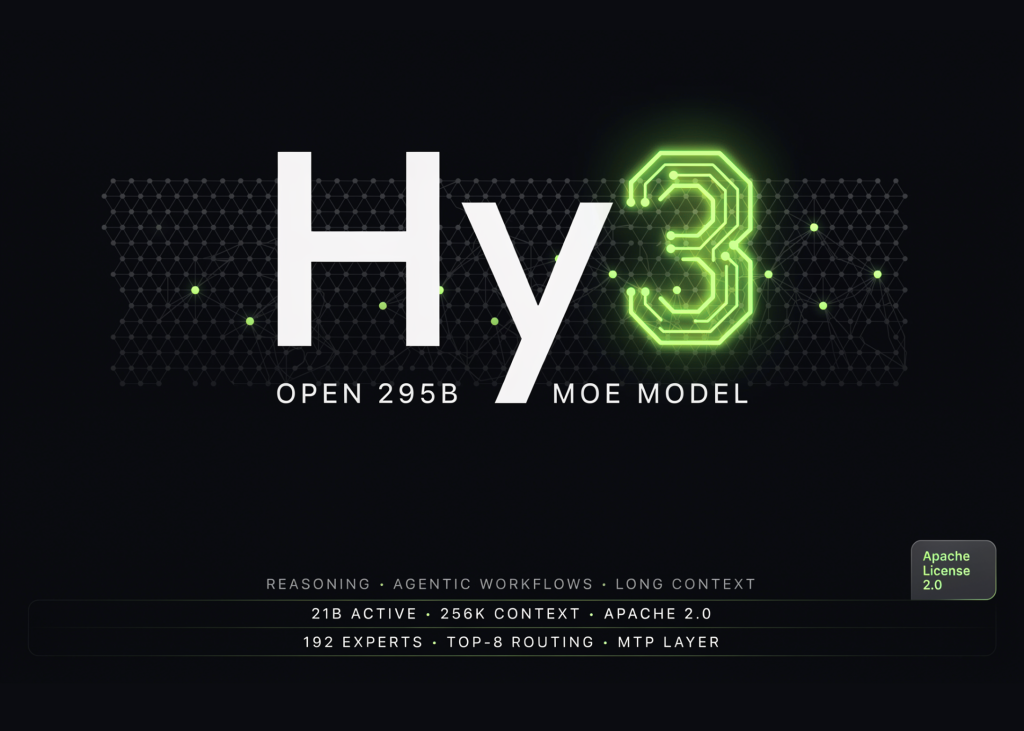
Tencent’s Hy team has shipped **Hy3**, an open‑weight 295‑billion‑parameter Mixture‑of‑Experts (MoE) model that activates only **21 billion parameters per token**. Released under the **Apache License 2.0**, Hy3 is positioned for **reasoning, agentic workflows, and long‑context tasks**, with a particular focus on production reliability and efficient inference.
—
## What Makes Hy3 Different?
Hy3 uses a **sparse MoE architecture** with **192 experts**, routing only the **top‑8** per token. This keeps compute low while maintaining capacity. A **Multi‑Token Prediction (MTP)** layer predicts multiple tokens ahead, enabling faster decoding when used with vLLM or SGLang’s speculative decoding.
| Property | Value |
|————————-|———————————|
| Architecture | Mixture‑of‑Experts (MoE) |
| Total parameters | 295B |
| Activated parameters | 21B per token |
| MTP layer parameters | 3.8B |
| Layers | 80 (plus 1 MTP layer) |
| Attention heads | 64 (8 KV heads, GQA) |
| Hidden size | 4096 |
| Context length | 256K tokens |
| Supported precision | BF16 |
A separate **Hy3‑FP8** checkpoint reduces memory footprint further for cheaper serving.
—
## Performance Highlights
In internal and published benchmarks, Hy3 shows strong results in coding, STEM, and agentic scenarios:
– **SWE‑Bench Verified:** 78.0
– **SWE‑Bench Multilingual:** 75.8
– **Terminal‑Bench 2.1:** 71.7
– **DeepSWE:** 28.0
– **GPQA Diamond (STEM):** 90.4
– **USAMO 2026:** 72.0
– **IMOAnswerBench:** 90.0
– **HLE (with tools):** 53.2
A blind evaluation by 270 experts across real workflows gave Hy3 a score of **2.67/4**, outperforming GLM‑5.1 (2.51), especially in frontend development, CI/CD, and data/storage tasks.
—
## Production‑Focused Improvements
The Hy3 release emphasizes **reliability in real deployments**:
– **Tool calling & output formatting:** Baseline stability fixes eliminated infinite loops in agent use, with accuracy variance within 4% across major frameworks.
– **Anti‑hallucination:** Hallucination rates dropped from **12.5% to 5.4%**, and commonsense errors fell from **25.4% to 12.7%**.
– **Multi‑turn dialogue:** Coreference and constraint tracking improved, lowering internal issue rates from **17.4% to 7.9%**, with MRCR long‑dialogue scores rising from **42.9% to 75.1%**.
—
## How to Use Hy3
Hy3 exposes an **OpenAI‑compatible API** via vLLM or SGLang. A key parameter, `reasoning_effort`, controls how much “thinking” the model does:
“`python
from openai import OpenAI
client = OpenAI(base_url=”http://localhost:8000/v1″, api_key=”EMPTY”)
response = client.chat.completions.create(
model=”hy3″,
messages=[{“role”: “user”, “content”: “Refactor this function and explain the change.”}],
temperature=0.9,
top_p=1.0,
extra_body={“chat_template_kwargs”: {“reasoning_effort”: “high”}}
)
print(response.choices[0].message.content)
“`
– Use `no_think` for quick, direct answers
– Use `low` or `high` for math, coding, and multi‑step reasoning
Recommended settings: **temperature=0.9**, **top_p=1.0**.
You can also try Hy3 for free via OpenRouter (`tencent/hy3:free`), though this free route is scheduled to end on **July 21, 2026**.
—
## Ideal Use Cases
Hy3 is designed for agentic, long‑context workloads:
– **Coding agents:** Feed a large repository into the 256K context window and ask Hy3 to fix failing tests with `reasoning_effort=”high”`.
– **Document processing:** Review long contracts or filings while minimizing fabricated clauses.
– **Financial analysis:** Combine tables and text, and request grounded summaries that flag missing data.
– **Frontend and game development:** Generate React components or game loops, with demonstrated strength versus GLM‑5.1.
—
## Size vs. Performance Trade‑offs
Compared to GLM‑5.2 (≈744B total, ≈40B active), Hy3 is **less than half the size** and uses **21B active parameters**. While GLM‑5.2 leads in raw coding benchmarks, Hy3 offers a compelling **smaller footprint**, which can translate into lower GPU costs for self‑hosted deployments.
| Benchmark | Hy3 (21B active) | GLM‑5.2 (~40B active) |
|———————–|——————|————————|
| SWE‑Bench Verified | 78.0 | 84.2 |
| SWE‑Bench Multilingual| 75.8 | 83.0 |
| Terminal‑Bench 2.1 | 71.7 | 81.0 |
| DeepSWE | 28.0 | 46.2 |
—
## Deployment Guidance
Due to its 295B total size, serving Hy3 requires serious hardware. Tencent recommends **8 GPUs** such as the **H20‑3e** or other high‑memory devices. Both **vLLM** and **SGLang** support MTP‑enabled serving:
“`bash
vllm serve tencent/Hy3
–tensor-parallel-size 8
–speculative-config.method mtp
–speculative-config.num_speculative_tokens 2
–tool_call_parser hy_v3
–reasoning-parser hy_v3
–enable-auto-tool-choice
–port 8000
–served-model-name hy3
“`
For model compression, Tencent points to **AngelSlim**, covering quantization, low‑bit methods, and speculative sampling, along with a full finetuning pipeline.
—
## Try It Yourself
An interactive explorer lets you visualize MoE routing, reasoning modes, benchmarks, and efficiency trade‑offs. Paste the provided HTML snippet into a WordPress “Custom HTML” block to explore Hy3 in the browser.
—
## Bottom Line
Hy3 delivers a balanced mix of **scale, efficiency, and reliability**, making it attractive for teams building agentic systems that run long context workloads without requiring massive GPU budgets. Its open weights, Apache 2.0 license, and strong production‑focused tuning set it apart in the crowded MoE landscape.
—
**Original source:**
Marktechpost. “Tencent Releases Hy3 Open 295B Moe Model.” *Marktechpost*, 6 July 2026, https://www.marktechpost.com/2026/07/06/tencent-releases-hy3-open-295b-moe-model/.
