



I’ll paraphrase the article while keeping the HTML structure intact. Here’s the rewritten version:
# Introduction
JSON works well for APIs, storage, and application logic. However, within large language model (LLM) pipelines, it often introduces significant token overhead that provides little benefit to the model: braces, quotes, commas, and duplicated field names on every row. TOON, which stands for Token-Oriented Object Notation, is a newer format created specifically to maintain the same JSON data model while consuming fewer tokens and providing models with clearer structural signals. The official TOON documentation characterizes it as a compact, lossless representation of JSON for LLM input, particularly effective for uniform arrays of objects.
In this article, you will discover what TOON is, when it makes sense to adopt it, and how to begin incorporating it step by step into your own LLM workflow. We will also be transparent about the tradeoffs, because TOON is beneficial in certain scenarios, not all of them.
# Why JSON Consumes Excessive Tokens in LLM Pipelines
JSON becomes costly in prompts because it duplicates structure repeatedly. LLMs do not recognize that JSON is a standard. They only process tokens.
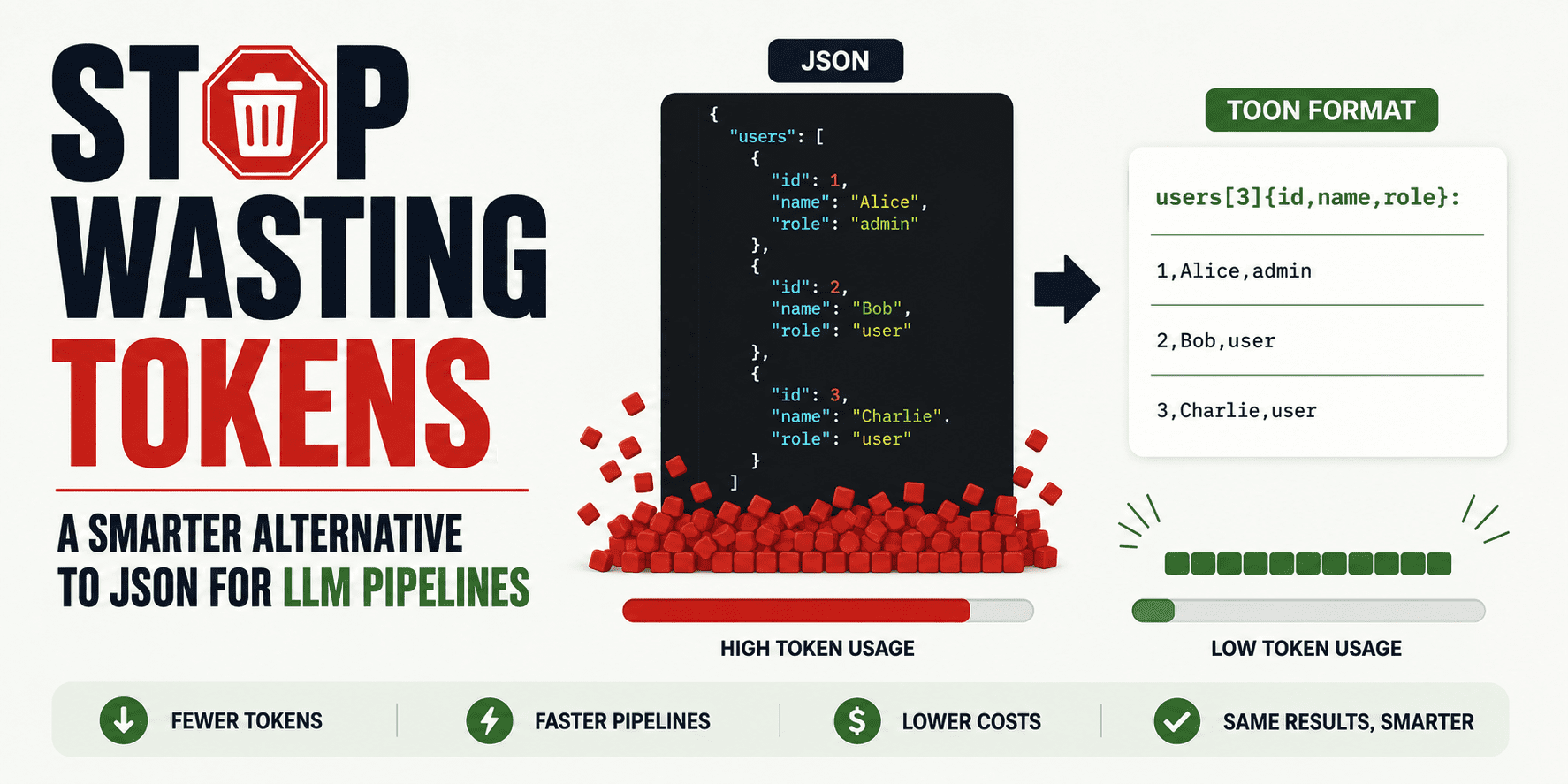
When you send 100 support tickets, product entries, or user records to a model, the same field names appear in every object. TOON minimizes that redundancy by declaring fields once and then streaming row values in a compact tabular layout. Here is a straightforward example.
JSON:
{
  "users": [
    { "id": 1, "name": "Alice", "role": "admin" },
    { "id": 2, "name": "Bob", "role": "user" },
    { "id": 3, "name": "Charlie", "role": "user" }
  ]
}
TOON:
users[3]{id,name,role}:
  1,Alice,admin
  2,Bob,user
  3,Charlie,user
Identical data, reduced noise.
The structure remains clear, but the repeated keys are eliminated. That is where TOON derives most of its advantage.
# What TOON Really Is and When It Makes Sense to Use It
TOON is a serialization format built for the JSON data model. This means it can represent objects, arrays, strings, numbers, booleans, and null values — but in a manner that is more compact for model input. The TOON project describes it as lossless relative to JSON, meaning you can convert JSON to TOON and back without any information loss. The key point to grasp is this:
You do not have to replace JSON throughout your application.
A more practical approach is to retain JSON in your backend, APIs, and storage, then transform it to TOON only when you are preparing to feed structured data into an LLM.
TOON delivers the most value when your prompt includes repeated structured records sharing the same fields. Strong use cases include retrieved support tickets, catalog entries, analytics records, tool outputs, CRM entries, or memory snapshots for agent systems. On the other hand, if your structure is deeply nested, highly irregular, purely flat, or very small, the advantages may diminish or vanish entirely.
# Getting Started with TOON
// Step 1: Setting Up the TOON Command-Line Interface
The simplest way to experiment with TOON is through the official command-line interface (CLI) provided by the TOON project. The TOON website links directly to its CLI, and the main repository presents the format as part of a broader SDK and tooling ecosystem.
Install the package:
npm install -g @toon-format/cli// Step 2: Transforming a JSON File into TOON
Let’s start by creating a folder:
mkdir toon-test
cd toon-test
Next, execute the following command to create the JSON file:
Paste this content:
[
  { "id": 1, "name": "Alice", "role": "admin" },
  { "id": 2, "name": "Bob", "role": "user" },
  { "id": 3, "name": "Charlie", "role": "user" }
]
Now perform the conversion:
npx @toon-format/cli users.json -o users.toonYou should receive a compact output similar to this:
[3]{id,name,role}:
  1,Alice,admin
  2,Bob,user
  3,Charlie,user
This represents the core TOON pattern: define the structure once, then enumerate the values row by row. This aligns with the official design objective of tabular arrays for uniform objects.
// Step 3: Feeding TOON as Model Input
The ideal place to leverage TOON is on the input side of your pipeline. Rather than inserting a large JSON block into a prompt, pass the TOON version and keep the instruction concise.
For instance:
The following data is in TOON format.

users[3]{id,name,role}:
  1,Alice,admin
  2,Bob,user
  3,Charlie,user

Summarize the user roles and highlight anything unusual.
This approach works effectively because TOON is engineered to help the model interpret repeated structure with reduced overhead. That is also how the official project frames its benchmarks: as an evaluation of comprehension across different structured input formats.
// Step 4: Preserving JSON for Outputs
This is one of the most critical practical considerations. TOON excels for input, but JSON remains the preferable choice for output when another system needs to parse the model’s response. This is because JSON enjoys far more robust tooling support, and modern APIs can enforce structured JSON output through schemas.
In practice, the most reliable pattern is:
- JSON within your application.
- TOON for extensive structured prompt context.
- JSON again for machine-readable model responses.
This delivers efficiency on the input side and dependability on the output side.
// Step 5: Running Benchmarks in Your Own Pipeline
Do not change formats based solely on excitement.
Conduct a small benchmark within your own workflow:
- Measure input tokens for JSON.
- Measure input tokens for TOON.
- Evaluate latency differences.
- Assess answer quality.
- Compare overall cost.
The official TOON project highlights token savings as one of the primary advantages, and third-party coverage echoes those claims, but community discussions also indicate that outcomes depend significantly on the shape of the data. That is why the best question is not “Is TOON superior to JSON?”
The more useful question is: “Is TOON superior for this specific LLM step?”
# Final Thoughts
TOON is not something you need to deploy everywhere.
It is a focused optimization for one particular problem: squandering tokens on repeated JSON structure within LLM prompts. If your pipeline feeds large volumes of repeated structured records into a model, TOON is worth evaluating. If your payloads are small, irregular, or deeply nested, JSON may still be the superior option.
The most intelligent way to adopt it is straightforward: keep JSON where JSON already performs well, apply TOON where you are packing substantial structured inputs into prompts, and benchmark the outcomes on your own tasks before fully committing to it.
Kanwal Mehreen is a machine learning engineer and a technical writer with a deep passion for data science and the intersection of AI with medicine. She co-authored the ebook “Maximizing Productivity with ChatGPT”. As a Google Generation Scholar 2022 for APAC, she champions diversity and academic excellence. She’s also recognized as a Teradata Diversity in Tech Scholar, Mitacs Globalink Research Scholar, and Harvard WeCode Scholar. Kanwal is a passionate advocate for change, having founded FEMCodes to empower women in STEM fields.
