



Key Insights
- In 2025, institutional giants Visa, Stripe, and Worldpay built-in Solana to settle and/or settle for stablecoin funds. Visa’s USDC pilot surpassed $3.5 billion in annualized quantity, whereas Worldpay achieved a 50% discount in processing instances utilizing the International Greenback Community (USDG). 57% of USDG is issued on Solana, because the community’s quick finality and near-zero charges help the high-frequency settlement wants of establishments.
- Western Union is issuing a brand new stablecoin on Solana, migrating its treasury operations onchain and opening up its community of over 500,000 retail brokers to Solana apps. The 2026 launch of the USDPT token goals to eradicate the “working capital trap” of pre-funded accounts and drastically decrease common worldwide switch prices.
- Fiserv, one of many world’s largest financial institution processors and service provider acquirers, is issuing FIUSD on Solana, a bank-centric stablecoin. Fiserv introduced the launch of a digital asset platform with FIUSD, designed for its shoppers spanning 10,000 monetary establishments, in addition to its service provider community
- Gusto is piloting immediate USDC payouts for over 400,000 international companies on the Solana community. Launched in January 2026, the partnership with Zero Hash targets the 11% of U.S.-based small and midsize companies (SMBs) hiring worldwide contractors to bypass conventional three-to-seven-day wire delays.
- PayPal USD (PYUSD) market cap on Solana hit $834.7 million on Feb. 2, 2025, a 500.9% YoY enhance. Adoption was fueled by “Pay with Crypto” service provider integrations, “PayPal Links” for URL-based transfers, and a 4.0% reward fee for customers.
- Huma Finance transaction quantity surged 232% YoY to $8.9 billion in 2025. Following its merger with Arf, the protocol originated $3.8 billion in onchain credit score, changing legacy SWIFT techniques with 24/7 stablecoin settlement for international companies.
Introduction
The present international monetary system stays tethered to legacy infrastructure predating the web, leading to an surroundings marked by opacity and prohibitive prices. Legacy monetary infrastructure is characterised by deep decoupling between messaging and settlement. Transaction finality is usually delayed by days as a result of “multi-hop” reliance on correspondent banking intermediaries.
Past easy latency, this fragmentation necessitates intensive pre-funding necessities, trapping trillions in idle, non-productive capital to bridge the hole between archaic “bankers’ hours” and a 24/7 international market. The ensuing reconciliation burden, pushed by siloed, non-interoperable inside ledgers, creates a “liquidity tax” on each cross-border fee. Finally, the brittleness of this legacy infrastructure, coupled with a scarcity of native programmable logic, renders the legacy stack incapable of supporting the high-velocity, automated necessities of funds within the twenty first century.
Solana addresses these structural gaps by unifying messaging and settlement right into a single, atomic operation. As a result of its high-throughput, parallelized structure, the community settles transactions in milliseconds, bypassing correspondent banking intermediaries and the latency of legacy techniques. The Solana blockchain has traditionally maintained a median block time of 392 milliseconds and a median transaction price of $0.0004. This real-time settlement surroundings eliminates the necessity for capital-intensive pre-funding, drastically decreasing the operational burden on monetary establishments and companies by means of a shared, clear, and 24/7 ledger. With native programmability and predictable, near-zero charges, Solana supplies the high-velocity, internet-native fee rails to help the fashionable financial system.
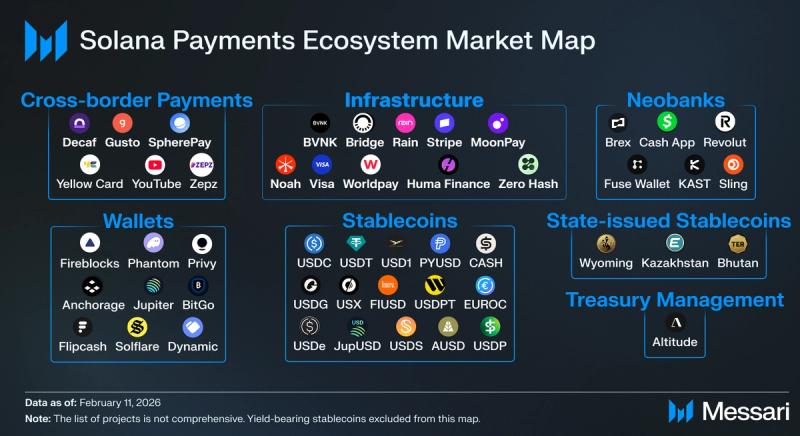
Solana’s fee ecosystem spans a number of classes: (1) Cross-Border Funds, led by Gusto, Sphere Labs, and Yellow Card; (2)Cost Infrastructure, that includes giants like Worldpay, Visa, and Stripe; (3) Neobanks, together with Money App, Revolut, and Sling Cash; (4) State-issued Stablecoins, corresponding to Wyoming’s Frontier, Kazakhstan’s Evo, and Bhutan’s gold backed TER; (5) Treasury Administration, anchored by Squads Altitude; (6) Stablecoin Issuers, like Circle, Tether, and PayPal; and Digital Wallets, corresponding to Fireblocks, Phantom, and Jupiter.
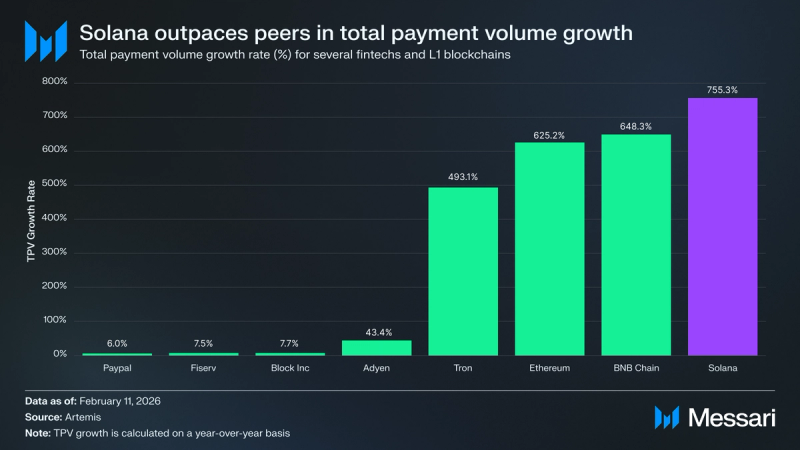
As of Feb. 11, 2026, Solana’s Complete Cost Quantity (TPV) progress fee considerably outperformed each conventional fintech giants and peer Layer-1 (L1) blockchains, growing 755.3% YoY. That is almost triple the median progress fee of 268.24%.
Cost Infrastructure
Bridge
In February 2025, Stripe accomplished its $1.1 billion acquisition of Bridge, integrating a complete stablecoin orchestration platform into one of many world’s largest funds processors. Bridge affords a collection of APIs that enable companies to ship, retailer, and obtain stablecoins throughout a number of blockchains. Notable shoppers embrace SpaceX, Coinbase, and Payoneer.
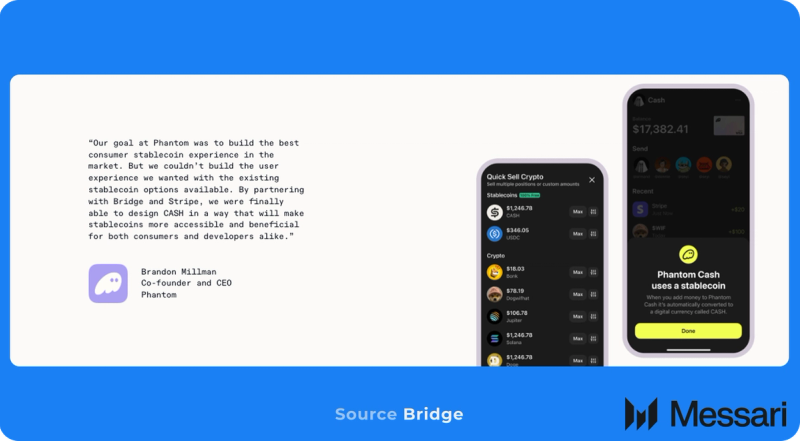
By its Open Issuance platform, Bridge permits companions to launch branded stablecoins, whereas controlling and tailoring their product expertise, tapping right into a shared liquidity community, and incomes curiosity earnings on reserve belongings. It additionally integrates these branded stablecoins with Bridge’s onramp and offramp community. Phantom, a crypto pockets with a neighborhood of greater than 15 million customers, is launching a brand new stablecoin, CASH, on the Open Issuance platform.
Different Merchandise Embrace:
- Orchestration: Strikes funds globally utilizing a mixture of fiat rails (ACH, Wire, SEPA, SPEI, Pix) and stablecoins, enabling 24/7 settlement for platforms like Bitso and ARQ.
- Digital Accounts: Immediately points USD, EUR, GBP, BRL, and MXN deposit accounts for customers with native financial institution particulars.
- Card Issuance: Allows customers to spend from their stablecoin balances with Visa-powered digital playing cards.
- Wallets: Provisioning of safe custodial wallets to carry and handle stablecoin balances at scale.
In February 2026, Bridge acquired conditional approval from the Workplace of the Comptroller of the Forex (OCC) to prepare a federally chartered nationwide belief financial institution. As soon as totally accepted, the constitution will allow Bridge to supply federally overseen custody, issuance, and reserve administration, a necessity for U.S.-based enterprises emigrate fee flows onto Solana’s rails.
Visa
In December 2025, Visa launched stablecoin settlement for U.S.-based issuer and acquirer banks. This improvement represents a shift from legacy “net settlement” fashions to a real-time settlement structure that makes use of the Solana blockchain. To know the impression, one should distinguish between the 2 main pillars of a card community:
- Issuers: Monetary establishments that present credit score or debit playing cards to customers. They’re accountable for authorizing transactions and increasing credit score to the cardholder.
- Acquirers: Banks or fee processors that present the infrastructure for retailers to just accept funds. They handle the service provider’s account and guarantee funds from the transaction are deposited into the enterprise’s steadiness.
These two entities don’t usually transact in actual time. As an alternative, card networks like Visa calculate the “net” debt between them on the finish of every day, and the issuers and acquirers settle these obligations over a number of enterprise days. With USDC on Solana, Visa has launched a settlement layer that serves as a 24/7 various to conventional rails, enabling these entities to settle straight with Visa in stablecoins and bypass the shortcomings of techniques just like the Automated Clearing Home (ACH). This system started with preliminary participation from Cross River Financial institution and Lead Financial institution. Broader availability is deliberate all through 2026.
The unique USDC pilot program surpassed $3.5 billion in annualized quantity by Nov. 30, 2025. Leveraging stablecoins, Visa decreased friction throughout its international card community and eradicated delays related to conventional banking hours. This positions Solana as a core settlement layer for the following era of card merchandise and inter-bank funds.
Worldpay
Worldpay, one of many world’s largest service provider acquirers, joined the International Greenback Community in April 2025, enabling its retailers to settle transactions utilizing USDG on the Solana community. This partnership permits Worldpay’s international service provider base to bypass the excessive FX and middleman charges related to conventional cross-border funds.
The selection of USDG is critical due to its yield-sharing mannequin. In contrast to conventional stablecoins, the International Greenback Community distributes a portion of the reserve curiosity again to its companions, permitting Worldpay to go on decrease processing prices to its retailers. By automating reporting and reconciliation workflows, Worldpay achieved a 50% discount in processing instances in comparison with conventional fiat rails. This integration eliminated the operational burden of pre-funding financial institution accounts and supplies a 24/7/365 settlement window, impartial of legacy banking hours.
Stripe
Stripe considerably broadened its crypto infrastructure all through 2025, including Solana help to its crypto merchandise in October 2025. Utilizing this suite, Stripe robotically converts stablecoins into fiat foreign money. The funds settle straight into the product owner’s Stripe steadiness in USD to eradicate value volatility. That is at the moment restricted to checkout transactions for companies based mostly in the USA. The next options are invitation-only and in non-public preview:
- Stablecoin Subscriptions: This function makes use of customized good contracts to allow automated recurring billing. It permits clients to avoid wasting a digital pockets as a everlasting fee technique so they don’t have to manually signal each transaction.
- Market and Platform Payouts: Platforms can use this infrastructure to pay out service suppliers, sellers, or creators straight in USDC.
- Stablecoin Monetary Accounts: Stripe is testing the flexibility for companies in over 100 international locations to carry stablecoins in devoted accounts and hyperlink them to bodily or digital playing cards.
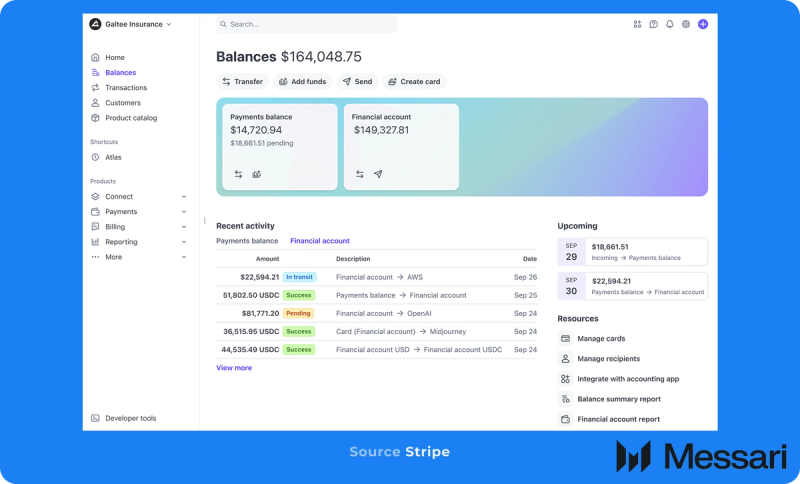
Stripe additionally affords hosted and embedded onramps that enable builders to construct widgets straight into their functions for customers who want to accumulate crypto through fiat.
Huma Finance
By permitting companies to make use of future money flows, corresponding to industrial invoices and bank card receivables, as collateral, Huma Finance is unlocking onchain credit score that was beforehand troublesome to entry. Huma acts as a bridge between funds and DeFi. It supplies the infrastructure for fee service suppliers (PSPs) to settle transactions 24/7 utilizing stablecoins, changing slower, dearer techniques corresponding to SWIFT.
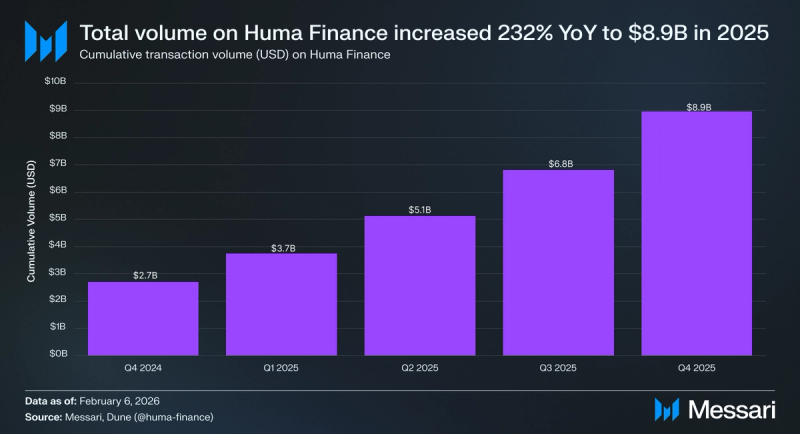
Following its 2024 merger with Arf, Huma’s transaction quantity elevated 232% to $8.9 billion in 2025. Huma is making the worldwide financial system sooner and extra capital-efficient. By Feb. 2, 2026, the protocol had originated $4.2 billion in credit score.
BVNK
BVNK acts as a significant bridge between fintechs and the onchain financial system, abstracting the technical complexities of crypto to make it simple for corporations like Worldpay, Deel, and Flywire to make use of Solana for immediate, international funds.
The platform’s worth proposition lies in its capacity to unify stablecoins and fiat currencies right into a single expertise. This enables companies to maneuver cash between conventional rails (corresponding to SWIFT or ACH) and Solana with out managing the operational complexities of digital belongings themselves. Past B2B cross-border, BVNK affords a full suite of providers, together with embedded wallets and auto-conversion, which let retailers settle for stablecoins and obtain fiat, or fund a payout in fiat and ship stablecoins to a recipient’s pockets.
In January 2026, BVNK introduced a landmark partnership to energy stablecoin infrastructure for Visa Direct, a community reaching over 7 billion endpoints in additional than 190 international locations. This integration leverages blockchains like Solana as a fee rail, enabling Visa’s shoppers to fund accounts in actual time and extra capital-efficiently than conventional wires.
MoonPay
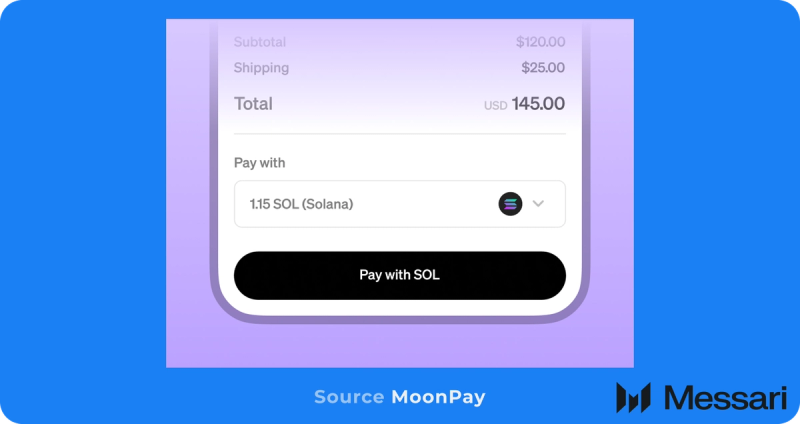
MoonPay supplies the important infrastructure for fiat-to-crypto onramps and offramps throughout main functions on the Solana community. As the popular onramp for Phantom, MoonPay facilitates seamless capital flows for over 15 million customers, enabling them to buy SOL and Solana-native stablecoins straight through a number of fee strategies, together with bank cards, Apple Pay, and financial institution transfers. Past onramps, MoonPay’s suite of fee options is designed to summary blockchain complexity:
- Commerce: A turnkey resolution for retailers to just accept crypto deposits and stablecoins at checkout, which MoonPay can robotically route and convert into fiat.
- MoonPay Brokers: Launched in late 2025, this specialised infrastructure permits AI brokers on Solana to autonomously maintain balances, execute swaps, and pay for providers, making a regulated layer for agent-to-agent commerce.
- Stablecoin Orchestration: By its subsidiary Iron, MoonPay affords a sturdy set of orchestration APIs that facilitate swaps and onramps, enabling companies to bridge conventional fiat rails (together with ACH, FedWire, and SEPA Instantaneous) with Solana-native stablecoins.
Noah
Noah supplies infrastructure for each people and companies to navigate between fiat currencies and digital belongings. By streamlining fiat-to-stablecoin conversions, Noah permits functions and fintech platforms to supply localized fee experiences that combine straight with Solana’s high-speed settlement rails.
The platform’s core performance facilities on its Payin and Payout providers, which help transactions throughout greater than 100 international locations. This infrastructure permits companies to just accept native fiat currencies from clients and obtain settlement in stablecoins on Solana, or conversely, provoke mass payouts from onchain wallets on to conventional financial institution accounts. Noah manages the end-to-end course of, together with KYC/AML compliance, liquidity administration, and real-time international trade (FX), decreasing the operational and regulatory burden for its companions.
In 2026, Noah partnered with a number of entities to additional this aim:
- Jupiter: In February 2026, Noah embedded its regulated banking infrastructure into the Jupiter International “superapp,” offering greater than 50 million customers with digital USD and EUR accounts. This integration permits customers to obtain salaries or worldwide wire transfers straight into their Jupiter accounts, successfully merging neobanking with Solana’s DeFi ecosystem.
- Picnic: By a specialised partnership centered on the Brazilian market, Noah powers USD-native payroll and settlement for Brazil’s international workforce. By permitting distant employees to generate distinctive USD digital accounts throughout the Picnic app, Noah permits them to obtain ACH funds from U.S. employers that settle as stablecoins in seconds, bypassing legacy cross-border charges that usually declare as much as 8% of a employee’s earnings.
- Payd: Noah supplies the core infrastructure for Payd, a monetary platform serving over 30,000 professionals throughout sub-Saharan Africa. By using Noah’s digital USD and EUR accounts, Payd customers can obtain worldwide earnings that settle immediately as USDC or USDT on Solana. This allows employees to bypass the excessive charges and multi-day delays of conventional regional banking whereas gaining rapid entry to liquidity.
Rain
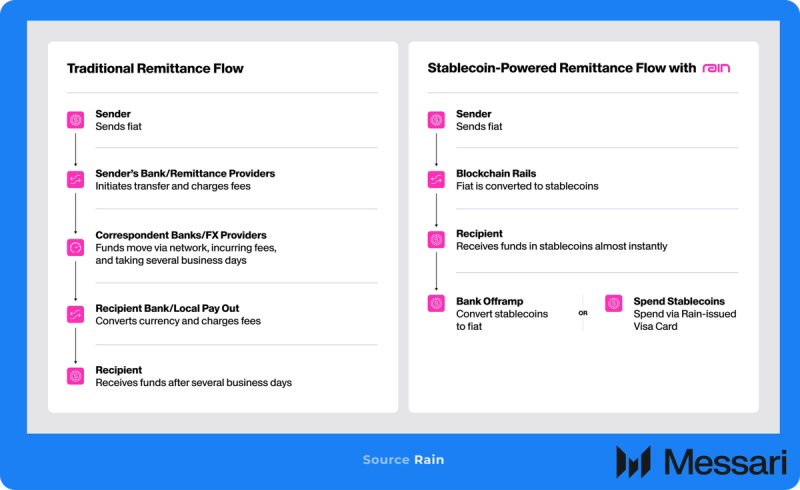
Rain is a stablecoin-powered funds platform designed to bridge the hole between digital belongings and conventional commerce. As a Visa Principal Member, Rain permits companies to launch branded card applications accepted at greater than 150 million retailers throughout over 150 international locations. Rain settles straight with Visa 12 months a yr, bypassing banking hours and permitting for real-time clearing of tokenized credit score receivables. This supplies an “invisible” funds layer that permits neobanks and platforms to supply international playing cards in a matter of weeks through a single API.
This infrastructure is core to the imaginative and prescient of remittance platforms like Zar, a Solana-based funds platform that goals to modernize the remittance lifecycle in cash-heavy economies throughout the International South. Whereas Zar plans to permit customers in areas like Pakistan to obtain worldwide remittances in stablecoins, its partnership with Rain makes these funds instantly usable through Visa playing cards, eliminating the necessity for conventional offramps. Below this imaginative and prescient, Zar customers will be capable to go to native nook outlets to transform bodily money into digital {dollars} on Solana, permitting the unbanked to retailer worth and spend it globally.
Zero Hash
Zero Hash, a Mastercard firm, supplies the regulatory and technical infrastructure required for B2B and B2C platforms to embed digital asset providers straight into their merchandise. By abstracting the complexities of onchain settlement, Zero Hash permits main fintech gamers to leverage Solana’s high-throughput structure with out further operational complexity.
In latest months, Zero Hash signed notable partnerships with a number of exchanges:
- Interactive Brokers: In January 2026, Zero Hash started powering Interactive Brokers’ 24/7 account funding function. This allows worldwide buyers to deposit USDC through the Solana community, which is robotically transformed to USD for rapid buying and selling. This bypasses the delays of legacy wire transfers, offering near-instant capital mobility.
- Public.com: In late 2025, the retail investing platform Public migrated its total crypto operation to Zero Hash. This transfer was designed to offer 24/7 buying and selling and sooner settlement cycles, using Zero Hash’s capacity to interface with blockchains like Solana for immediate asset transfers.
Cross-border Funds
Decaf
Decaf is a non-custodial pockets designed to deliver the utility of stablecoins to on a regular basis commerce, particularly focusing on cash-heavy and high-inflation economies. Utilizing stablecoins on blockchains like Solana, Decaf supplies a person expertise that bypasses the borders and prohibitive prices of the legacy monetary system.
By strategic integration with MoneyGram, Decaf permits customers to transform bodily money to USDC (and vice versa) for no charges at over 350,000 retail areas throughout greater than 175 international locations. This supplies a important lifeline to the unbanked in areas like Latin America, Africa, and Southeast Asia, giving them entry to digital {dollars} and not using a conventional checking account.
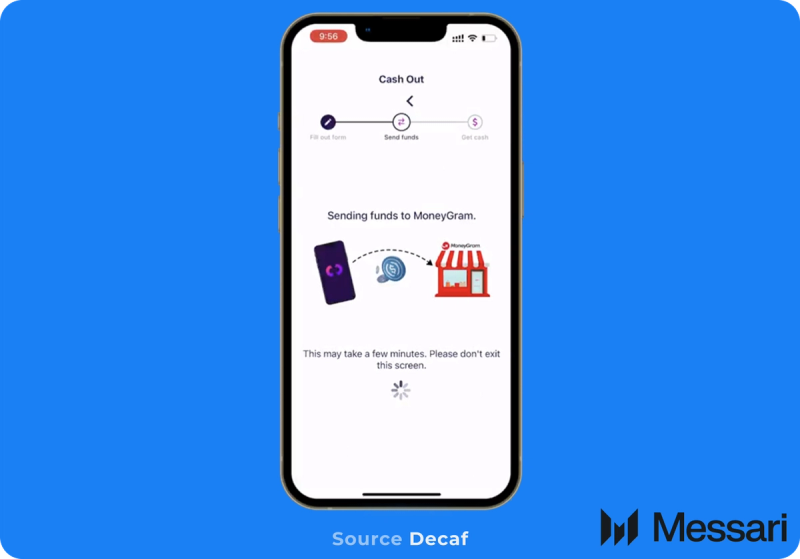
Decaf additionally affords a simplified service provider interface that permits companies to make funds and ship assist utilizing stablecoins as simply as money. Retailers profit from immediate settlement and keep away from the excessive processing charges and chargeback dangers related to conventional card networks.
Gusto
In January 2026, Gusto, a cloud-based HR platform with over 400,000 companies worldwide, introduced a partnership with Zero Hash to pilot stablecoin-based payouts for worldwide contractors on the Solana community. Whereas conventional cross-border wires take three to seven enterprise days to settle, this integration permits immediate international payouts in USDC. In response to Zero Hash, 11% of U.S. small- and medium-sized companies (SMBs) already rent worldwide contractors. Supporting onchain payroll permits quick, low-cost payouts to those contractors for the primary time.
Sphere Labs
Sphere Labs supplies the infrastructure required to bridge fiat currencies with stablecoins. The platform serves as a settlement layer for international companies that require quick, low-cost cross-border funds. Sphere helps over 12 international currencies, together with USD, EUR, and MXN, facilitating cross-border funds in each established and rising markets.
A cornerstone of this infrastructure is the Onramper Account, which assigns distinctive banking particulars on to a person’s crypto pockets. These Onramper Accounts enable companies to obtain customary ACH or Wire transfers, that are robotically transformed into stablecoins on Solana, successfully abstracting the complexity of crypto on-ramps and off-ramps for finish customers.
Sphere supplies 4 distinct merchandise:
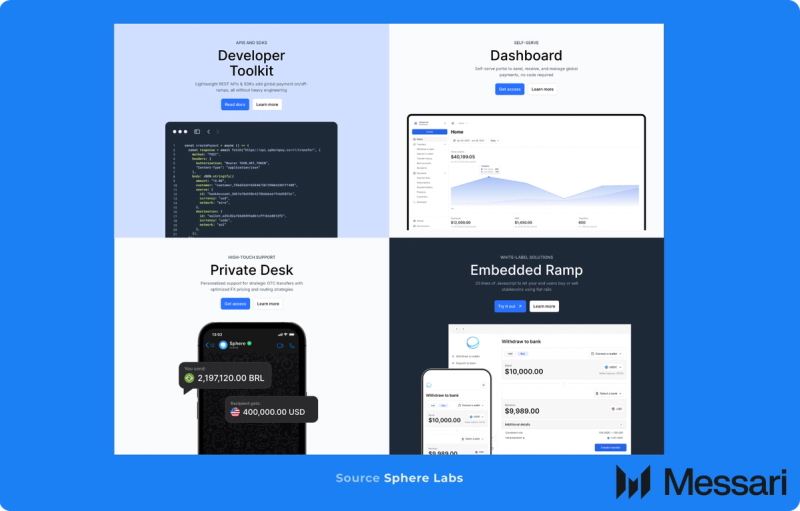
- The Developer Toolkit supplies a sturdy API and SDK that allow groups to embed multichain transfers and stablecoin conversions straight into their tech stacks.
- The Enterprise Dashboard serves as a turnkey resolution for each finish customers and companies to handle treasury and transfers.
- Platforms trying to present in-app on-ramps and off-ramps can make the most of Embedded Ramps to combine a useful widget straight into their web site.
- Institutional companions that require vital quantity use the Personal Desk to deal with large-scale FX and fiat-crypto conversions.
YouTube
In December 2025, YouTube took a big step towards mainstream adoption of blockchain-based funds by enabling U.S.-based creators to obtain earnings in PayPal USD (PYUSD) on the Solana community. This integration permits creators to bypass the settlement delays and restricted working hours attribute of legacy monetary establishments in favor of same-day settlement and near-zero charges.
By leveraging PayPal’s regulated, 1:1 USD-backed stablecoin, YouTube supplies its customers with an asset that may be transferred immediately worldwide. Whereas at the moment restricted to U.S. creators, this launch may function a stepping stone for increasing stablecoin payouts to YouTube’s international creator base, significantly in areas the place conventional cross-border wire transfers stay prohibitively costly or gradual.
Yellow Card
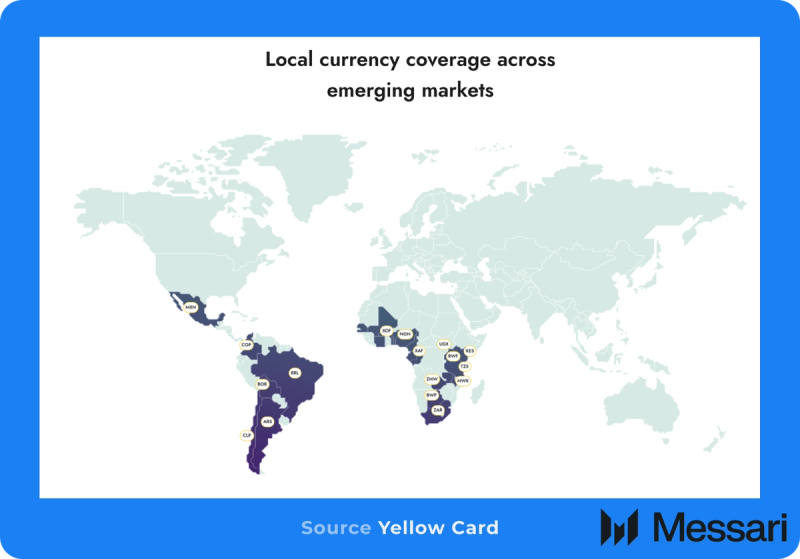
Yellow Card is the most important pan-African stablecoin infrastructure supplier, providing a complete fiat-to-crypto ramp that permits banks, monetary establishments, and international companies to entry, retailer, and handle digital belongings. By its API and Treasury platform, the platform permits companies to execute bulk cross-border payouts and remittances utilizing stablecoins, decreasing settlement instances from days to seconds.
The platform makes a speciality of resolving the structural liquidity bottlenecks and prohibitive charges inherent in legacy banking rails. Yellow Card has change into the popular settlement layer for a number of international monetary leaders working in rising markets:
- Visa: Makes use of Yellow Card to streamline treasury operations and improve liquidity administration, enabling extra agile and cost-effective cross-border cash motion.
- Thunes: Leverages Yellow Card’s stablecoin infrastructure to bypass conventional treasury bottlenecks, executing international fee flows at unprecedented speeds.
- Western Union: Employs Yellow Card’s rails for stablecoin-based settlement, offering clients with near-instant fee clearance and considerably improved trade charges in comparison with conventional corridors.
- Xoom (a PayPal service): Depends on the community to execute cross-border transfers into areas corresponding to Cameroon, the Ivory Coast, and Senegal, permitting funds to achieve cell wallets and financial institution accounts in seconds.
Zepz
In October 2025, Zepz, the worldwide funds group behind WorldRemit and Sendwave, introduced the launch of Sendwave Pockets, a stablecoin-backed peer-to-peer (P2P) cross-border resolution constructed on the Solana blockchain. Designed to maneuver past remittances, the pockets permits Zepz’s 9 million international clients to ship, retailer, and spend funds throughout greater than 130 international locations and a pair of,000 corridors.
By leveraging Circle’s USDC and Portal’s pockets infrastructure, the Sendwave Pockets abstracts the technical complexity of blockchain expertise to offer a seamless UI/UX for the International South. The platform permits customers to hedge in opposition to native foreign money devaluation by holding digital {dollars}, which might be despatched throughout the app in seconds.
Prospects can withdraw USDC balances into native fiat foreign money by means of Zepz’s payout community to pay for healthcare, training, and day by day necessities. In the long run, Zepz plans to develop the pockets’s utility to incorporate playing cards and QR-based service provider funds.
Neobanks
Brex
In September 2025, Brex introduced the launch of stablecoin funds, making it the primary international company card to allow immediate steadiness funds utilizing USD stablecoins. By integrating USDC on the Solana community, Brex supplies its clients with a consolidated monetary platform to handle each conventional fiat and stablecoin-backed spend at scale.
The combination is designed to eradicate the fragmented workflows usually related to managing digital belongings and company bills. By this new infrastructure, Brex clients can bypass the constraints of conventional institutional fee platforms and entry liquidity with 24/7 international reliability.
Key options embrace:
- Instantaneous Stability Funds: Prospects pays their company card balances straight utilizing stablecoins, beginning with USDC.
- Automated Fiat Conversion: Enterprise accounts can settle for incoming stablecoins and robotically convert them to USD, whereas additionally permitting customers to ship stablecoins straight from their present USD balances.
- Zero-Charge International Settlement: Brex permits customers to ship stablecoin funds that settle in seconds throughout borders without cost, eradicating the hidden prices and delays of legacy banking rails.
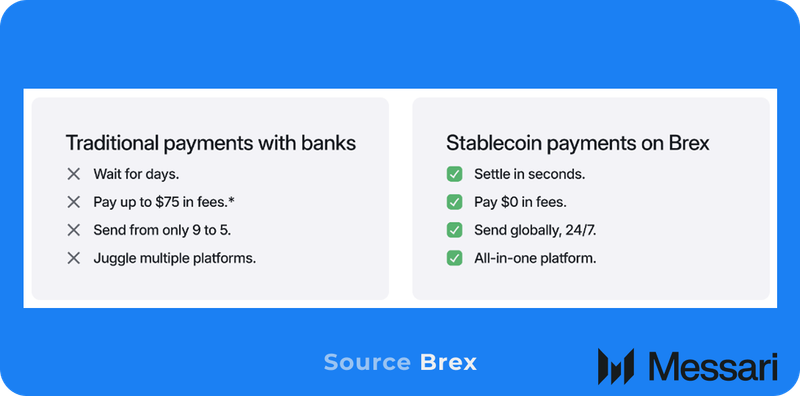
Integrating stablecoins on Solana permits forward-looking corporations to maneuver thousands and thousands of {dollars} immediately, combining the velocity of crypto-native rails with the safeguards required by international companies
Money App
In a big departure from its traditionally Bitcoin-only technique, Money App, a unit of Block, is integrating stablecoin rails, selecting Solana because the preliminary community for the rollout. Launching in early 2026, this integration permits Money App’s 56 million month-to-month energetic customers to ship and obtain USDC.
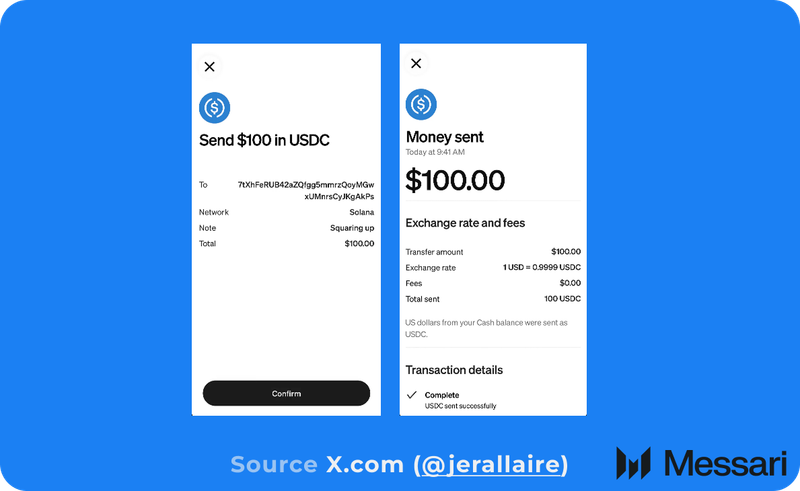
Below the hood, the system assigns a devoted Solana blockchain deal with to each Money App person, enabling them to work together straight with the onchain financial system with out leaving the app’s acquainted interface. The platform options an automatic conversion engine: incoming USDC on Solana is immediately credited as a USD steadiness, whereas outgoing funds might be despatched as USDC to any exterior Solana pockets.
Fuse Pockets
Fuse Pockets is a “smart wallet” constructed on the Squads Protocol. For the reason that pockets is constructed on good accounts, it has options beforehand unavailable to retail customers, corresponding to spending limits to stop “drainers”, key rotation for misplaced units, and gasoline abstraction, which permits customers to pay transaction charges with any token and commerce Solana tokens with zero charges.
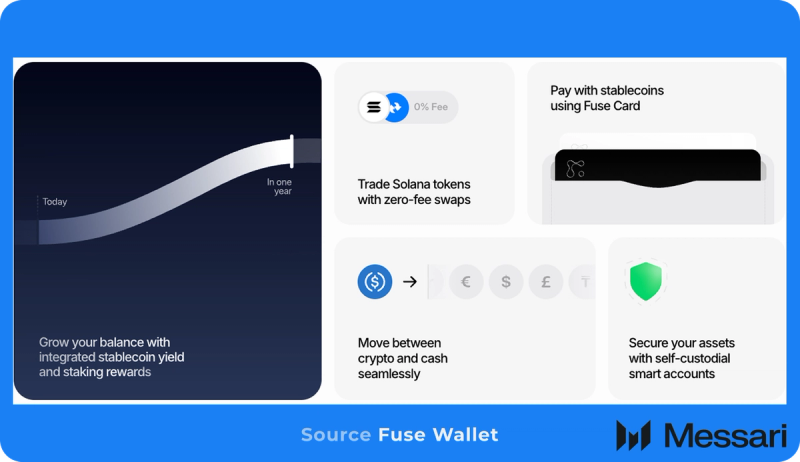
Past safe custody, Fuse supplies a complete suite of instruments, together with:
- Fuse Earn: A local yield engine that integrates straight with Lulo to rebalance deposits throughout Kamino, Drift, MarginFi, and Save, permitting customers to generate yield on their stablecoins whereas sustaining self-custody.
- Digital Financial institution Accounts: These present customers with devoted IBAN or account numbers, facilitating a seamless Off-Ramp by permitting direct fiat-to-USDC transfers for customers within the U.S. and Europe.
- Fuse Card: A digital Visa pay as you go card that permits immediate spending of stablecoin balances at thousands and thousands of retailers worldwide. The cardboard supplies real-time “swipe-and-go” utility, finishing the loop from incomes to spending.
KAST
KAST is a worldwide neobank constructed natively on stablecoin rails, designed to bridge the hole between digital earnings and real-world spending. By partnering with Rain, KAST permits customers to spend stablecoins at greater than 150 million retailers and ATMs worldwide. The platform targets the “borderless” workforce, offering freelancers, distant employees, and crypto-native founders with a high-velocity various to conventional banking.
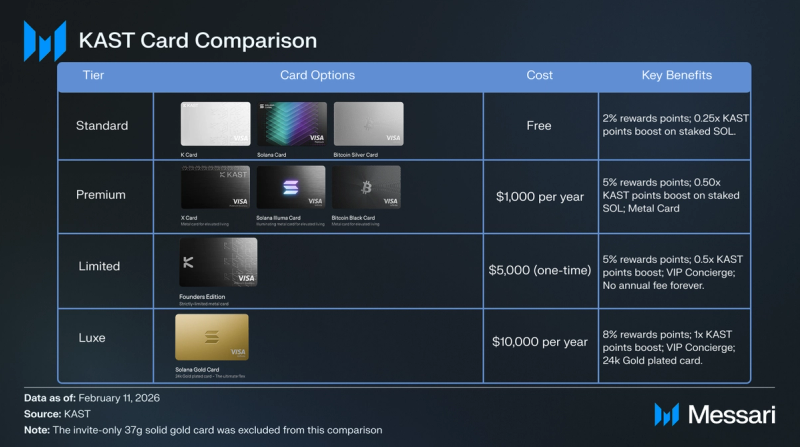
The KAST card ecosystem supplies a multi-tiered strategy to onchain spending, scaling from a free, entry-level plastic card to high-end, steel, and gold-plated editions. Every tier will increase the person’s incomes potential by means of tiered reward factors on card spend and a factors increase on staked SOL, which scales from 0.25x to 1x. Whereas the higher-level Premium and Luxe tiers require an annual price, they provide enhanced advantages, together with VIP concierge entry and considerably larger reward charges.
Inside the ecosystem, customers can ship funds immediately through KAST Tags, cellphone numbers, or e-mail addresses. These transfers are peer-to-peer, borderless, and incur zero transaction charges, facilitating frictionless international motion for a distributed workforce. KAST connects on to international fee networks, permitting customers to offramp their stablecoin balances into native financial institution accounts in over 50 international locations, together with immediate native techniques like Brazil’s Pix and India’s UPI.
In February 2026, KAST launched the vault product KAST Earn in partnership with Gauntlet. These risk-optimized vaults enable customers to earn a sustainable 4%–9% APY on stablecoin balances. Funds stay 100% liquid, accruing yield till the precise microsecond the cardboard is swiped at a terminal.
Revolut
In December 2025, Revolut, Europe’s largest neobank with over 65 million customers, expanded its digital asset suite to incorporate full help for the Solana community. This integration permits greater than 15 million crypto clients to work together with the Solana ecosystem as seamlessly as conventional fiat, leveraging the community’s velocity and low charges for on a regular basis transactions.
Following a November rollout of 1:1 stablecoin conversions for USDC and USDT, Revolut now permits its international person base to maneuver between fiat and crypto with zero friction. Customers can ship, obtain, or pay through Solana utilizing SOL, USDC, and USDT. Revolut customers also can stake their SOL straight throughout the app to earn yield, decreasing the technical obstacles of staking for retail customers.
Sling Cash
Sling Cash is a cell fee utility designed to make worldwide cash transfers as quick and cheap as sending a textual content message. It’s constructed by Avian Labs, a startup based by former executives from Monzo, Fb, and Spotify.
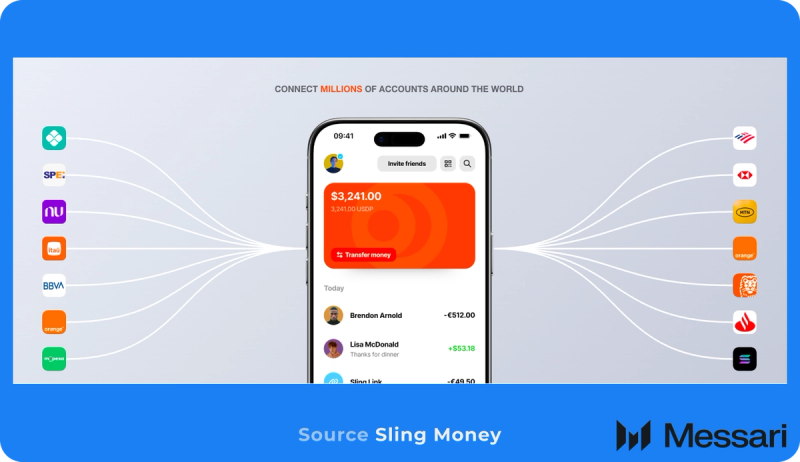
At its core, Sling acts as a user-friendly interface for blockchain expertise. It makes use of the Solana blockchain and stablecoins (USDP, USDC, and EURC) to maneuver funds immediately throughout borders, bypassing the gradual and costly “correspondent banking” techniques utilized by conventional banks and providers like Smart.
After launching in beta in Could 2023, Sling considerably expanded its footprint. As of February 2026, it’s obtainable in over 140 international locations and helps immediate withdrawals to native financial institution accounts in over 75 of them. The corporate not too long ago secured a MiCA license within the EU and FCA approval within the UK. This follows an integration into Mexico’s SPEI fee system in August 2025, permitting the worldwide Mexican diaspora to transform stablecoins to pesos immediately.
Digital Wallets
Anchorage Digital
Anchorage Digital, the primary and longest-standing federally chartered crypto financial institution within the U.S., serves as foundational infrastructure for institutional participation within the Solana ecosystem. The platform permits monetary establishments to deploy institutional wallets for treasury administration, stablecoin issuance, and cross-border settlement. Their services are well-suited for company treasuries and fintechs that require SOC 1 Sort 2 and SOC 2 Sort 2 licensed environments. This enables entities to handle digital belongings with the identical rigorous controls as they do for conventional money accounts.
In October 2025, Anchorage partnered with Western Union to launch USDPT (U.S. Greenback Cost Token) natively on the Solana blockchain. As the first custodian and issuer, Anchorage manages the stablecoin’s reserves and minting and burning to take care of a $1 peg.
Anchorage can be a founding member of the International Greenback Community, performing as a main minting and redemption hub for USDG. This stablecoin framework is particularly designed to incentivize fee service suppliers (PSPs) and retailers by distributing yield/rewards, offering an institutional-grade various to conventional dollar-pegged belongings.
BitGo
BitGo supplies institutional-grade custody and pockets infrastructure that serves as a core pillar for safe fee operations and stablecoin administration on Solana. Their platform is particularly designed to fulfill the rigorous safety and compliance necessities of company treasuries and large-scale monetary service suppliers.
In March 2025, BitGo partnered with World Liberty Monetary to launch USD1, a fiat-backed stablecoin through BitGo’s “Stablecoin-as-a-Service” providing. Because the designated custodian and infrastructure supplier, BitGo is accountable for securing the stablecoin’s reserves, that are 100% collateralized by short-term U.S. Treasury payments and money deposits. This regulated custody association ensures the asset maintains its 1:1 peg to the U.S. greenback, offering a excessive diploma of transparency and security for institutional market makers and retail customers alike.
Fireblocks
Fireblocks makes a speciality of offering institutional clients with the Multi-Get together Computation (MPC) pockets infrastructure and coverage engines required for compliant onchain funds and treasury administration options. The platform permits banks, fee service suppliers (PSPs), and company treasuries to orchestrate advanced stablecoin flows with enterprise-grade safety and automatic compliance.
A core part of their providing is the Fireblocks Community for Funds, which unites native fee rails, blockchains, and stablecoin techniques by means of a single API. This connectivity layer permits establishments to entry over 40 suppliers throughout greater than 100 international locations and 60 currencies, protecting use instances from FX and remittances to onramps and offramps. By the Fireblocks Community Listing, customers can uncover and join straight with trusted international suppliers to launch and scale fee merchandise with out the necessity for a number of, bespoke integrations.
Worldpay, one of many world’s largest service provider acquirers, makes use of Fireblocks to energy its stablecoin settlement resolution on the Solana community. By leveraging the Fireblocks Funds Engine, Worldpay achieved 50% sooner fee processing and enabled T+0 settlement for its retailers. This integration permits Worldpay to offer retailers with sooner entry to capital and improved liquidity administration whereas sustaining strict compliance.
In early 2026, Solana and Fireblocks formalized a partnership to ship an entire treasury working system designed for enterprise velocity and institutional management. This infrastructure introduces a number of key options particularly for the Solana community:
- Gasless Transactions: Fireblocks permits “network fee abstraction,” permitting treasury groups to pay transaction charges in stablecoins or USD. This eliminates the operational overhead of managing and pre-funding a number of wallets with native SOL for gasoline.
- Native Program Calls: This function supplies real-time transparency and coverage enforcement for good contract operations, permitting treasury groups to whitelist particular applications and automate workflows
Flipcash
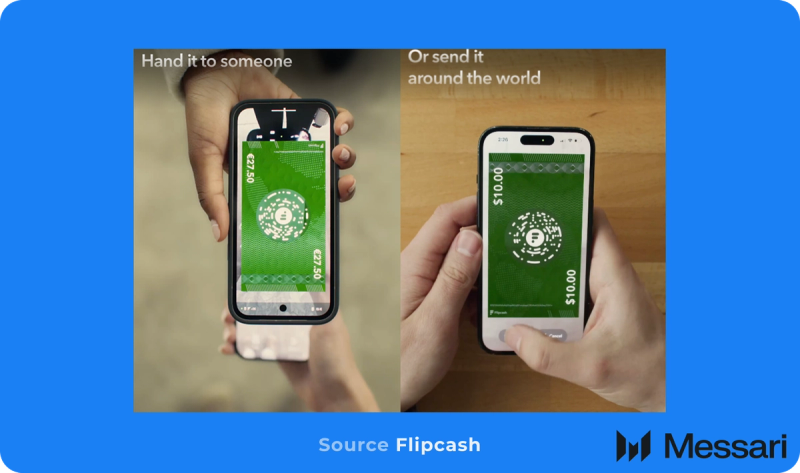
Launched by Kik creator Ted Livingston in late 2025, Flipcash goals to duplicate the privateness and immediacy of bodily money in a digital surroundings. Powered by Solana’s quick finality, Flipcash permits customers to “hand over” cash in a cash-like method through immediate QR code scans or URLs, eliminating the necessity to trade usernames or public keys. In January 2026, Flipcash built-in USDF, a customized stablecoin developed in partnership with Coinbase, enabling frictionless service provider settlement and 24/7 liquidity. The applying’s “point-and-pay” UX has positioned it as a number one contender for P2P digital transactions, significantly within the U.S. and European markets.
The platform encompasses a “currency creator” that permits communities to challenge their very own currencies, that are instantly usable for sending, spending, or tipping. In contrast to conventional launchpads, each Flipcash foreign money is backed by USD stablecoins on a gradual bonding curve, guaranteeing immediate liquidity from day one. It’s not a 1:1 peg with USD stablecoins; as a substitute, the exponential curve permits the foreign money’s value to rise because the neighborhood grows, letting customers share within the worth of their native financial system.
Jupiter International
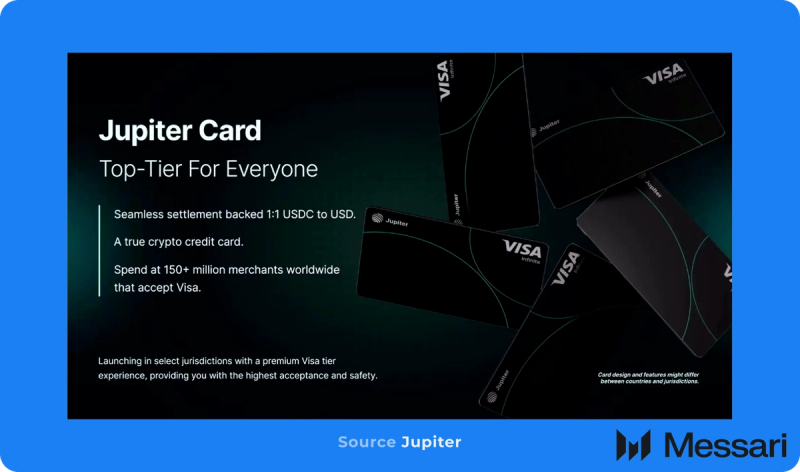
Following its $35 million funding from ParaFi in February 2026, Jupiter expanded its attain with Jupiter International, a devoted funds module throughout the Jupiter cell utility. This suite introduces digital fiat accounts, offering customers with a digital account and routing numbers to straight obtain USD, GBP, and EUR, in addition to a bank card that permits them to spend USDC at over 150 million retailers worldwide.
Phantom Money
Launched in September 2025, Phantom Money is a devoted account throughout the Phantom pockets designed to bridge the hole between self-custody and day by day client spending on Solana. This function is powered by CASH, a USD-pegged stablecoin issued by Bridge.
This devoted account permits customers to carry, ship, and commerce CASH with out sustaining a SOL steadiness to cowl community charges, successfully eradicating the gasoline barrier for on a regular basis customers. The platform additionally supplies gasless stablecoin-to-CASH swaps and immediate P2P transfers utilizing solely a Phantom username, accessible to all customers.
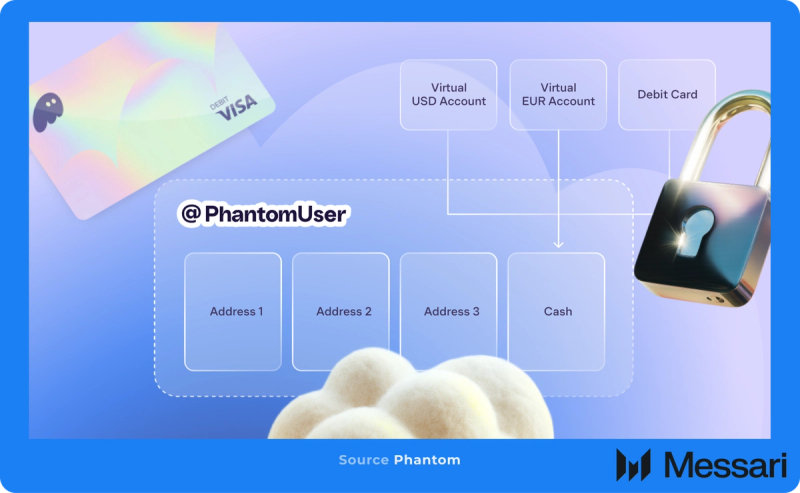
Whereas the core options are dwell, Phantom is at the moment rolling out an expanded suite of options to U.S. customers. These options require identification verification (KYC) and embrace:
- Phantom Money Card: A digital and bodily debit card (issued by Lead Financial institution) that may be added to Apple Pay or Google Pay for on-line or in-person purchases.
- Seamless Financial institution Transfers: The flexibility to fund the account, make withdrawals on to a financial institution, or arrange direct deposits utilizing the supplied account and routing particulars.
By preserving balances in CASH on the Solana blockchain till the precise second of a transaction, Phantom merges the velocity of Solana with the real-world utility of a conventional debit card to supply a “better of each worlds.”
Treasury Management
Squads Altitude
Squads Altitude, launched in May 2025, is a corporate treasury and payment platform built on the Squads Protocol. It functions as a “stablecoin native working system” for global enterprises. Using both USDC and EURC, the platform provides businesses with dual-currency access to digital dollars and euros while integrating onchain security with legacy payment channels such as ACH, Fedwire, and SEPA.
Funds are secured by the Squads multisig protocol, which currently secures over $15 billion in total value for more than 450 teams. This architecture allows treasurers to set specific approval thresholds and team permissions, ensuring that fund movements align with internal corporate governance. Altitude gives companies worldwide the ability to maintain working capital in USD/EUR, utilize multi-sig approval flows for vendor payments, and earn competitive yields through integrated DeFi protocols like Kamino, all within a single, permissioned interface.
Stablecoins
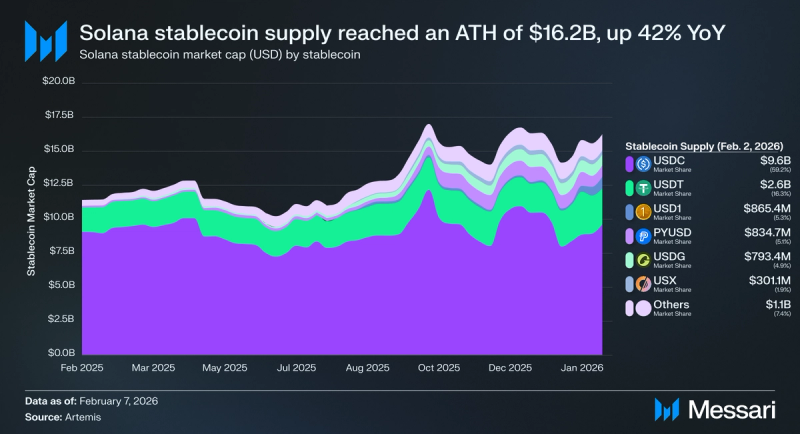
Stablecoins have emerged as the “killer utility” of the Solana network, driven by the blockchain’s high throughput and very low transaction fees. In 2025, the ecosystem experienced a “Cambrian explosion” of issuers, increasing the total stablecoin market cap by 42% YoY to an all-time high of $16.2 billion, as of Feb. 2, 2026. This ranks Solana fourth-highest by circulating stablecoin supply, and third-highest if you only include stablecoins issued natively on the network.
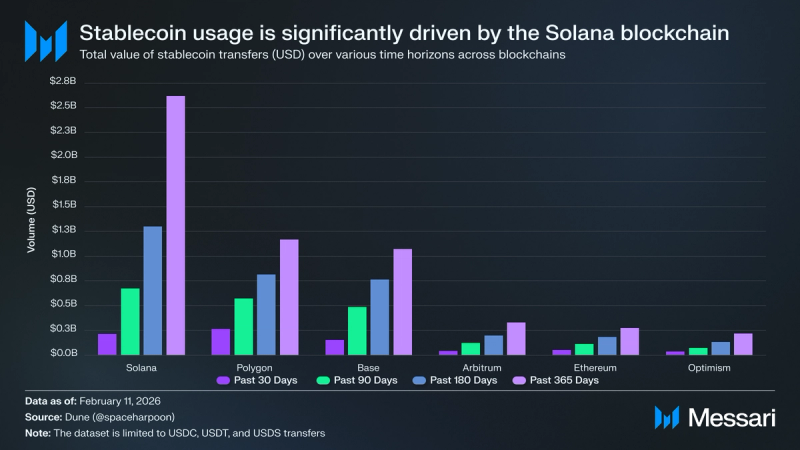
Solana maintains a distinct lead in stablecoin usage, facilitating $2.61 billion in P2P transfers over the past year, 46% of all P2P stablecoin volume among its peers, and more than doubles the annual volume of its nearest competitor, Polygon ($1.16 billion). This lead in 90, 180, and 365-day horizons underscores a structural preference for Solana’s fast finality and near-zero fees.
USD Coin (USDC)
USDC, issued by Circle, is a fully reserved, fiat-backed digital dollar regulated in the United States and major global jurisdictions. It serves as the backbone of the Solana stablecoin ecosystem, with the largest market cap among its peers ($9.61 billion). Its reserves consist of short-term U.S. Treasury securities and cash. In January 2026, Interactive Brokers launched 24/7 account funding via stablecoins, allowing eligible clients to deposit USDC directly into their brokerage accounts using the Solana network. Powered by Zero Hash, these deposits are automatically converted to USD, providing international investors with near-instant capital mobility, bypassing traditional cross-border wire delays and the friction of legacy payment networks.
Tether (USDT)
USDT, issued by Tether, is the industry’s longest-standing and most liquid stablecoin. Unlike the purely Treasury-backed model of its competitors, Tether maintains a diversified reserve that also includes corporate bonds, secured loans, precious metals, and other cryptocurrencies to maintain its peg. USDT’s market cap on Solana increased by 47.6% YoY to $2.65 billion. Its primary value proposition is to serve as a de facto “digital dollar” in emerging markets where access to U.S. banking is limited.
In October 2025, the Solana ecosystem’s connectivity to the broader Tether network was significantly enhanced through the launch of USDT0 and XAUT0 via Everdawn Labs and LayerZero. This integration enables seamless movement of native USDT (and gold-backed XAUT) between Solana and other chains, effectively unifying the Solana network with the entire $184.4 billion USDT supply and the $2.58 billion XAUT supply.
PayPal USD (PYUSD)
PayPal USD (PYUSD) PYUSD is a fiat-backed stablecoin issued by Paxos Trust Company in partnership with PayPal. Fully pegged 1:1 to the U.S. dollar, its reserves are 100% collateralized by U.S. Treasury bills, cash deposits, and cash equivalents. As the first major stablecoin to extensively leverage Solana’s Token Extensions (Token-2022), PYUSD incorporates advanced features, including confidential transfers for merchant privacy and permanent delegate authorities for regulatory compliance.
By February 2026, PYUSD’s market cap on Solana reached approximately $834.7 million, representing a 500.9% YoY increase. This growth was fueled by the launch of “Pay with Crypto,” which allows millions of merchants to accept 100+ cryptocurrencies with instant conversion to PYUSD at a 0.99% transaction fee. Further adoption was driven by “PayPal Links,” which enables users to send PYUSD as easily as a text message using URLs, and by a 4% reward rate for PayPal users. In December 2025, YouTube enabled U.S. creators to receive stablecoin payouts in PYUSD on the Solana blockchain, a significant step toward mainstream adoption.
Global Dollar Network (USDG)
Global Dollar Network (USDG) USDG is a fiat-backed stablecoin issued by Paxos in collaboration with the Global Dollar Network, a consortium of 100 partners including DBS Bank, Robinhood, Kraken, Galaxy Digital, and Anchorage Digital. Pegged 1:1 to the U.S. dollar, the stablecoin is regulated by the Monetary Authority of Singapore (MAS) and has 100% of its reserves collateralized by U.S. dollars, short-term U.S. Treasuries, and cash equivalents.
By February 2026, USDG’s market cap on Solana reached $793.4 million, becoming the fifth largest stablecoin on the network in less than a year. USDG leverages Solana’s Token Extensions to support its unique economic model, which distributes yield generated from its reserves among network partners.
World Liberty Financial USD (USD1)
USD1 is a fiat-backed stablecoin issued by World Liberty Financial. Pegged 1:1 to the U.S. dollar, its reserves are 100% collateralized by short-term U.S. Treasury bills and cash deposits, held under BitGo’s custody. By February 2026, USD1’s market cap on Solana increased to approximately $865.4 million, solidifying its “pole position” within the Solana ecosystem. World Liberty Financial’s recent application for a U.S. national banking license through its subsidiary, World Liberty Trust, signals a shift toward a “federally chartered” stablecoin model. This would allow World Liberty Financial to directly mint and redeem USD1 on behalf of users, allowing institutional market makers to arbitrage the peg with extreme efficiency.
Solstice USX (USX)
Solstice USX (USX) is a synthetic stablecoin issued by Solstice Finance. USX is built to offer high yields generated from delta-neutral, institutional-grade trading strategies (such as funding rate arbitrage), rather than speculative, volatile DeFi farming. It is fully collateralized 1:1 by stablecoins, such as USDC and USDT. The flagship feature of the protocol is the Solstice YieldVault, which allows users to lock USX in exchange for eUSX, a yield-bearing token representing a share of a fund that employs institutional delta-neutral strategies like funding-rate arbitrage and hedged staking.
Supported by major firms including Deus X Capital, Galaxy Digital, and MEV Capital, the protocol utilizes Chainlink for real-time Proof of Reserves and Chainlink’s CCIP for cross-chain interoperability. By February 2026, USX’s market cap on Solana reached $301.1 million.
Upcoming Launches:
Fiserv USD (FIUSD)
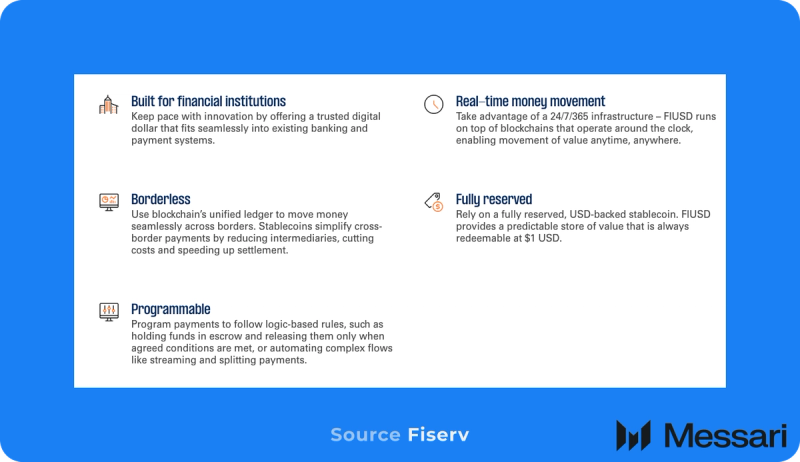
In June 2025, Fiserv announced plans to issue FIUSD, its native stablecoin on Solana, backed by Paxos and Circle as infrastructure partners. FIUSD will be integrated directly into Fiserv’s Finxact core processing platform, enabling approximately 10,000 financial institutions and six million merchants to access stablecoin settlement without additional hardware, allowing banks to offer 24/7 real-time money movement and programmable escrow services. The integration demonstrates the scale and performance improvements enabled by Solana’s high-performance ledger.
Western Union U.S. Dollar Payment Token (USDPT)
In a landmark move, Western Union announced the launch of its native stablecoin, USDPT, on Solana in early 2026. Partnering with Anchorage Digital for institutional-grade custody, Western Union is transitioning a portion of its more than $100 billion annual remittance volume onto Solana’s high-throughput rails. The move aims to reduce the “working capital lure” of pre-funded accounts and decrease the common price of worldwide transfers for its international buyer base. By the top of H1 2026, USDPT is predicted to be a core settlement asset for Western Union’s digital corridors, marking probably the most vital institutional validation of Solana as a worldwide fee rail up to now.
State-issued Stablecoins
Solana has not too long ago attracted a number of sovereign and state-level stablecoin initiatives. These efforts goal to modernize public monetary infrastructure and inform sovereigns on the advantages and nuances of blockchain-based funds.
Wyoming’s Frontier (FRNT)
Wyoming continues to guide the USA in digital asset innovation by means of the Wyoming Frontier (FRNT) token. Issued by the Wyoming Secure Token Fee, FRNT is a clear, fiat-backed stablecoin designed to offer a trusted, state-sanctioned digital greenback for each private and non-private use instances. Wyoming goals to cut back the prices of state-level funds and supply a safe, liquid asset that’s 100% backed by money and short-term authorities securities.
Solana hosts the vast majority of the circulating FRNT provide, accounting for 61.1% of the overall 1.5 million FRNT in circulation as of their newest attestation report on Jan. 30, 2026.
Kazakhstan’s Evo (KZTE)
The Nationwide Financial institution of Kazakhstan launched its first tenge-backed stablecoin, Evo (KZTE), inside its regulatory sandbox. Developed by the licensed trade Intebix in partnership with Mastercard and Eurasian Financial institution, KZTE brings the Kazakhstani tenge natively to the Solana blockchain.
Bhutan’s Gold Backed Token (TER)
In December 2025, the Kingdom of Bhutan launched TER, a gold-backed stablecoin issued by the Gelephu Mindfulness Metropolis Authority (GMCA). Distributed solely through DK Financial institution, which is topic to twin regulatory oversight by the GMCA and the Royal Financial Authority of Bhutan (RMA). Every token represents possession of 0.01 gram of .9999 superb gold held in audited vaults, eradicating conventional obstacles to entry corresponding to excessive storage prices and minimal funding thresholds.
The reserves are completely composed of 99.99% purity UAE Items Supply Emirates Gold Solid Bars. These belongings are distributed throughout three main skilled vaulting areas:
- Emirates Vault (UAE): Holds the most important portion of the reserves with 48 kg (61.5% of the overall provide).
- Methub (Bhutan): Offers native sovereign custody with 20 kg (25.6% of whole provide).
- Brinks (HK): Maintains 10 kg (12.8% of whole provide) in Hong Kong, providing publicity to a significant Asian monetary hub.
Closing Abstract
Solana continues to draw massive establishments and fee service suppliers (PSPs), as evidenced by Visa’s stablecoin-native settlement program, Stripe’s crypto suite, and Worldpay’s integration with USDG. With the overall stablecoin market cap reaching $16.2 billion and Solana accounting for almost half of stablecoin switch quantity, the community is proving to be a hub for onchain funds.
Trying forward, Solana’s distinctive mixture of sub-second finality and excessive cost-efficiency positions it to seize a bigger share of world funds quantity. As cash switch operators, card networks, and PSPs migrate volumes onchain, the friction of legacy funds is changed by a unified, clear, and 24/7 settlement layer. Solana is poised not solely to problem the dominance of those fragmented legacy techniques however to function core infrastructure for an internet-native monetary system.
