




Key Insights
- The Canary Marinade Solana ETF (SOLC) launched on Nov. 18, 2025. The ETF stakes 100% of its belongings by way of Marinade Choose with BitGo custody, marking Marinade’s most important institutional distribution milestone up to now.
- Marinade Choose TVL grew 205.5% QoQ to 2.7 million SOL, turning into the protocol’s main supply of development. Roughly 2.2 million SOL of inflows occurred on Nov. 27, 2025, following the Canary Marinade Solana ETF launch.
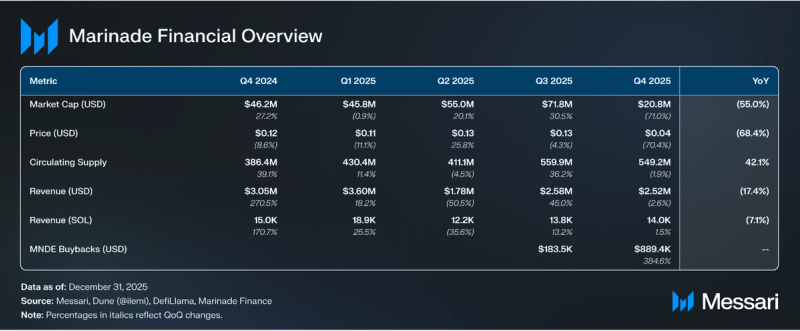
- Protocol income elevated 1.5% QoQ to 13,970 SOL, whereas declining 2.6% QoQ in USD phrases to $2.52 million. Marinade maintained secure income regardless of a 67.6% QoQ decline in SOL’s market worth.
- Marinade repurchased $889K of MNDE in This fall’25, growing buyback exercise 384.6% QoQ. Nonetheless, the DAO voted to pause buybacks by way of the approval of MIP-17 on Dec. 26, 2025, redirecting capital towards bettering MNDE liquidity.
- In 2026, Marinade plans to broaden past SOL staking with new revenue-generating product strains. These embody stablecoin-based staking, treasury invoice–backed yield methods, delta-neutral revenue merchandise, USD-denominated accounts, and cost card integrations.
Primer
Marinade (MNDE) is an automatic staking protocol on Solana that provides three core merchandise: liquid staking by way of mSOL, native Solana staking by way of Marinade Native, and Marinade Choose, an enterprise-focused native staking answer that launched in Q2’25 and consists of a curated validator set that has been verified by way of KYC and is dedicated to moral MEV practices.
Marinade Native and Marinade Choose allow customers to delegate SOL on to top-performing validators whereas retaining custody of their SOL, thereby minimizing dangers and offering constantly larger staking yields in comparison with any 0% payment validator. Marinade Native doesn’t use any good contracts, costs no administration charges, and doesn’t difficulty a liquid staked token. Institutional-grade options equivalent to SOC 2 Sort 2 compliance, integrations with custodians like BitGo, Zodia, and Copper, a staking rewards report instrument for tax functions, and prompt liquidity by way of Native Instantaneous Unstake have positioned Marinade Native and Choose as a number one selection for institutional stakers.
Marinade’s liquid staking product, Marinade SOL (mSOL), is a tokenized model of staked SOL that may be freely used throughout DeFi protocols. Customers obtain mSOL when staking by way of Marinade’s liquid staking interface, permitting them to earn staking rewards whereas sustaining the flexibleness to commerce, lend, or use their belongings inside Solana’s rising DeFi ecosystem.
Marinade was based throughout the March 2021 Solana x Serum Hackathon and launched on mainnet on Aug. 2, 2021. Marinade’s governance token, MNDE, was launched a number of months later, with a retroactive airdrop for mSOL holders. Marinade has not raised enterprise capital funding or performed public token gross sales. As an alternative, Marinade’s token, MNDE, has primarily been distributed by way of numerous campaigns to reward customers and contributors. Past incentives, MNDE is used for governance on Realms, and since Sept. 5, 2025, a portion of protocol charges has been allotted to onchain MNDE buybacks, aligning token worth with protocol income.
Beforehand, Marinade delegated staked SOL to validators primarily based on its algorithmic delegation technique. After Q2’24, the delegation technique was up to date with the launch of the Stake Motion Market (SAM), the place validators bid on stakers’ SOL deposits, making a market-based mechanism for validator competitors and enabling stakers to earn optimized returns.
To take part in Marinade, validators should preserve a most efficient fee of seven%, factoring in offsets from Stake Public sale Market (SAM) bids. A validator with a 25% public fee can nonetheless qualify if its bid reduces the efficient fee to 0%. Validators are additionally required to take part in Protected Staking Rewards (PSR) by posting a SOL-denominated bond that may be slashed for downtime, fee modifications, or different misbehavior.
Web site / X / Discord
Key Metrics
Monetary Evaluation
Market Cap
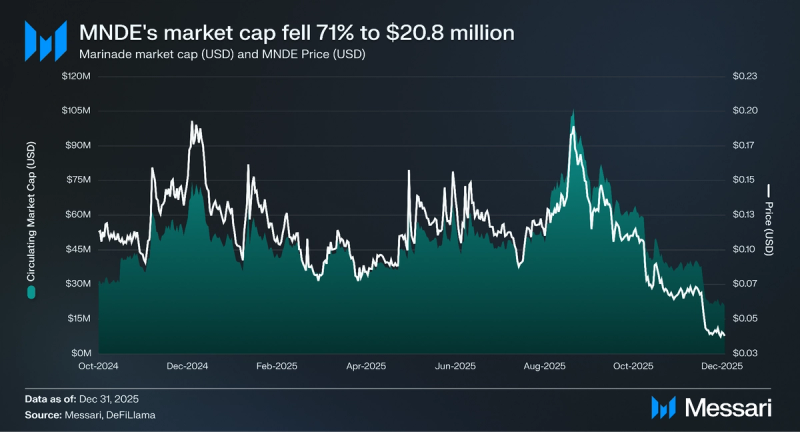
Throughout This fall’25, Marinade’s market capitalization declined 71.0% QoQ, falling from $71.8 million to $20.8 million. This contraction was pushed by a 70.4% QoQ decline in MNDE’s worth, which fell from $0.128 to $0.038. MNDE’s circulating provide additionally decreased 1.9% QoQ throughout the quarter, falling from 559.9 million to 549.2 million tokens, resulting from MNDE repurchases executed in This fall’25 that eliminated MNDE from circulation and allotted these tokens to the DAO treasury. Notably, this drawdown occurred regardless of repurchase exercise totaling $889,400 in This fall, whereas 50% of protocol charges had been nonetheless being allotted towards MNDE buybacks. The sustained decline in MNDE’s valuation reveals that the MNDE buyback program was inadequate to offset broader market weak spot, prompting the DAO to redirect protocol income towards liquidity enhancements and long-term development initiatives.
Staking
Marinade is a non-custodial staking protocol that provides three distinct SOL staking merchandise: liquid staking by way of mSOL, native staking by way of Marinade Native, and institutional-grade staking by way of Marinade Choose, which adheres to stringent efficiency, uptime, and verification requirements, together with a KYC verification, and nil tolerance for malicious MEV conduct.
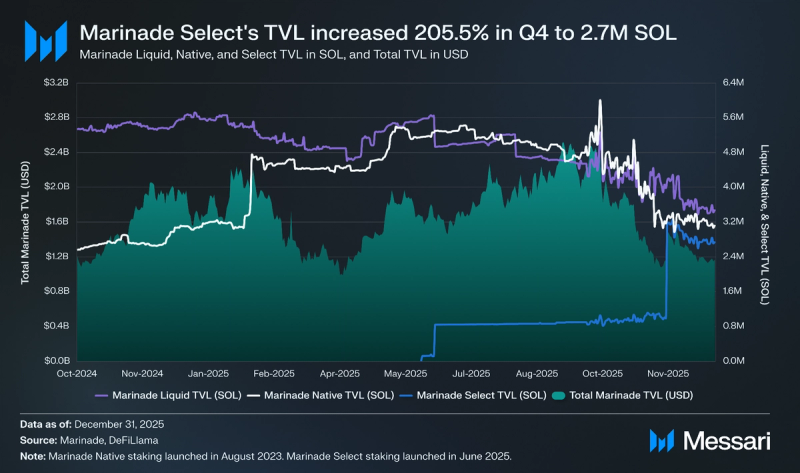
Marinade’s liquid staking product permits customers to obtain mSOL, a tokenized receipt of their staked SOL that’s freely usable throughout DeFi purposes. Marinade Native permits customers to stake with out receiving a token, retain full custody, get rid of good contract danger, and earn staking rewards on to their stake accounts with no administration charges. Marinade Choose is an institutional-grade native staking answer that includes a curated, KYC-verified validator set with a monitor document of reliability and a dedication to moral onchain conduct, together with prohibitions on front-running and sandwiching.
Marinade Choose has additionally been chosen because the staking supplier for the Canary Marinade Solana ETF, which launched beneath the ticker image SOLC on Nov. 18, 2025. Earlier within the quarter, Nasdaq-listed VisionSys AI introduced a partnership with Marinade to launch a Solana-based digital asset treasury initiative valued at as much as $2 billion, with an preliminary goal of $500 million in SOL to be acquired and staked by way of Marinade’s infrastructure. In each instances, Marinade serves because the unique staking accomplice, overseeing delegation, compliance, and efficiency optimization.
Throughout This fall’25, the whole quantity of SOL staked throughout Marinade’s three merchandise declined 9.9% QoQ, falling from 10.4 million to 9.4 million SOL, whereas remaining up 5.7% YoY in comparison with 8.8 million SOL in This fall’24. Not like Q3’25, a 67.6% QoQ decline in SOL’s worth compounded the influence of staking outflows, driving a 47.2% QoQ decline in whole USD-denominated TVL to $1.2 billion.
Marinade Native ceded its prime spot as Marinade’s largest staking product, as Native Staked SOL TVL declined from 4.9 million to three.1 million SOL. mSOL TVL additionally fell from 4.5 million to three.5 million SOL, as contraction persevered throughout Marinade’s retail-focused staking merchandise, however regained the lead as Marinade’s largest staking product by TVL. Marinade Choose’s SOL TVL grew considerably in This fall’25, growing from 896,900 SOL to 2.7 million SOL (+205.5% QoQ), as Marinade attracted stake by way of its institutional-grade providing, which options SOC 2 Sort 2 compliance, protected staking rewards, and integrations with custodians equivalent to BitGo, Zodia, and Copper.
Income
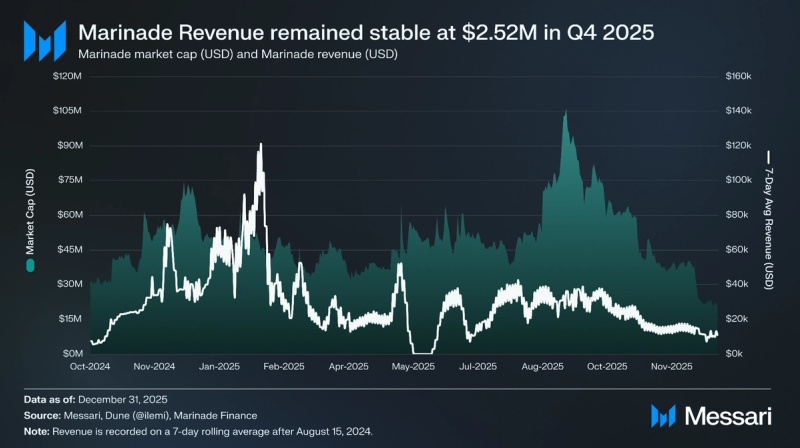
Marinade’s protocol income is primarily derived from validator efficiency charges collected by way of the Stake Public sale Market (SAM), with further income generated from unstake charges utilized throughout Marinade Native, mSOL, and Marinade Choose. Throughout This fall’25, Marinade generated 13,970 SOL in income, equal to $2.52 million. This represented a 1.5% improve in income measured in SOL and a 2.6% decline in greenback phrases from Q3’s $2.58 million (13,760 SOL). Whereas staking-related exercise remained secure, weaker SOL’s worth decreased 67.6% QoQ, offsetting modest development in SOL-based charges and leading to largely flat USD-denominated income. On a YoY foundation, income declined 7.1% in SOL phrases and 17.4% in USD phrases in comparison with This fall’24, when Marinade generated 15,038 SOL and $3.05 million in income.
As in prior quarters, practically all protocol income was sourced from validator efficiency charges collected by way of the SAM. These charges, capped at 9.5%, symbolize a portion of staking rewards supplied by validators in change for delegated stake. As a result of the SAM is a market-driven mechanism, Marinade’s income stays carefully tied to validator competitiveness, staker demand, and broader sentiment towards Solana staking.
MNDE Buybacks
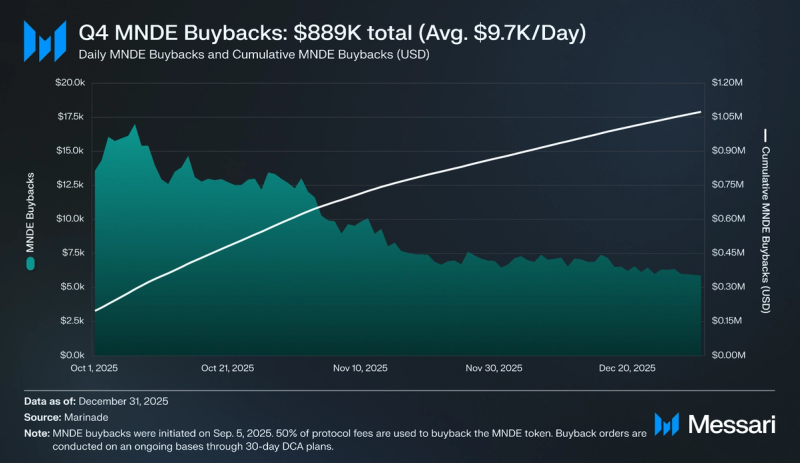
Throughout This fall’25, Marinade continued executing its onchain MNDE buyback program, repurchasing roughly $889,400 value of MNDE, equal to a mean of $9,773 per day. Buybacks had been executed by way of ongoing 30-day dollar-cost-averaging (DCA) schedules funded by protocol efficiency charges generated by way of the Stake Public sale Market (SAM), persevering with the framework authorized beneath MIP-11, MIP-13, and MIP-15. Nonetheless, on Dec. 26, 2025, the Marinade DAO voted to pause the buyback program by way of MIP-17.
Token Emissions
Marinade has a hard and fast most token provide of 1.0 billion MNDE. Throughout Q3’25, the DAO executed MIP-14, completely burning 300 million MNDE from the DAO treasury. The burn lowered the whole token provide to 700 million MNDE. In This fall’25, the circulating provide decreased from 559.9 million to 549.2 million MNDE (-1.9% QoQ) resulting from Marinade’s token buyback program. On a YoY foundation, circulating provide elevated 42.1%, rising from 386.4 million MNDE in This fall’24.
Efficiency Evaluation
Validators and APY
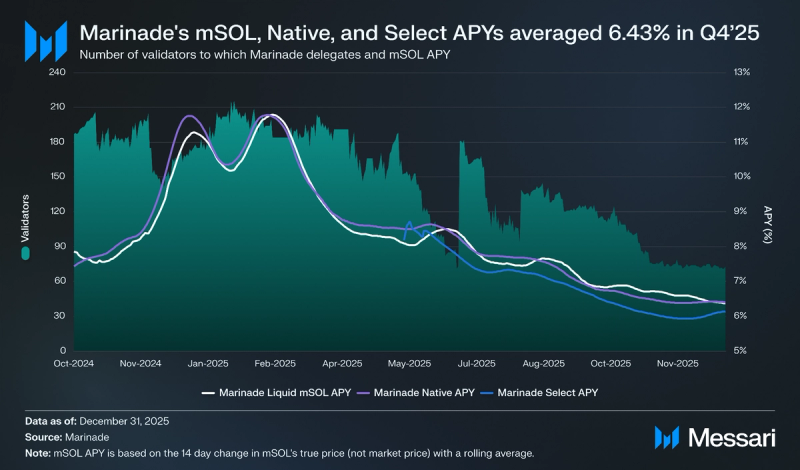
Marinade’s staking yields remained aggressive in This fall’25, although returns continued to say no from Q2’s highs of over 8% APY throughout all three of Marinade’s merchandise. Staking yields are influenced by Solana community exercise, validator efficiency, and the distribution of precedence charges.
Marinade Liquid (mSOL)
The mSOL APY ended This fall’25 at roughly 6.33%, in comparison with 6.87% on the finish of Q3’25. mSOL yields are calculated utilizing Marinade’s true worth metric, which measures the ratio of SOL backing every mSOL token. These yields stay delicate to validator uptime, community transaction volumes, and precedence payment technology.
Marinade Native
Native staking APRs fell from 6.81% to six.37% throughout the quarter, primarily resulting from network-wide declines in precedence charges, which have remained close to all-time lows for a number of months, lowering validator earnings throughout Solana. Decrease validator bidding exercise within the Stake Public sale Market (SAM) and the proportion of precedence charges handed by way of to stakers additional contributed to the decline. Native staking usually provides barely larger yields than mSOL as a result of it avoids liquidity-related charges. Traditionally, native staking required customers to watch a 2–3-day unstaking cooldown interval, however Marinade launched prompt unstake. This function, in-built collaboration with Anza, permits customers to exit any native staking positions immediately, with out ready for the unstaking cooldown interval, even these not created by way of Marinade.
The continued improvement of Marinade Native’s infrastructure and liquidity options has additionally strengthened its standing amongst institutional staking options. Its integration because the staking supplier for the reside Bitwise Solana Staking ETP showcases Marinade’s credibility as a trusted, compliant accomplice for regulated publicity to Solana staking.
Marinade Choose
Marinade Choose, launched in June 2025, is an institutional-grade staking answer constructed on a curated validator set that enforces KYC verification, moral MEV practices, and excessive uptime requirements. Validator accountability is strengthened by way of Marinade’s Protected Staking Rewards. Throughout This fall’25, Marinade Choose’s APY declined QoQ alongside broader compression in Solana staking yields, falling from 6.44% at Q3-end to six.16% at This fall-end.
The product is particularly designed to satisfy institutional and regulatory necessities, and serves because the unique staking supplier for Canary Capital’s Canary Marinade Solana ETF (SOLC). The ETF launched on Nov. 18, 2025, and is designed to cross by way of 100% of staking yield on to buyers. Notably, Marinade Choose skilled a pointy improve in SOL TVL on Nov. 26, 2025, shortly after the launch of the Canary Marinade Solana ETF, which stakes all underlying belongings by way of Marinade Choose.
Staking Incentive Design: SAM, PSR, Validator Accountability
As of the tip of This fall’25, Marinade delegated SOL to 73 energetic validators on Solana, down from 126 on the finish of Q3’25. All validators receiving Marinade delegation should preserve a most efficient fee fee of seven%, which accounts for offsets by way of their bids within the Stake Public sale Market (SAM). A validator might cost the next public fee, for instance 25%, and nonetheless qualify if their bid offsets that fee. Validators are additionally required to take part within the Protected Staking Rewards (PSR), a bonding program the place validators put up a SOL-denominated bond that may be slashed for misbehavior, prolonged downtime, or fee manipulation. This bond serves as an financial safeguard to advertise validator efficiency and reliability.
Following the approval of MIP-3 in November 2024, Marinade transitioned all stake allocation to the Stake Public sale Market (SAM), changing its earlier hybrid delegation mannequin. Beneath the SAM, validators bid for SOL delegation by providing customized yield phrases, competing towards different validators to supply probably the most engaging phrases. Previous to MIP-18, Marinade utilized a efficiency payment of as much as 9.5% on validator bids, which was captured as protocol income. Nonetheless, on Dec. 26, 2025, the Marinade DAO authorized MIP-18, introducing a revised payment construction to enhance yield competitiveness and align incentives. The replace changed the mounted efficiency payment with a conditional efficiency payment charged solely when Marinade’s staking APY exceeds the Solana Staking Fee, a chain-wide benchmark derived from inflation and transaction charges. MIP-18 additionally introduces a unified 20 bps unstake payment throughout Marinade Native, mSOL, and Marinade Choose, shifting income assortment towards exits reasonably than ongoing rewards. Collectively, these modifications align protocol income extra carefully with measurable outperformance whereas lowering payment drag for long-term stakers.
The SAM incentivizes validator competitors and yield optimization, whereas PSR enforces minimal efficiency requirements, collectively balancing staking effectivity and decentralization. Marinade additionally actively screens validator conduct and has taken enforcement actions, together with validator exclusions, towards operators partaking in unethical MEV practices, serving to protect constant staking outcomes for customers. As yields compressed and validator participation declined in This fall’25, these protocol-level controls grew to become more and more essential in sustaining efficiency stability and capital effectivity.
Institutional Adoption
Institutional adoption of Marinade’s staking infrastructure accelerated in This fall’25, pushed by elevated demand for compliant, native Solana staking. One among these drivers was the launch of the Canary Marinade Solana ETF, which stakes all underlying belongings by way of Marinade Choose. Moreover, earlier within the quarter, Marinade additionally partnered with Nasdaq-listed VisionSys AI to help a Solana-based digital asset treasury initiative valued at as much as $2 billion, with an preliminary $500 million allocation focused for acquisition and staking. In each instances, Marinade serves because the unique staking accomplice, overseeing delegation, compliance, and efficiency optimization, reinforcing its position as a core infrastructure supplier for large-scale, institutional Solana staking.
mSOL in DeFi
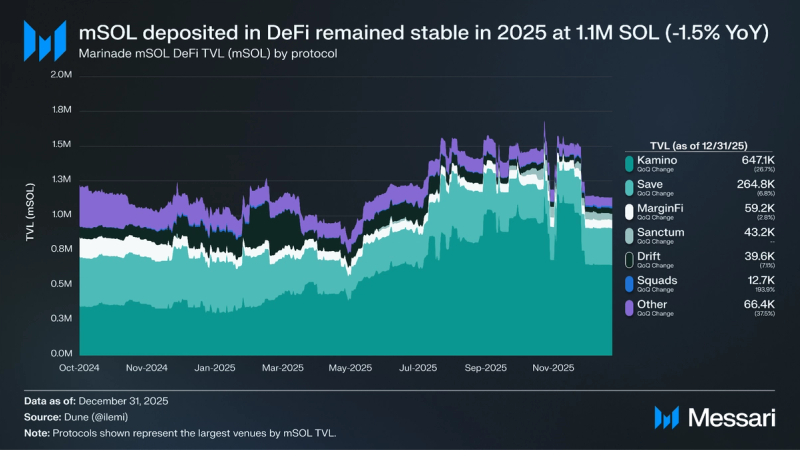
mSOL utilization inside DeFi declined in This fall’25 as SOL’s worth entered a sustained downtrend, lowering the attractiveness of holding SOL to entry single-digit staking yields. As of quarter-end, 1.1 million mSOL was deployed throughout Solana DeFi protocols, representing a 17.7% QoQ decline. On a YoY foundation, mSOL deployed in DeFi was largely unchanged, declining 1.5% YoY, indicating that mSOL maintained its position as a core yield-bearing asset inside Solana DeFi regardless of near-term deleveraging.
Kamino remained the biggest venue for mSOL utilization, holding 647,145 mSOL at quarter-end, although mSOL TVL declined 26.9% QoQ as utilization throughout leveraged and yield-enhancement methods moderated. Save adopted with 264,836 mSOL, down 6.8% QoQ, whereas MarginFi and Sanctum held 59,154 mSOL and 43,210 mSOL, respectively. Drift maintained 39,608 mSOL, whereas Squads grew to 12,700 mSOL, pushed by elevated multisig treasury utilization.
Aggressive Panorama
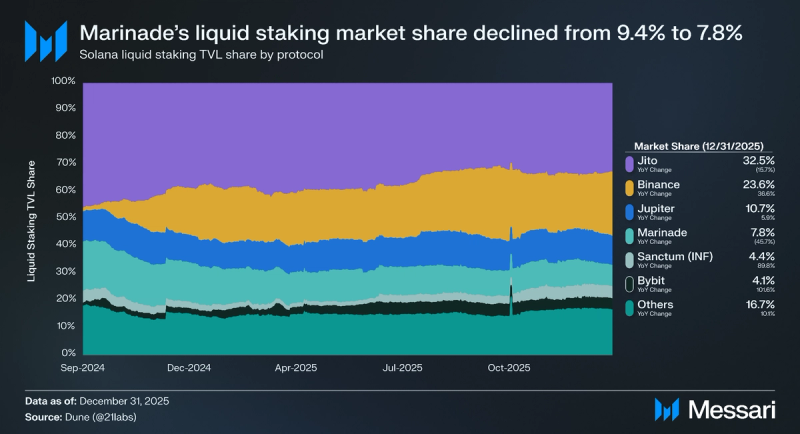
Solana’s liquid staking fee elevated in This fall’25, rising from 9.4% to 10.5% of all SOL, at the same time as broader market circumstances weighed on DeFi exercise. Market share remained concentrated amongst incumbents. Jito maintained its place because the main liquid staking protocol with jitoSOL, ending the quarter with a 32.5% share, supported by deep integrations throughout Solana DeFi and constant validator efficiency. Binance’s bnSOL remained the second-largest supplier at 23.6%, persevering with to learn from centralized change distribution at the same time as total liquid staking participation declined.
Jupiter’s jupSOL held 10.7% of Solana liquid staking TVL, reinforcing its place because the third-largest supplier following speedy adoption earlier in 2025. Marinade’s mSOL market share declined from 9.4% to 7.8% over the quarter as Marinade’s product focus shifted additional towards institutional staking by way of Marinade Choose, which grew SOL TVL 205.5% QoQ. Even with market share losses, mSOL remained broadly built-in throughout Solana DeFi, with ongoing utilization in lending markets, structured yield merchandise, and liquidity venues.
Amongst smaller suppliers, Sanctum ended the quarter at 4.4% market share, and Bybit’s bbSOL at 4.1%, whereas the lengthy tail of different liquid staking suppliers collectively represented 16.7%. General, This fall’25 featured a extra defensive liquid staking surroundings, the place share was more and more formed by distribution and liquidity depth reasonably than web new sector development.
Qualitative Evaluation
Governance
Marinade’s governance framework continued to function the muse for protocol improvement in This fall’25. The DAO launched and authorized a number of MIPs targeted on emissions, buybacks, MNDE liquidity, payment construction updates, and SAM enhancements. These proposals replicate the group’s ongoing effort to handle protocol income appropriately.
MIP-16: Liquidity Provisioning Framework for MNDE
Launched on Nov. 4, 2025, MIP-16 proposed establishing a structured framework for deploying DAO-owned MNDE into liquidity swimming pools to enhance market depth and scale back volatility following the activation of protocol-funded buybacks. Reasonably than persevering with to rely solely on direct repurchases, the proposal emphasised bettering secondary-market liquidity by way of managed LP deployments throughout authorized venues. The initiative aimed to help more healthy worth discovery whereas preserving treasury optionality. MIP-16 handed on Dec. 7, 2025, authorizing the DAO to deploy MNDE liquidity beneath predefined danger parameters and reporting necessities.
MIP-17: Pause Protocol-Funded MNDE Buybacks
MIP-17, launched on Nov. 7, 2025, proposed pausing the protocol-funded MNDE buyback program that had been activated earlier within the yr beneath MIP-11, MIP-13, and MIP-15. The proposal cited sustained weak spot in MNDE’s market worth and restricted effectiveness of buybacks in bettering token efficiency relative to broader market circumstances. As an alternative, it really helpful reallocating protocol income towards liquidity provisioning and longer-term development initiatives. The Marinade DAO authorized MIP-17 on Dec. 26, 2025, formally suspending buybacks and marking a shift away from direct token worth help mechanisms.
MIP-18: Conditional Efficiency Charges and Unified Unstake Charge
MIP-18 launched an replace to Marinade’s payment mannequin to enhance yield competitiveness and align incentives. Permitted on Dec. 26, 2025, the proposal changed the mounted 9.5% efficiency payment with a conditional efficiency payment charged solely when Marinade’s staking APY exceeds the Solana Staking Fee (SSR), a network-wide benchmark derived from inflation and transaction charges. As well as, MIP-18 unified unstake charges throughout Marinade Native, mSOL, and Marinade Choose by introducing a 20 bps unstake payment on exits. The modifications had been designed to cut back payment drag during times of compressed rewards whereas guaranteeing the DAO captures charges solely when the protocol delivers measurable outperformance.
MIP-19: SAM Effectivity and Redelegation Value Optimization
Launched on Dec. 16, 2025, MIP-19 targeted on bettering capital effectivity throughout the Stake Public sale Market (SAM) by lowering pointless redelegation prices and smoothing validator transitions. The proposal addressed inefficiencies noticed during times of declining validator participation, aiming to protect web yields for stakers whereas sustaining decentralization and validator accountability. MIP-19 was authorized on Dec. 26, 2025.
MIP-21: Change mSOL from and Redirect Charges to the Council Pockets
MIP-21, launched on Jan. 14, 2026, proposes a treasury administration mechanism to cut back MNDE promote stress whereas preserving operational funding for Marinade Labs. The proposal suggests exchanging 2,279 mSOL held within the DAO treasury for 9.74 million MNDE of equal worth held by the Council pockets, permitting bills to be funded utilizing a extra liquid asset with out promoting MNDE on the open market. MIP-21 additionally proposes briefly redirecting protocol charges to the Council pockets, with an equal worth of MNDE transferred again to the DAO treasury on a month-to-month foundation, sustaining financial neutrality for the DAO whereas lowering governance overhead.
Partnerships, Integrations, and Listings
Metaplex Genesis Partnership
Marinade joined Metaplex’s Genesis Companion Community, offering staking infrastructure for initiatives launching with Metaplex. Collaborating groups can stake raised SOL with Marinade Native or Choose and direct staking rewards towards automated token buybacks, enabling sustainable, yield-driven tokenomics. Early companions embody Collector Crypt, Goated, and Portals, every leveraging Marinade to fund long-term buyback and development mechanisms.
Token Terminal Knowledge Partnership
In This fall’25, Marinade entered into an information partnership with Token Terminal to reinforce transparency and stakeholder reporting throughout its staking merchandise. By way of the mixing, Token Terminal started monitoring Marinade’s onchain metrics, together with belongings staked, protocol income, and validator efficiency, offering standardized monetary and operational insights for customers, analysts, and institutional stakeholders. As Marinade’s whole belongings staked surpassed $2 billion, the partnership mirrored a rising want for a steady, data-driven reporting infrastructure to help knowledgeable decision-making and exterior evaluation of the protocol’s efficiency.
Fragmetric Integration
In This fall’25, Marinade built-in mSOL with Fragmetric, enabling customers to restake mSOL into fragSOL and take part in Node Consensus Networks whereas retaining liquid staking publicity. The combination permits mSOL holders to layer further yield on prime of Solana staking rewards by contributing financial safety to Fragmetric’s restaking framework. By extending mSOL into the rising restaking ecosystem, the partnership expands mSOL’s utility past conventional DeFi use instances.
World Greenback Community (USDG) Integration
On Nov. 20, 2025, Marinade launched its first World Greenback Community (USDG) recipe, enabling customers to stake SOL and obtain USDG-denominated rewards. The product converts Solana staking rewards into secure, predictable yield whereas preserving full publicity to native staking. Throughout the preliminary launch interval, 100% of validator and precedence charges had been handed by way of to stakers, with further USDG incentives collectively funded by Marinade and the World Greenback Community. Even excluding launch incentives, the technique delivered materially larger APYs than Marinade Native and Marinade Choose throughout the quarter, as rewards had been paid in a secure asset throughout a interval of declining SOL costs. The launch expanded Marinade’s yield choices past SOL-native rewards and demonstrated the protocol’s skill to help stablecoin-based revenue methods on prime of its institutional-grade staking infrastructure.
Jupiter Lend Integration
In This fall’25, mSOL was added to Jupiter Lend, increasing its utility inside Solana’s cash market ecosystem. The combination permits customers to provide mSOL into borrow and multiply vaults, permitting leveraged staking methods and collateralized borrowing towards SOL, USDG, and USDC with excessive loan-to-value and liquidation thresholds. By supporting each yield amplification and low-risk collateral use instances, the mixing strengthens mSOL’s place as a core liquid staking asset inside Solana DeFi and deepens its presence throughout capital-efficient lending and leverage platforms.
Roadmap and Wanting Forward
Marinade’s roadmap getting into 2026 facilities on validator accountability, institutional-grade staking infrastructure, and improved capital effectivity throughout Solana’s staking ecosystem. Continued refinement of validator incentive design and stake allocation mechanisms is meant to maintain aggressive yields whereas lowering redelegation prices and operational friction as community circumstances mature.
Alpenglow
Wanting into 2026, the Solana staking panorama is anticipated to bear a structural shift pushed by protocol-level upgrades. Alpenglow, Solana’s proposed consensus redesign, goals to cut back transaction finality to sub-150ms by simplifying vote propagation and eliminating per-slot vote transactions. For staking, this lowers validator working prices by eradicating vote charges and improves the viability of smaller validators, supporting broader participation and decentralization.
Product Growth
In 2026, Marinade can also be exploring product enlargement past SOL-native staking to handle a wider vary of yield and danger preferences. Potential choices embody stablecoin-based staking merchandise that pair onchain staking infrastructure with treasury invoice–backed and delta-neutral revenue methods, focusing on customers searching for yield with out direct publicity to SOL worth volatility. Over the long run, the group is evaluating account-level abstractions equivalent to USD-denominated accounts and cost card integrations, which might permit staking-derived yield to be delivered by way of acquainted monetary interfaces. If carried out, these merchandise would lengthen Marinade’s staking infrastructure past crypto-native customers and place it as a backend yield supplier for each institutional and consumer-facing monetary purposes.
Marinade Staff Commentary
Staff Commentary Disclaimer
The Marinade Staff Commentary part of this report was written by the Marinade group and displays the views, opinions, and forward-looking statements of Marinade solely. This part is included to offer further context on the undertaking’s technique, priorities, and outlook and doesn’t essentially replicate the views or opinions of Messari, Inc.
______________________________________________________________________________
Michael Repetný, Co-Founder & CEO, Marinade Labs
This fall was a troublesome quarter by any market measure. SOL down 67%, MNDE beneath stress. However what really shipped tells a special story.
Recipes had been the spotlight. The validator recipe system went reside and delivered actual outcomes: significant TVL development and the most effective staking yield on Solana. That is not a short lived edge. Recipes are the infrastructure that makes it sustainable.
Choose stored rising. 205% QoQ to 2.7M SOL, with the Canary Marinade Solana ETF staking completely by way of Choose. As ETF merchandise proceed launching on Solana, we anticipate Choose to be the pure staking layer beneath. Native staking and institutional merchandise are the place we see probably the most momentum, and that is the place we’re doubling down.
The group proposed and voted to pause MNDE buybacks. They weren’t shifting the needle on worth. The group is now engaged on one thing meaningfully higher for MNDE holders and can share extra this yr.
On the roadmap, we’re near asserting a stablecoin product that converts staking yield into secure returns. That opens a a lot bigger market than native SOL staking alone. We’re additionally contributing to the Solana Staking Index, a network-wide benchmark fee the ecosystem can use as a shared reference level.
The macro was troublesome, however This fall gave us confidence that what we’re constructing holds up. Our primary precedence going into 2026: making Marinade’s staking yield the most effective in the marketplace and widening the hole. Rising institutional traction and a product roadmap that expands what staking can do. The main target now could be on delivering.
______________________________________________________________________________
Michael Repetný is Co-Founder and CEO of Marinade Labs, the main staking infrastructure on Solana. Its Stake Public sale Market lets validators compete for delegated SOL, delivering prime staking yields with protected rewards and automatic validator choice. Marinade serves over 150,000 holders throughout native staking, liquid staking (mSOL), and institutional merchandise, together with Marinade Choose. SOC 2 Sort II licensed and built-in with main custodians, together with BitGo, Bitwise, Zodia, and Copper. Be taught extra at marinade.finance.
Closing Abstract
In This fall’25, Marinade maintained secure protocol income regardless of a 9.9% QoQ decline in whole SOL TVL, highlighting the resilience of its market-driven staking mannequin beneath weaker community circumstances. Income elevated 1.5% QoQ in SOL phrases to 13,970 SOL, whereas USD-denominated income declined 2.6% QoQ and 17.4% YoY to $2.52 million, primarily resulting from SOL’s sustained SOL worth weak spot, which fell 67.6% QoQ. Institutional demand partially offset broader staking outflows, as Marinade Choose’s SOL TVL elevated 205.5% QoQ following the Nov. 18, 2025, launch of the Canary Marinade Solana ETF beneath the ticker image SOLC.
Throughout the quarter, Marinade executed $889,400 in MNDE buybacks, representing a 384.6% QoQ improve in repurchase exercise. Nonetheless, later within the quarter, the Marinade DAO voted to pause protocol-funded buybacks and redirect protocol income towards new revenue-generating product strains. Wanting into 2026, Marinade plans to broaden past SOL-native staking with new choices, together with stablecoin-based staking, treasury invoice–backed yield methods, delta-neutral revenue merchandise, and account-level abstractions equivalent to USD-denominated accounts and cost card integrations. These initiatives place Marinade to increase its staking infrastructure right into a broader yield platform whereas sustaining a give attention to validator accountability, capital effectivity, and institutional accessibility.
