



**Advancing Spike Inference with GCaMP8 Indicators: A New Era in Neural Circuit Recording**
Recent advances in genetically encoded calcium indicators (GCaMPs) have revolutionized our ability to monitor neuronal activity. Among these, the GCaMP8 family stands out for its speed and sensitivity. A new study published alongside the GCaMP8 research provides a comprehensive benchmark of spike inference algorithms, revealing how these new indicators can be best utilized to unlock high-resolution mapping of neural circuits.
### Benchmarking Modern Spike Inference Algorithms
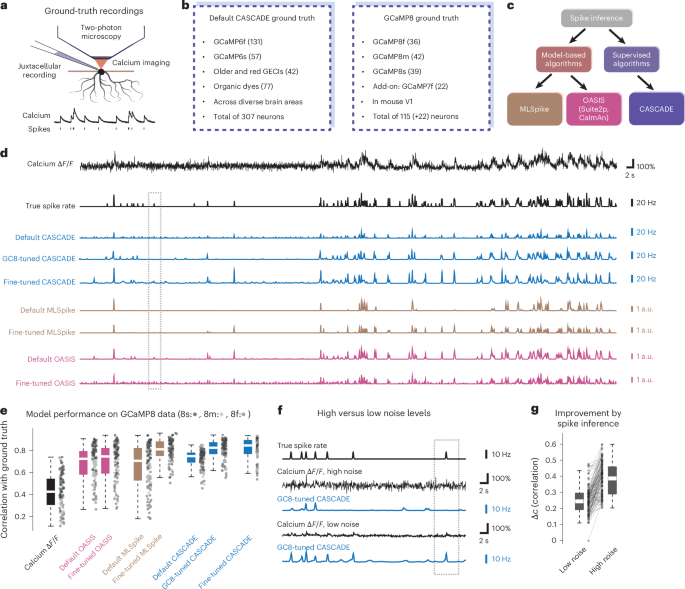
The research team, led by scientists at the University of Bern, evaluated how well established spike inference methods perform with the new GCaMP8 indicators. Using ground-truth datasets from the original GCaMP8 study, they compared performance against the widely used GCaMP6 indicators.
The study found that while traditional algorithms like OASIS and MLSpike perform adequately, their accuracy is significantly enhanced when fine-tuned with GCaMP8 data. However, the most substantial improvements came from a specialized deep-learning model called CASCADE.
**GC8-tuned CASCADE** emerged as the top performer, setting a new standard for spike inference accuracy. It consistently outperformed other methods, including the previously superior Default CASCADE model trained on GCaMP6 data, particularly when analyzing data from GCaMP8m and GCaMP8s indicators.
### Overcoming Nonlinearities and Improving High-Frequency Event Detection
A key finding of the research was understanding how calcium indicator properties affect spike pattern detection. GCaMP6 exhibits significant nonlinearity, meaning its fluorescence signal doesn’t scale proportionally with spike frequency. This leads to systematic errors where early spikes in a burst are overestimated and later ones are underestimated.
In contrast, GCaMP8 indicators are far more linear. This linearity directly translates to more accurate spike inference, especially during high-frequency firing events. The study demonstrated that models trained specifically for GCaMP8 data virtually eliminated these timing biases, providing a more faithful representation of complex spiking patterns.
### The Critical Advantage for Single Action Potential Detection
Perhaps the most impactful finding relates to the detection of single action potentials (APs). While GCaMP6 has historically struggled to resolve individual spikes, GCaMP8m and GCaMP8s proved capable of reliable single-AP detection, particularly at low noise levels.
The researchers showed that this ability stems directly from the indicators’ linearity and their optimal matching to the resting calcium concentration of neurons. When single APs were detected, the researchers could even apply an “autocalibration” method to further refine spike rate accuracy, a breakthrough that was not feasible with previous indicators.
### The Power of Speed: Fast Rise Times for Real-Time Applications
GCaMP8 indicators are also significantly faster than their predecessors. The study measured the rise times of calcium signals and found that GCaMP8 variants have the fastest onset times recorded to date.
This speed is crucial for **online, closed-loop experiments**. The analysis showed that GCaMP8 data requires much shorter integration times to achieve high accuracy—median times of just 31–33 milliseconds. This rapid feedback loop capability brings brain-machine interfaces and real-time neural modulation within closer reach.
### Generalization to Different Neuron Types
The study also tested how well these algorithms generalize to other cell types. When applied to fast-spiking interneurons, which have distinct firing patterns and much smaller calcium signals, the performance of all algorithms dropped. This highlights a current limitation: spike inference tools are still primarily optimized for excitatory pyramidal cells and require further development for a full picture of brain function.
### Conclusion
The comprehensive benchmarking of spike inference algorithms for GCaMP8 indicators represents a major step forward for the field. By matching the right tool (algorithmic model) to the right indicator (GCaMP8), neuroscientists can now achieve unprecedented accuracy in decoding neural activity. This work not only validates GCaMP8 as a powerful new tool but also provides a clear roadmap for analyzing complex, high-frequency neural circuits with greater precision than ever before.
—
### Frequently Asked Questions (FAQ)
**Q1: What are GCaMP8 indicators, and why are they better than previous versions?**
GCaMP8 is the latest generation of a genetically encoded calcium indicator used to visualize neuronal activity. Compared to GCaMP6 and GCaMP7, GCaMP8 variants (GCaMP8f, GCaMP8m, GCaMP8s) are significantly faster and more linear. This linearity allows for a more proportional fluorescence response to neural activity, which is critical for accurately detecting both single spikes and complex burst patterns.
**Q2: Which spike inference algorithm performed best in the study?**
The **GC8-tuned CASCADE** model, a deep-learning algorithm specifically trained on GCaMP8 data, achieved the highest accuracy. It outperformed other methods like OASIS, MLSpike, and the original CASCADE model across almost all metrics and datasets.
**Q3: Why is detecting single action potentials important?**
The ability to detect single spikes is essential for understanding how individual neurons contribute to a circuit. GCaMP8m and GCaMP8s enable this for the first time with high reliability, moving the field beyond just observing population-level activity and allowing for a more detailed understanding of neural coding.
**Q4: What practical advantage does the speed of GCaMP8 offer?**
The extremely fast rise time of GCaMP8 means that researchers can implement **real-time, closed-loop experiments**. This allows for optical control or feedback based on neural activity with very low latency, which is critical for studying learning, plasticity, and brain-machine interfaces.
**Q5: Are these findings applicable to all neurons?**
The study shows that while GCaMP8 is a major improvement for excitatory pyramidal neurons, there is still a performance gap for other cell types like fast-spiking interneurons. This suggests that future algorithm development must continue to adapt to the unique challenges posed by different neuronal populations.
—
### Conclusion
This landmark study demonstrates that the GCaMP8 family of calcium indicators, when paired with modern deep-learning spike inference algorithms, unlocks a new level of precision in monitoring neural circuits. By overcoming the limitations of nonlinearity and slow kinetics that plagued previous tools, GCaMP8 enables researchers to detect single spikes, resolve high-frequency bursts, and even apply real-time feedback. As these tools and methods become standard, they will undoubtedly accelerate our understanding of how complex neural computations arise from the activity of individual cells.
