



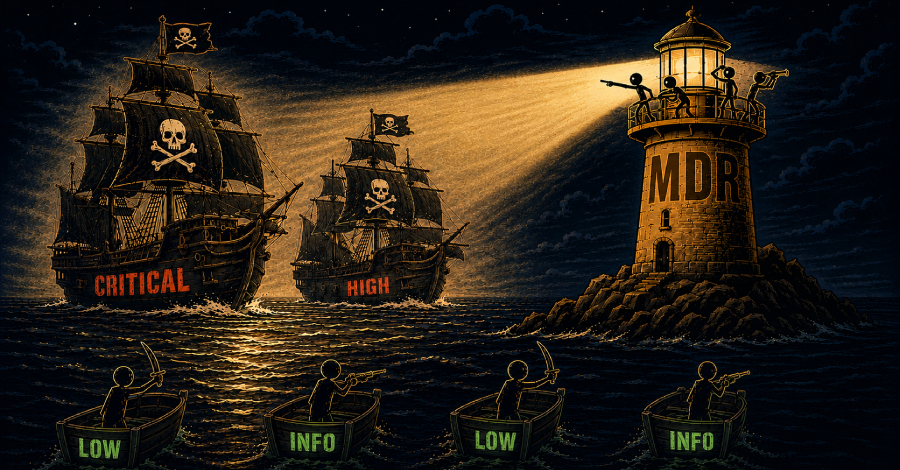
For much of the last ten years, Managed Detection and Response (MDR) solved a genuine issue. Security groups often lacked enough people to work around the clock, struggled to recruit skilled analysts, and urgently needed relief from overwhelming alert volumes. MDR filled that gap and delivered reasonable results—until the present.
Today’s threat environment has evolved faster than MDR can keep up with. Attackers now leverage AI to accelerate their operations, craft highly convincing phishing messages at scale, automate system reconnaissance, and produce malware that sidesteps traditional signature-based defenses. The battleground has also widened, spanning endpoints, cloud platforms, identity systems, and networks all at once. Yet most MDR providers still follow the same old playbook: routing alerts to human teams who triage what they can, in whatever order they have bandwidth for.
That approach falls short today. The evidence we present below demonstrates this clearly—and security decision-makers should seriously assess whether their current MDR solution still meets their needs.
### The Promise vs. Reality of 24/7 Coverage
MDR vendors promise round-the-clock human monitoring. What they actually deliver is round-the-clock human *capacity* to handle only high-priority alerts—a critical distinction.
Industry-wide, about 60% of security alerts go unexamined. This isn’t necessarily a failure of effort; no human team—internal or outsourced—can realistically siphon through the flood of alerts generated by modern IT ecosystems. So teams do what makes sense: they focus on top-tier priorities. Critical (P1) and high (P2) alerts get immediate attention, while lower-severity (P3) and informational alerts stack up unnoticed.
But that backlog is exactly where threats lurk.
In 2025, analysis of 25 million alerts across global organizations revealed that nearly 1% of actual threats originate from low or informational-severity alerts. For a company receiving 450,000 alerts per year, that equals roughly 54 genuine incidents annually—about one every week—sitting in a queue no one ever reviews.
These hidden breaches aren’t hypothetical. They’re actively occurring in companies that believe they’re fully protected.
**Note:** The calculation above assumes 450K yearly alerts, 60% of which remain uninvestigated. Of those unexamined alerts, 2% represent true incidents, and 1% of those real events stem from low-priority notifications.
### Inconsistent Investigation Quality
Even for alerts that *are* reviewed, MDR’s investigative rigor isn’t uniform. It hinges on factors like the analyst’s expertise at that moment, how backed-up the queue is, the time of day, or whether staffing levels are adequate. A critical alert handled at 3 a.m. may receive a very different level of scrutiny than an identical one addressed at 10 a.m.
This isn’t a flaw unique to MDR analysts—it’s an inherent limitation of any human-led process operating under pressure, around the clock at high volume.
Still, the impact is tangible. Shallow investigations may misclassify real threats as noise. Inconsistent follow-through can cause early-stage lateral movement to appear routine. An attacker who slips through via a low-priority alert continues operating unchecked—not because of malice, but because no one had the time or full context to connect the dots.
### Detection Gaps That Widen Over Time
In typical MDR setups, updating detection rules tends to happen reactively. Adjustments occur primarily when customers complain about excessive false positives, or when a major vulnerability (CVE) hits headlines. Otherwise, detection capabilities gradually drift.
The deeper issue is structural: MDR separates investigation from detection engineering. When an analyst closes an alert as a false positive, that insight rarely improves the detection logic itself. Flawed rules stay flawed. Noisy rules keep triggering. Emerging attacker tactics go undetected.
The outcome? A detection posture that erodes quicker than it improves. Actual coverage against frameworks like MITRE ATT&CK often lags far behind what teams assume.
### Lack of Transparency and Auditability
Most MDR services operate like black boxes. Clients receive escalations and executive summaries—but rarely gain access to the underlying investigation logic, evidence trails, verification steps, or a record of what the analyst actually reviewed before closing a case.
In an age demanding accountability and visibility, this opacity poses real risks. If an incident slips through, you can’t determine why. If a verdict is incorrect, you can’t trace the reasoning. When regulators ask how a case was handled, there’s typically nothing substantive to show.
### AI Savings Stay with the Vendor
While AI is making MDR more efficient—automating routine triage, reducing analyst hours, and boosting profit margins—these savings rarely reach the customer as reduced pricing or expanded services. Buyers continue paying the same—or more—while providers pocket the efficiency gains.
And yet, the fundamental coverage gap persists. The human bottleneck remains unchanged. Only the vendor’s bottom line benefits.
### You Don’t Own What’s Built for You
Over the contract term, valuable security knowledge accumulates within the MDR provider’s platform: custom detection rules, triage logic, case histories, and investigative insights. When the engagement ends, that institutional wisdom doesn’t transfer with you. Years of environmental tuning, contextual understanding, and data-driven detection improvements remain locked with the vendor.
This creates two major issues. First, switching providers means starting from zero—rebuilding expertise that took years to develop. Second, companies aiming to bring security operations in-house (a growing trend as AI-powered SOC tools advance) find themselves without a foundation to build upon.
Unsurprisingly, MDR vendors have little incentive to help clients strengthen internal capabilities—their business model depends on keeping that knowledge—and that workload—in-house.
### MDR Contracts May Block AI Adoption
This knowledge lock-in isn’t just a switching-cost headache; it’s now a barrier to AI adoption. Deploying an AI agent for SOC work requires a solid knowledge base to learn from: detection rules, historical case data, behavioral baselines, and forensic conclusions. If all that resides within your MDR provider’s proprietary system, your AI agent starts nearly from scratch.
### Other Overlooked MDR Shortcomings
Beyond core issues, MDR has accumulated smaller—but compounding—gaps over time:
– Every customer receives the same generic incident response playbook, regardless of their unique risk profile, compliance requirements, or data sensitivity.
– Tools like SOAR (Security Orchestration, Automation, and Response), meant to integrate MDR findings into internal workflows, largely underdeliver—because human-driven investigations rarely produce the structured, consistent outputs that automation demands.
– When a real incident hits and a client needs a human familiar with their environment, they’re often routed to an AI chatbot or impersonal ticketing system instead of a dedicated expert.
### What Modern Threat Demands Actually Require
Attackers in 2026 won’t wait for your alert backlog to clear. AI-powered phishing campaigns flood inboxes with messages that evade traditional filters. Fast-moving credential stealers like Agent Tesla and LummaC2 operate at machine speed. Meanwhile, research confirms that EDR tools are being actively bypassed—over half of confirmed compromised endpoints had already been flagged as “mitigated” by the EDR provider. The attacker had already won a round the defender didn’t even realize was happening.
Addressing this reality demands a fundamentally different operational approach. One where investigations wrap up in seconds instead of hours. Where every single alert gets reviewed, no matter its severity or when it occurs. Where the outcome is a clear, evidence-based conclusion rather than an analyst’s best guess made under pressure.
This is precisely what an AI-powered Security Operations Center (SOC) is built to provide.
A fundamental shift: AI handles execution, humans provide oversight
The central concept behind an AI SOC is straightforward. Shift the task of conducting investigations from human analysts to AI, freeing people to concentrate on making decisions rather than gathering information.
In real-world terms, this means every alert—whether from endpoints, identity systems, cloud environments, networks, phishing attempts, or SIEM platforms—is automatically triaged and investigated. Not a sample. Not just the high-priority ones. Every single one. The AI applies the same level of forensic rigor to a low-priority alert at 3 a.m. that a seasoned analyst would give to a critical incident during business hours.
Data from Intezer’s platform, drawn from 25 million alerts, demonstrates this is realistic. Fewer than 2% of alerts needed human involvement. The remaining 98%+ were resolved autonomously, with a median triage time under one minute and 98% verdict accuracy. For a large enterprise handling 450,000 alerts annually, that translates to roughly 441,000 alerts fully investigated and closed without human effort—and approximately 54 real threats that would have slipped through under traditional MDR coverage are now identified with actionable remediation steps.
Forensic depth is the foundation of trustworthy AI autonomy
AI can summarize an alert. That’s helpful. AI can add threat intelligence context. Also helpful. But neither of those tasks constitutes a real investigation. They’re preparatory steps.
True AI-driven investigation demands forensic-level analysis. When an alert triggers, the question isn’t “does this seem suspicious?” It’s: what code actually ran, where did it come from, what actions did it take, and is there evidence of compromise hidden in memory that the alert itself didn’t reveal?
This distinction matters because the most dangerous threats are engineered to bypass surface-level detection. Fileless malware operates entirely in memory and leaves no trace on disk. Code injection conceals itself within legitimate processes. Early-stage credential theft resembles normal login activity. Without memory forensics, binary analysis, and code reuse detection, an AI investigation is limited to whatever the initial alert data provides.
Forensic depth is also what establishes the trust threshold—the point where AI verdicts are accurate and well-supported enough to act on without human review. Below that threshold, AI supports analysts. Above it, AI can reliably handle the full investigative workload and only escalate when the evidence justifies it.
Closed-loop detection engineering transforms security posture
One of the most powerful structural benefits of a genuine AI SOC is the continuous feedback loop between investigation and detection. Every alert investigation reveals insights about detection quality. Which rules are working correctly, which are producing false positives, and which attacker techniques have no detection coverage whatsoever?
When this feedback continuously feeds into detection engineering, the security posture improves without waiting for an annual review or a customer complaint. Noisy rules get refined. Broken telemetry gets identified. New detection rules for emerging attack methods get rolled out in days rather than months. The detection system evolves in tandem with the investigation system.
This is how MITRE ATT&CK coverage evolves from a static snapshot into a dynamic, continuously improving map of what an organization can actually detect. It’s the difference between coverage that reflects configurations from two years ago and coverage that reflects what attackers are doing right now.
Pricing that supports complete coverage
The pricing model for an AI SOC should reflect the coverage it delivers. Per-alert pricing, still common among AI copilot tools that depend heavily on large language models, forces customers to pick and choose which alerts to submit. This recreates the same selective attention problem that MDR introduced. High-severity alerts get reviewed; low-severity ones pile up in a neglected backlog.
Per-endpoint pricing eliminates this issue entirely. The cost is tied to the number of monitored endpoints, not to alert volume. There’s no financial disincentive to investigate every alert. Full coverage becomes the standard, not an add-on.
This also matters for budget planning. Alert volumes can surge unpredictably during active incidents or when new detection rules go live. Endpoint counts remain stable. For finance teams planning security budgets, this difference is substantial.
What ownership means in an AI SOC
Detection rules, investigation records, and organizational context should belong to the organization, not the vendor. This means every detection rule deployed to a customer’s SIEM is the customer’s rule. Investigation evidence is accessible for audit whenever needed. If the organization chooses to build internal capabilities, develop its own AI agents, or switch platforms, they take all their data and rules with them.
This isn’t just a contractual detail. It’s a prerequisite for security maturity and for broader adoption of AI tools like Claude for security teams. Organizations that want to eventually oversee AI systems rather than depend entirely on vendors need a knowledge base to build upon. That knowledge base can’t exist if it’s locked inside a vendor’s platform.
Transitioning from MDR to AI SOC
Moving from MDR to an AI SOC doesn’t have to be an all-or-nothing decision for most organizations. The practical approach often starts with augmentation. Introduce AI investigation alongside the existing MDR contract, observe what the AI catches that the MDR missed, and let the side-by-side comparison build the case for a full transition at contract renewal.
By the time the MDR contract comes up for renewal, the organization typically has months of data showing what full alert coverage looks like, what the escalation rate was under AI triage, and what it would cost to stay with the old model versus switching to the new one. The decision is no longer hypothetical.
The question security leaders must confront
The MDR model was built for a world where attackers moved at human speed and the main challenge was staffing enough analysts. That world no longer exists. Attackers are now running AI-assisted campaigns, moving through environments faster than human triage queues can keep up, and deliberately targeting the low-severity alert space where MDR creates blind spots.
The question for every CISO and security leader reviewing their current operations is simple: of the 60% of alerts your team isn’t examining, how certain are you that none of them represent a genuine threat?
Based on Intezer’s analysis of 25 million real alerts, the answer is that roughly 54 of them do. Every year. About one per week. Sitting in the pile nobody is reviewing.
The AI SOC doesn’t claim to stop every threat. No platform can. But it closes the coverage gap that the MDR model is structurally unable to address. Every alert, at every severity level, at every hour of the day, is investigated with forensic depth in under a minute. That’s what security operations in the AI era look like.
Found this article interesting? Check out the 2026 MDR renewal checklist by Intezer.
